Boeing Canada is significantly boosting its commitment to sustainable aviation, announcing multi-million dollar investments in two ventures aimed at producing nearly 200 million litres of sustainable aviation fuel (SAF) annually. This move underscores the aerospace giant’s focus on decarbonizing flight and is tied to a major military aircraft acquisition by the Canadian government.
Contents
The announcement details investments totaling nearly $17.5 million across two projects: one leveraging wood waste in Quebec and another focusing on capturing industrial carbon emissions in British Columbia. Sustainable Aviation Fuel (SAF) is crucial for the industry’s environmental goals, offering up to an 80% reduction in lifecycle carbon emissions compared to traditional jet fuel.
Key Takeaways:
- Boeing Canada is investing $17.5 million in two Canadian SAF projects.
- Investments target bio-based SAF from wood waste and synthetic SAF from captured CO2.
- Projects aim for a combined production capacity of nearly 200 million litres per year.
- This initiative is linked to Canada’s recent purchase of Boeing P-8A Poseidon aircraft.
- SAF is critical for aviation decarbonization, but significant scaling challenges remain.
Driving Sustainable Fuel Production in Canada
The funding is divided between two distinct approaches to SAF production.
Project Avance, a joint venture between Bioenergie AECN and Alder Renewables in Port Cartier, Quebec, will receive $10 million. This initiative focuses on converting sawmill wood residue into low-carbon bio-crude, targeting an annual production of almost 38 million litres of unblended jet fuel.
In British Columbia, Dimensional Energy is allocated $7.5 million to expand its operations focused on capturing industrial CO2. This project aims to eventually produce significantly larger volumes of synthetic aviation fuel, potentially quadrupling the output of the Quebec project.
Dimensional Energy’s CEO, Jason Salfi, noted the strategic importance of scaling up in B.C., citing the province’s favorable environment for clean technology ventures.
The Aviation Industry’s Decarbonization Challenge
The push for SAF comes as the aviation sector grapples with its growing environmental footprint. Air travel emissions increased rapidly between 2000 and 2019, only pausing during the COVID-19 pandemic. By 2023, global commercial flights produced 950 megatonnes of carbon pollution, accounting for 2.5% of global emissions, according to the International Energy Agency (IEA). Projections indicate emissions will surpass 2019 levels in 2025 and continue rising.
Canada’s aviation industry consumed about eight billion litres of jet fuel in 2023, ranking it among the top global consumers. While operational efficiencies, such as improved flight planning and newer, more fuel-efficient aircraft, will contribute to emission reductions, the sheer volume of fuel required highlights the critical need for sustainable alternatives like SAF.
Boeing Canada president Al Meinzinger acknowledged the “significant” fuel needs and emphasized that technological advancements like SAF production must be coupled with operational improvements. Chris Lohmann, Boeing’s sustainability lead for Canada, highlighted Canada’s potential to become a leader in SAF manufacturing due to its substantial forestry industry and industrial emissions base.
Dimensional Energy’s B.C. Carbon Capture Technology
Dimensional Energy, founded in 2016, has developed technology that converts captured industrial CO2 into recycled carbon products, including synthetic oil that can be refined into jet fuel. The aim is to create a net-zero fuel source.
The company currently operates its industrial pilot facility at the Lafarge Canada cement plant in Richmond, B.C., in partnership with carbon capture technology firm Svante Inc. This pilot produces a small volume (one to two barrels per day) of synthetic oil used for various products.
 Lafarge Canada cement plant in Richmond, BC, site of Dimensional Energy's carbon capture pilot facility
Boeing’s investment is intended to accelerate a preliminary engineering study for building a much larger facility. Such a plant could potentially capture enough CO2 to produce 151 million litres of recycled carbon jet fuel annually, equivalent to roughly 3,000 barrels of oil per day. The estimated cost for this scale-up is several hundred million dollars, with investor interest already reported.
The ideal location for a large-scale facility would be next to a major industrial emitter, although sites capable of receiving captured CO2 via rail or barge are also being considered. Dimensional Energy sees this as an opportunity to provide an output solution for industries like pulp and paper and cement, which need ways to manage their carbon emissions.
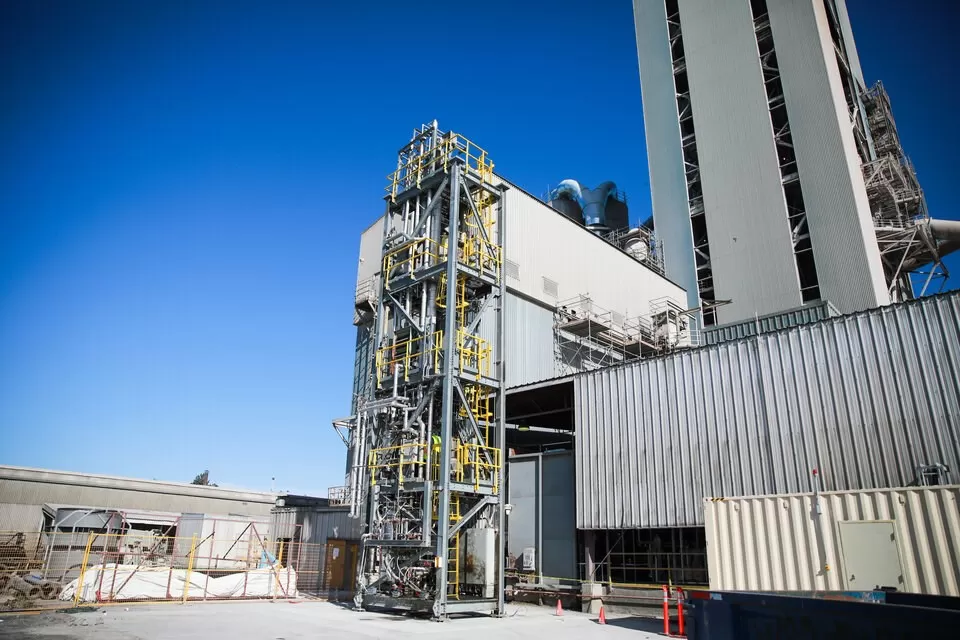 Dimensional Energy's pilot facility capturing CO2 at the Lafarge cement plant in Richmond, BC, aiming for large-scale synthetic fuel production
Dimensional Energy plans to remain in British Columbia, partly due to the province’s supportive regulatory environment for clean tech. While B.C. lacks extensive CO2 storage options compared to Alberta, this creates an opportunity for technologies that utilize captured carbon, like Dimensional’s process.
Investment Linked to Military Acquisition
These significant SAF investments are directly linked to the Canadian government’s November 2023 decision to acquire up to 16 Boeing P-8A Poseidon aircraft for the Royal Canadian Air Force. As part of the procurement agreement, Boeing committed to investing in Canadian industry.
The P-8A Poseidon is a multi-mission aircraft designed for anti-submarine warfare, intelligence, surveillance, reconnaissance, and search and rescue operations, replacing Canada’s aging CP-140 Aurora fleet.
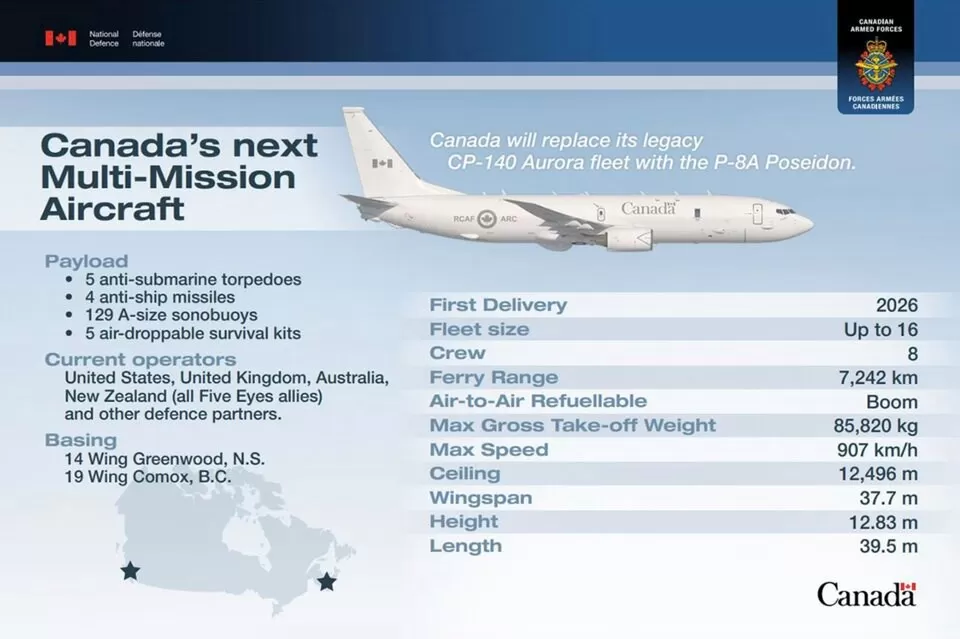 Infographic detailing the capabilities of Boeing's P-8A Poseidon aircraft, acquired by the Royal Canadian Air Force
Boeing Canada states it has now invested over $280 million in Canadian clean technology projects through the Poseidon program, part of more than $2 billion in contracts related to the acquisition. Previous investments under this program include funding for complex modeling and machine learning at Boeing’s Vancouver headquarters and support for an aerospace manufacturing training facility in Parksville, B.C., owned by an Indigenous company.
While driven by the military contract, the sustainable fuel production capacity developed through these new investments is intended to serve both the Royal Canadian Air Force and the broader commercial aviation sector in Canada.
Outlook: Scaling SAF for the Future
Boeing’s investment in Canadian SAF projects represents a strategic move to help decarbonize the aviation sector and fulfill industrial benefits requirements linked to a major defense contract. While the target production volume of nearly 200 million litres per year is substantial for current SAF capacity, it remains a fraction of Canada’s total eight billion litres of annual jet fuel consumption.
The challenge ahead involves scaling up production technologies, securing feedstocks (whether wood waste or captured carbon), building expensive infrastructure, and ensuring the economic viability of SAF compared to conventional fuels. These investments are crucial early steps in a long journey towards making sustainable aviation fuel a mainstream reality.
To learn more about the technologies and companies involved in Canada’s clean energy transition, explore related articles on carbon capture, biofuels, and aerospace technology.