The Greater Toronto Area (GTA) housing market saw significant shifts in June 2025, marked by a substantial increase in available homes and a noticeable slowdown in transaction pace. This signals a market caught in a moment of hesitation, where buyers are exercising caution despite having more choices than they’ve seen in years.
Contents
Key Takeaways:
- Active listings surged by over 30%, pushing inventory to a record high.
- Average home prices saw a modest decline of 5.4% year-over-year.
- Sales activity remained subdued, down slightly by 2.4%.
- Properties are taking significantly longer to sell.
- Uncertainty around future mortgage rate movements is influencing buyer decisions.
Decoding the June 2025 Market Numbers
June’s data from the Toronto Regional Real Estate Board (TRREB) paints a clear picture of a market rebalancing. After years of rapid price growth and fierce bidding wars, the scales are tipping, offering a reprieve to potential buyers.
Here’s a breakdown of the key figures compared to June 2024:
- Prices: Down 5.4%
- Sales: Down 2.4%
- New Listings (Supply): Up 7.7%
- Active Listings (Inventory): Up a significant 30.8%
- Days on Market: Increased by 30% to 40%
The most striking figure is the jump in active listings, reaching the highest level recorded. This influx of supply fundamentally changes the market dynamic, shifting it away from the seller-friendly conditions that dominated for so long.
 Chart showing active listings in the GTA housing market reaching a record high
This surge in inventory means buyers face less competition and have more time and options to find a suitable property, a stark contrast to the frenetic pace of the pandemic-era market.
The Standoff Over Mortgage Rates
A significant factor contributing to the market’s current pause appears to be the uncertainty surrounding future interest rates. While mortgage rates have eased slightly from their recent peaks, they remain a primary barrier to affordability for many.
Buyers are signaling their expectation for rates to fall further, evident in a shift towards shorter-term fixed and variable-rate mortgages. This suggests many are anticipating a future refinance opportunity at lower rates.
Meanwhile, economists at major Canadian banks have expressed views that the Bank of Canada’s rate-cutting cycle might be short-lived or even concluded for now. This divergence in expectations between buyers and lenders/analysts creates a “wait-and-see” environment. Instead of lower rates sparking a rush of demand, the uncertainty itself is encouraging caution as buyers carefully weigh their borrowing costs and market timing.
The result is an uneasy calm – a market searching for a clear direction amid conflicting signals.
More Supply, Less Urgency for Buyers
The increase in available homes, with active listings surpassing 31,600 units, undeniably favors buyers. Coupled with a 5.4% dip in the average GTA home price to around $1.1 million, conditions would historically suggest a surge in sales.
However, June’s sales figures, a modest 6,243 transactions (down 2.4%), indicate buyers are not rushing in. Homes are taking longer to sell, averaging 26 days on the market, while properties relisted without success often take 42 days or more to find a buyer.
This suggests that while price relief and inventory growth are welcomed, they haven’t fully overcome lingering buyer hesitation. Economic uncertainties, including uneven job growth and geopolitical risks, coupled with the continued impact of higher borrowing costs on household budgets, mean many buyers remain reluctant to overextend themselves or commit quickly.
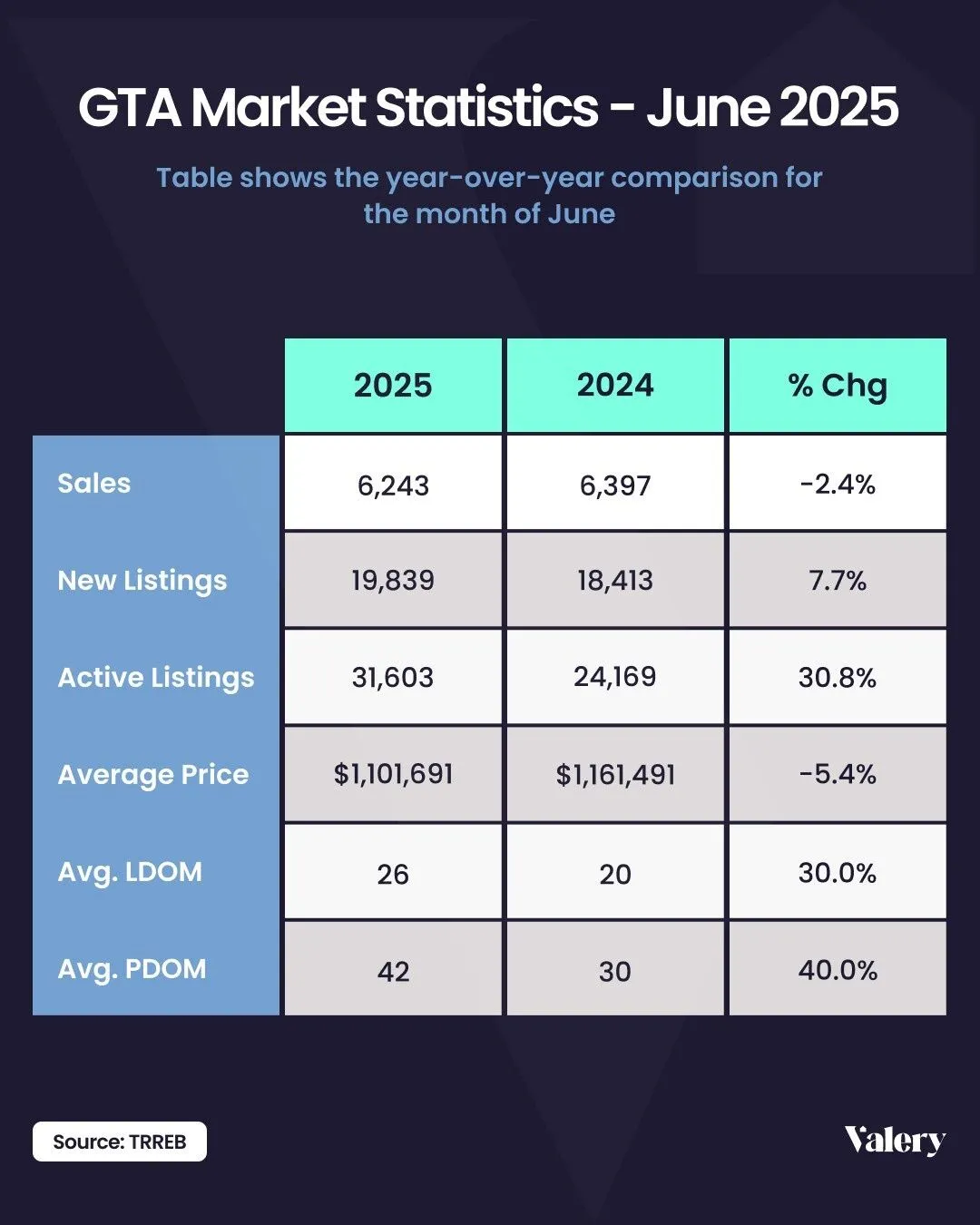 Chart showing a shift in mortgage type preferences among buyers
The Urban vs. Suburban Trend
Within the GTA, a notable divergence is appearing between the core (Toronto 416) and the surrounding suburbs (905 regions).
- Toronto (416): Shows early signs of renewed buyer interest, particularly in semi-detached homes, where sales increased significantly. A modest price dip in detached homes ($1.64 million average, down 6.5%) seems to be attracting some buyers back to urban living, suggesting that in supply-constrained areas, price adjustments can stimulate demand.
- Suburbs (905): Tell a different story. Despite similar price declines in detached homes ($1.3 million average), sales fell by 5.7%. Sales of semi-detached homes and townhouses also decreased. This indicates that lower prices alone are not sufficient to drive demand in the 905, pointing to potentially lower buyer confidence or different market dynamics compared to the urban core.
Beyond the Numbers: Confidence and Generational Shifts
Market stability depends on more than just interest rates and inventory. Buyer confidence, influenced by overall economic certainty and even non-financial factors, plays a critical role. Surveys indicate many potential buyers are delaying purchases, waiting for rates to fall further and for a clearer signal that the market has truly stabilized after recent volatility. Concerns about overpaying in an unpredictable environment are prevalent among first-time buyers.
Furthermore, the housing market exists within a broader societal context. Discussions around public safety and social stability, though seemingly separate from market data, can influence buyer psychology by impacting the perception of a home as a secure sanctuary.
Generational shifts are also reshaping the buyer profile. Younger cohorts like Millennials and older Gen Zers are entering the market with different priorities than previous generations. Shaped by the cost-of-living crisis and witnessing past market volatility, they are often more cautious, prioritize affordability and flexibility, and are open to alternative ownership models to avoid overleveraging.
Outlook: Awaiting Momentum
The current environment presents unique opportunities for buyers, including increased negotiating power, softer prices, and more available inventory. Conditional offers, a rarity during the boom, are back on the table.
However, the broader trajectory of the GTA market hinges on the return of conviction. Until greater economic and geopolitical certainty takes hold, and there’s a clearer signal on the direction of interest rates, the cautious, measured pace observed in June is likely to continue.
The market is currently at a crossroads, paused and searching for momentum. This period of quiet could either serve as a necessary reset, bringing the market back to a sustainable balance, or it could simply be the calm before the next significant swing, direction yet unknown.