
The Halifax Examiner has kicked off its biannual subscriber drive by publishing its financial details, aiming for transparency as subscriber revenue forms the backbone of its operations. The independent news outlet provides a glimpse into its financial health while covering significant local news, from major infrastructure projects and political accountability to public garden conservation and debates over green energy initiatives.
Contents
Key Takeaways:
- The Halifax Examiner relies solely on subscriber revenue and donations, with no advertising or foundation funding.
- Publishing the annual tax return aims for transparency, showing $372,523 in subscription revenue in the past year, slightly down but offset by donations.
- Wages for employees and freelancers represent the largest expense ($263,046 and $85,884 respectively in the past year).
- A goal of 200 new subscribers in June would fund hiring an additional reporter to expand coverage and investigative journalism.
- Major local news includes a new $684.7 million Nova Scotia–New Brunswick power intertie project and controversy surrounding Halifax Transit’s hydrogen bus pilot as potential “greenwashing.”
Inside the Halifax Examiner’s Financials
The Halifax Examiner, an independent voice in Canadian local journalism, operates without the common revenue streams of advertising or large foundation grants. Its existence and ability to fund reporting staff depend entirely on its subscribers and occasional donations. This model drives a commitment to financial transparency, exemplified by the unique practice of publishing the publication’s annual tax return.
In the most recent financial year (referring to the 2024 tax return period as per the original text’s context), the Examiner recorded $372,523 in subscription revenue. This figure saw a slight decrease from the previous year. However, an additional $51,960 in donations helped boost total revenue year-over-year by approximately $10,000.
The primary expenditure for the Examiner is its reporting staff. In the same period, $263,046 was paid to employees, alongside $85,884 for freelance contributors. The owner’s salary is stated as $55,333 for the past year, with a recent increase to $70,000 annually, noted as having been kept low historically to support the publication’s growth. The business operates with no debt beyond potential internal, no-interest loans from the owner.
This financial structure underscores the publication’s “shoestring operation” philosophy: subscriber money directly funds reporting. The current subscriber drive aims to leverage this model for expansion. Achieving 200 new subscribers by the end of June would enable the hiring of another full-time reporter, which the Examiner states would allow for deeper investigative work, broader coverage, and enhanced public accountability from institutions and governments. This direct link between subscriber support and journalistic output is a core message of the drive.
Nova Scotia – New Brunswick Power Intertie Project Advances
Major energy infrastructure development is underway with the Nova Scotia – New Brunswick Reliability Intertie project. This initiative involves constructing a new 160km, 345kV transmission line designed to strengthen the electrical grid connection between Nova Scotia Power and New Brunswick Power. The new line will run parallel to an existing one built in 1976, which is no longer adequate for modern grid demands, particularly in phasing out coal power plants.
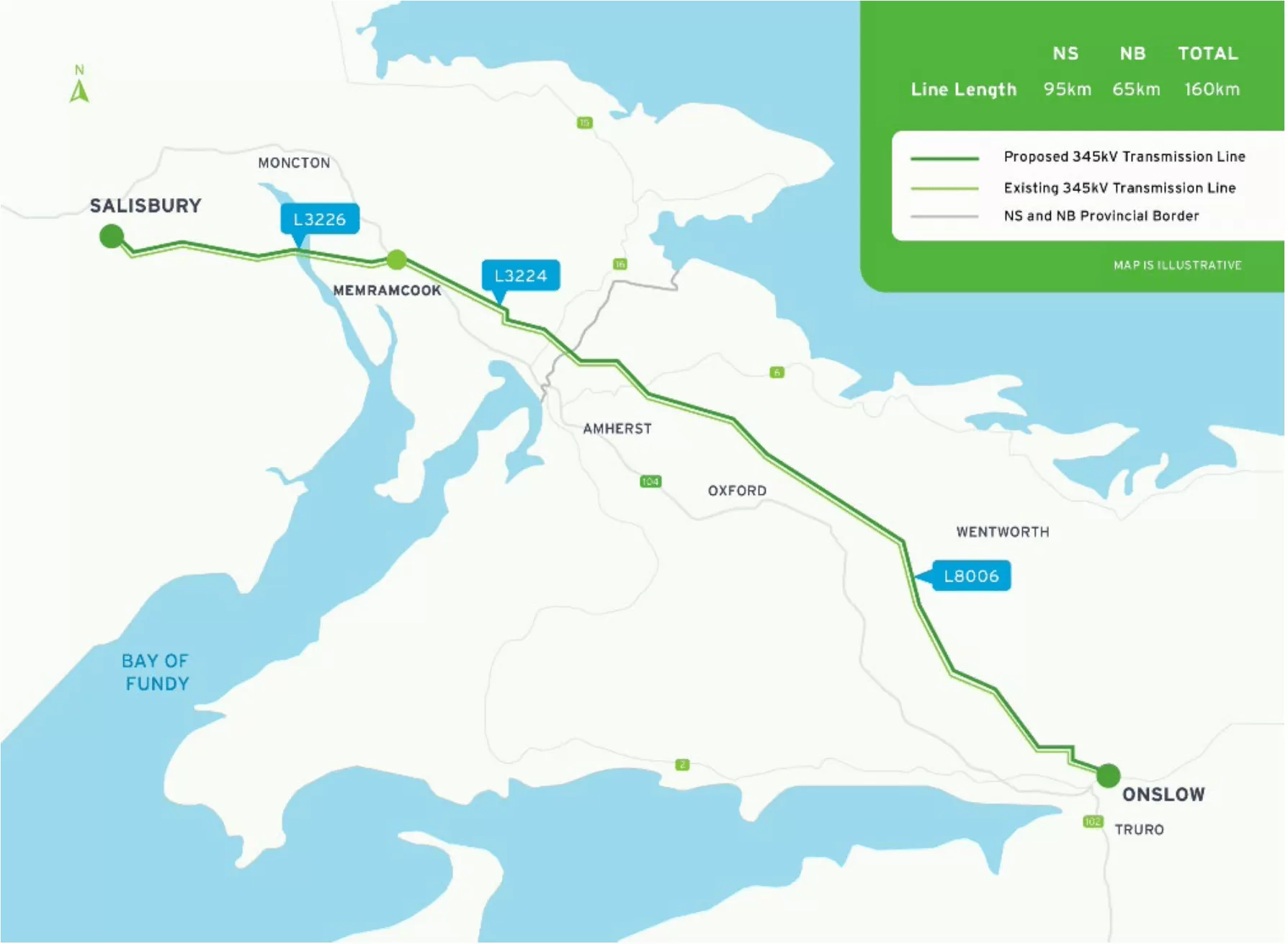 Map showing the route of a transmission line from Salisbury, New Brunswick to Onslow, Nova Scotia, with substation locations marked.
The project encompasses upgrades to substations in both provinces and the construction of 396 new, taller transmission towers (averaging 46 meters compared to the old 35-meter towers). These new structures are designed to be more resilient to weather conditions like ice and snow.
The strategic purpose of the intertie is to enhance grid stability. It will facilitate the importation of low-carbon electricity into Nova Scotia when local renewable sources like wind aren’t sufficient to meet demand. Conversely, it will allow Nova Scotia to export surplus renewable energy generated during peak production times. This flexibility is crucial for Nova Scotia’s transition away from fossil fuels and integrating more intermittent renewable sources.
The estimated capital cost for the project is $684.7 million, split between the Nova Scotia and New Brunswick segments. A new regulated utility, Wasoqonatl Transmission Incorporated (WTI), has been established to implement and operate the project. WTI is a joint venture, owned equally by Nova Scotia Power and the Canada Infrastructure Bank. The name “Wasoqonatl” is Mi’kmaq for “illuminate” or “keep light on,” acknowledging an investment by the Mi’kmaq Wskijnu’k Mtmo’taqnuow Agency Limited (WMA). Despite joint ownership, Nova Scotia Power will handle the construction and operation of the line, including the portion in New Brunswick, which will be owned by NB Power under an operating agreement. The project is slated for completion by the end of 2028.
Halifax Transit’s Hydrogen Bus Trial Sparks Greenwashing Debate
A pilot project launched by Halifax Transit to convert four city buses to run on a hydrogen-diesel dual-fuel system has drawn criticism, being labelled as potential “greenwashing.” The initiative, funded by $122,500 from the city and $367,500 from the province’s Clean Fuels Fund, aims to test if this technology can reduce carbon emissions and diesel use in the transit fleet. Projections from Halifax Transit suggested significant reductions in emissions (69-74%) and diesel use (70%).
 Passengers boarding a public transit bus at a terminal during a rainy day.
However, external analysis, notably from Michael Barnard at CleanTechnica, disputes these optimistic figures, particularly for urban transit environments characterized by frequent stops and idle times. Past trials in similar conditions, like in Wellington, New Zealand, have shown hydrogen substitution rates averaging only 10%. The limitation arises because hydrogen injection is restricted during low-load and idle periods to prevent engine issues, significantly curtailing its potential to displace diesel in typical urban bus operations.
Beyond the technical feasibility, the source of the hydrogen is a major concern highlighted by critics. Nova Scotia’s electricity grid remains heavily reliant on fossil fuels. Producing hydrogen via electrolysis using this grid power would result in hydrogen with a higher carbon footprint than standard “grey” hydrogen derived from natural gas. There is currently no significant green hydrogen production capacity in the province from renewable sources.
This context leads to the “greenwashing” accusation. Critics suggest the pilot project, funded in part by a provincial “Clean Fuels Fund,” serves as a promotional tool for large-scale hydrogen projects proposed in the province, such as EverWind, which has reportedly received significant government attention and potential subsidies. The concern is that these projects may rely on less-than-green energy sources during a lengthy “transition” phase, potentially using fossil fuels, undermining the “green” label. The Halifax Transit trial, consuming a relatively small amount of hydrogen, could inadvertently contribute to upstream emissions without achieving substantial environmental benefits, essentially acting as a public relations boost for larger, potentially questionable hydrogen ventures.
Other Local News Highlights
Beyond infrastructure and energy debates, the Halifax Examiner also covers a range of other significant local stories:
- NDP Criticism of Government Secrecy: Nova Scotia’s Official Opposition leader, Claudia Chender, has raised concerns about a pattern of government secrecy, citing the refusal to release recommendations from an advisory panel on environmental racism and lack of transparency regarding housing funding allocation. Historical context on environmental injustices in the province is also explored in this coverage.
- Preserving Burlesque History: A project is underway to unearth and preserve the history of burlesque in Nova Scotia. Led by performers, the initiative highlights burlesque as a form of resistance and agency for women from difficult backgrounds, while also examining the recurring societal backlash and moral arguments against the art form throughout history.
- Halifax Public Gardens as Pollinator Hub: The Halifax Public Gardens are recognized for their crucial role as a downtown ecosystem supporting pollinators like bees, birds, and butterflies. Horticultural staff manage the diverse plant life, contributing to the gardens’ function not just as a public space but as a vital habitat.
Stay informed on these and other local developments by exploring related articles.
Looking Ahead: Support for Local Journalism
The Halifax Examiner’s financial transparency report and subscriber drive highlight the ongoing challenges and vital role of independent local journalism. The direct funding model means the breadth and depth of reporting, including complex investigations into infrastructure projects, energy policy, and government accountability, are directly tied to reader support. The success of the current drive could significantly impact the publication’s ability to cover critical issues affecting Nova Scotia. Meanwhile, major projects like the NS-NB Intertie continue to progress, and debates surrounding the environmental impact of energy initiatives like the hydrogen bus pilot will likely continue, shaping the province’s future.
Click here to learn more about supporting local journalism by subscribing.