Canadian investors holding U.S. stocks face potential changes to how their dividend income is taxed. A new bill proposed in the U.S. House of Representatives could significantly increase the withholding tax on U.S. dividends received in non-registered accounts, potentially impacting overall investment returns.
Contents
- The Potential Tax Increase Explained
- Impact on Investor Returns
- The Stated Reason: Retaliation for Canada’s Digital Tax
- Key Considerations for Canadian Investors
- Is This Bill Law Yet?
- Potential USMCA Renegotiation Impact
- Registered Accounts Are Safe
- Low US Dividend Yields Limit the Overall Impact
- What’s Next for Investors
This proposed change, part of a larger tax bill, is framed by the U.S. government as a response to taxes like Canada’s digital service tax (DST) on large technology companies. While the bill’s passage is not guaranteed and U.S. dividend yields are currently low, Canadian investors should understand the potential implications and how it might affect their portfolios.
The Potential Tax Increase Explained
Currently, Canadian investors receive U.S. dividend income subject to a 15% withholding tax when held in non-registered cash accounts. This means for every $100 in U.S. dividends, $15 is withheld, leaving $85 for the investor.
The proposed “One, Big, Beautiful Bill” includes provisions that could raise this rate. Starting January 1, 2026, the withholding tax could increase to 20%, with further 5% annual increases eventually reaching a potential maximum of 50%. Importantly, this change appears focused on dividend income, with interest income from U.S. bond investments likely unaffected.
Impact on Investor Returns
Should this bill pass, the higher withholding tax would directly reduce the net dividend income received by Canadian investors from U.S. stocks in non-registered accounts. This reduction in income would also drag down overall portfolio returns over the long term.
For instance, if an investor holds U.S. stocks with a 2% dividend yield, the 15% withholding tax currently reduces the effective yield to 1.7% (a 0.3% reduction in overall return). Under the proposed changes, the reduction would start at 0.1% in the first year of the change (20% tax on 2% yield = 0.4% total reduction, compared to 0.3%) and could eventually increase to a 0.7% annual reduction once the 50% rate is reached (50% tax on 2% yield = 1% total reduction compared to 0.3%). While these percentage points might seem small, they compound over time, especially for income-focused portfolios.
The Stated Reason: Retaliation for Canada’s Digital Tax
The U.S. government has publicly stated this proposed tax hike is a retaliatory measure against what they view as “discriminatory” taxes imposed by Canada on U.S. companies. A prime example cited is Canada’s recently implemented digital service tax (DST), which imposes a 3% annual tax on the revenues of large digital corporations like social media platforms and search engines operating in Canada. The U.S. considers this an unfair targeting of its dominant tech sector.
 US President speaking to steelworkers, symbolizing US policies impacting Canadian economy
Key Considerations for Canadian Investors
While the headlines might sound alarming, several crucial factors could mitigate the impact or prevent the proposed changes from fully materializing.
Is This Bill Law Yet?
The “One, Big, Beautiful Bill” has passed the U.S. House but still needs approval from the Senate and the President’s signature to become law. There is significant opposition to the bill, partly due to its estimated US$3.7 trillion addition to the national debt. Strong opposition could lead to the bill being blocked or substantially altered, potentially removing or changing the dividend tax provision.
Potential USMCA Renegotiation Impact
The upcoming renegotiation of the USMCA free trade agreement between Canada, the U.S., and Mexico presents another avenue where this issue could be addressed. Canada’s Prime Minister has expressed a desire to begin these negotiations. It’s possible that resolving the proposed withholding tax increase could become part of a broader trade discussion, perhaps involving Canada making concessions on taxes like the DST in exchange for the U.S. maintaining the current 15% rate.
Registered Accounts Are Safe
A critical point for Canadian investors is that this potential tax increase only applies to U.S. dividends received in non-registered accounts. Investments held within registered accounts such as Registered Retirement Savings Plans (RRSPs), Tax-Free Savings Accounts (TFSAs), Registered Education Savings Plans (RESPs), or Registered Disability Savings Plans (RDSPs) are generally protected from this U.S. withholding tax under existing tax treaties. Therefore, a significant portion of Canadian holdings in U.S. stocks may be unaffected.
Low US Dividend Yields Limit the Overall Impact
Currently, dividend yields on major U.S. market indices like the S&P 500 are relatively low, hovering around 1%. Even smaller cap stocks often have similarly low yields. For many investors holding U.S. stocks, the primary driver of returns has been price appreciation rather than dividend income. Given the low starting yield and the fact that the tax only impacts non-registered accounts, the overall financial hit to most Canadian investors, even if the tax hike passes, would be relatively minimal compared to markets with higher yields.
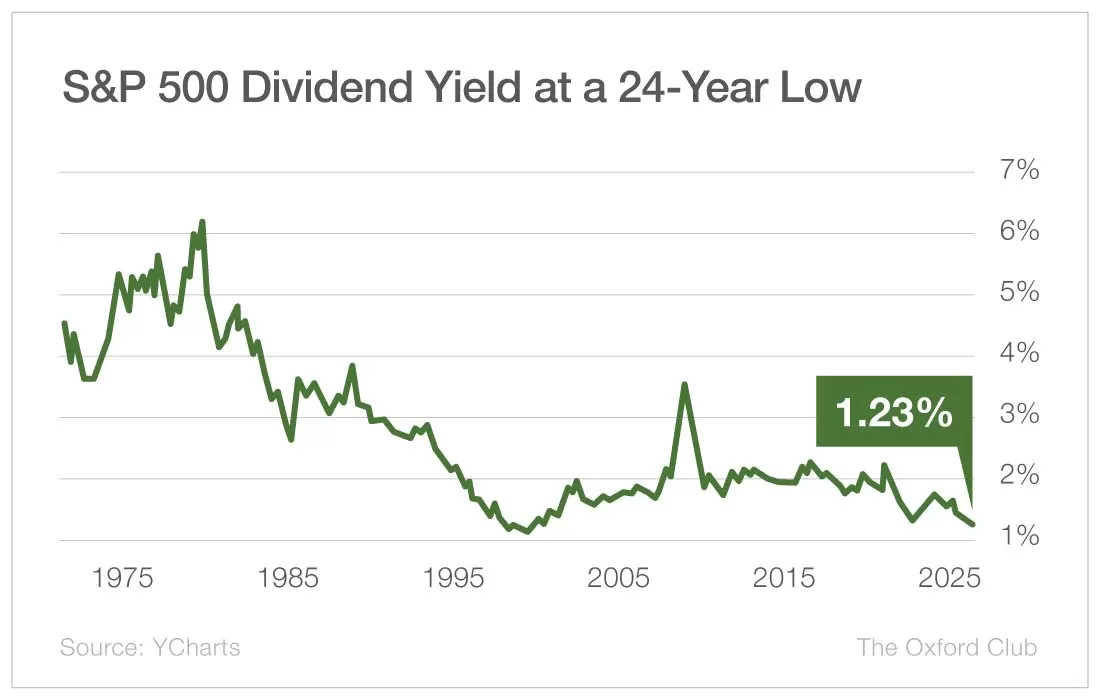 Chart illustrating dividend yields, highlighting investment returns for Canadian investors holding US stocks
This is why many Canadian investors focus their dividend-seeking investments within Canada, where yields are often higher and favourable tax treatment via the dividend tax credit is available. The U.S. market is often viewed more for its potential for long-term capital growth.
What’s Next for Investors
This proposed increase in the U.S. dividend withholding tax for Canadian investors is a development to monitor, but it’s far from a done deal. The bill faces significant hurdles in the U.S. Senate, and the issue could become a point of negotiation in future U.S.-Canada trade discussions.
While potentially negative for investors with significant U.S. stock holdings in non-registered accounts, the financial impact is likely to be relatively small for many, primarily due to the low prevailing dividend yields in the U.S. market and the exemption for registered accounts. Investors primarily focused on Canadian dividend stocks or holding U.S. growth stocks in registered accounts will see minimal effect. Keeping U.S. dividend-paying stocks primarily within registered accounts remains a prudent strategy for tax efficiency.
Stay informed on the bill’s progress and potential trade negotiations. For more insights on cross-border investing and tax implications, explore our related articles.