The strategic partnership between Rivian and Volkswagen is poised to reshape the future of electric vehicles for the German automotive giant. A key Rivian executive has revealed that the core technology platform underpinning Rivian’s upcoming R2 series will be adopted across Volkswagen’s entire future electric vehicle lineup. This move signals a deep integration of Rivian’s advanced software and architecture into VW’s sprawling brand portfolio, providing a significant boost to both companies.
Contents
Key takeaways from this development:
- Volkswagen will use Rivian’s R2 “technology stack” for all future EVs.
- This refers to the software and zonal architecture, not necessarily the physical vehicle platform.
- VW brands will retain unique identities through custom interfaces and vehicle tuning.
- The adoption aims to accelerate VW’s software development and create economies of scale.
- VW continues developing its own SSP platform and a separate platform with Xpeng for specific markets/needs.
Rivian’s R2 Tech Becomes the Backbone for VW’s EV Strategy
According to Wassym Bensaid, Rivian’s chief software officer and co-head of the Rivian-VW joint venture, the R2 platform’s technology will be foundational for Volkswagen. Bensaid stated, “R2 is the platform that will underpin actually all future EV products from VW.”
He clarified that this adoption focuses on Rivian’s modular, scalable technology stack. This includes the advanced software, electrical architecture, and underlying computing power that manage vehicle functions, connectivity, and user experience. While sharing this core technological base, Volkswagen intends to allow its various brands (like VW, Audi, Skoda, SEAT, etc.) to maintain distinct identities. This will be achieved through custom user interfaces, unique design elements, and brand-specific vehicle tuning, such as suspension characteristics. The goal is a common, efficient underlying system that supports diverse brand expressions on top.
Why This Partnership Matters for Both Automakers
This collaboration provides substantial benefits for both Rivian and Volkswagen. For Rivian, the $5 billion investment from VW provides crucial capital to support its growth, scale production, and continue developing its technology, including the R2 and R3 models. It also serves as a major validation of Rivian’s engineering and software capabilities, potentially opening doors for future partnerships.
For Volkswagen, integrating Rivian’s technology stack addresses a known challenge: accelerating and standardizing software development across its vast portfolio. Adopting a proven, advanced architecture like Rivian’s could significantly speed up the development cycle for future electric models, potentially reduce costs, and provide a modern, capable digital foundation that is critical in the competitive EV market. Access to Rivian’s zonal architecture is particularly valuable, simplifying wiring harnesses and enabling more efficient over-the-air updates. This move underscores VW’s commitment to overcoming software hurdles and rapidly expanding its electric vehicle offerings globally.
Navigating Volkswagen’s Multiple Platform Initiatives
It’s important to understand that the adoption of Rivian’s technology stack exists alongside Volkswagen’s other platform strategies. VW is heavily invested in developing its in-house Scalable Systems Platform (SSP), which is intended to be the backbone for a future generation of electric vehicles, including models like the next electric Golf.
 Volkswagen ID.4 electric SUV representing VW's current EV lineup.
Additionally, Volkswagen is collaborating with Chinese EV maker Xpeng on the China Electrical Architecture (CEA) platform, specifically aimed at developing cost-competitive EVs for the Chinese market. VW expects this partnership to yield significant production cost reductions. (Learn more about the Xpeng and VW partnership on electric architecture).
The integration of Rivian’s technology stack appears to be a layer that can potentially sit on top of or integrate with these different physical platform developments, providing a consistent software and architectural experience across various vehicle bases and brands within the VW Group. This approach suggests a strategy focused on modularity, where different hardware platforms can utilize a common, advanced software and electrical brain provided by the Rivian collaboration.
Bensaid highlighted the maturity of the R2 technology, noting it’s an evolution based on lessons learned from Rivian’s R1 vehicles. “That is allowing us to really not only make progress, but we’re extremely happy with the maturity of R2 compared to where R1 was,” he stated.
Looking Ahead: R2 Production and VW’s Future EVs
Production of the Rivian R2 is scheduled to begin in the second half of 2026, followed by the more affordable R3 lineup. As Volkswagen commits to integrating this same underlying technology, it underscores a shared vision that a common foundation can accelerate development, achieve economies of scale, and provide flexibility to deploy advanced features across a wide range of future electric vehicles.
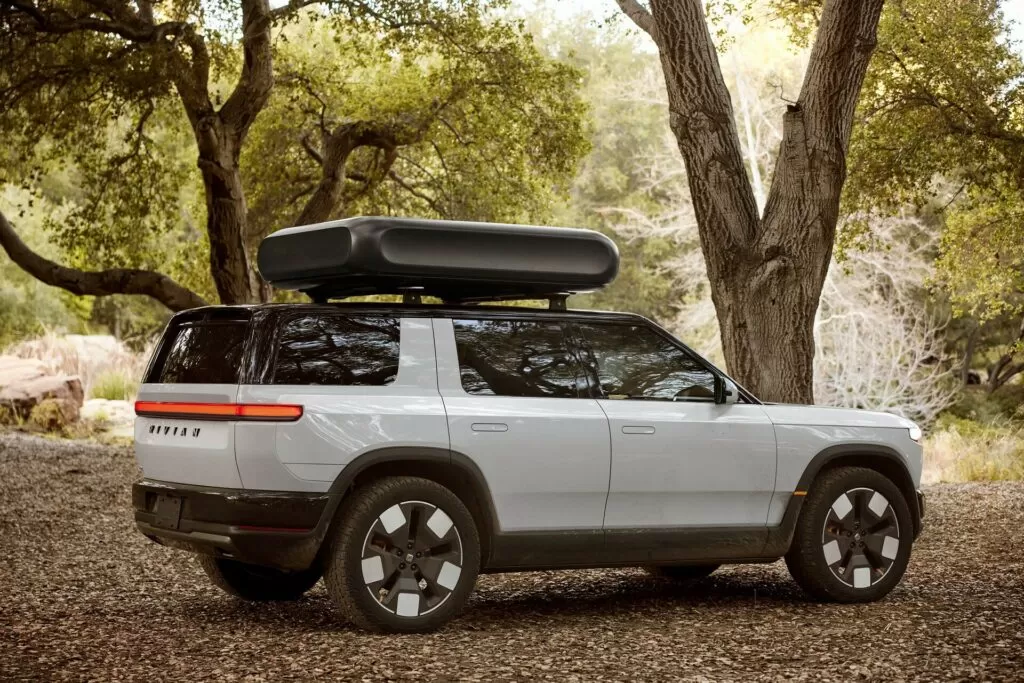 Official image of the upcoming Rivian R2 electric SUV.
This strategic technology adoption positions Volkswagen to leverage Rivian’s innovative electrical and software architecture, potentially streamlining its complex EV development process and enhancing the capabilities of its upcoming models. It suggests that future VW Group EVs, regardless of the specific physical platform they ride on, could share a core technological DNA derived from Rivian’s next-generation vehicles. This could include models ranging from passenger cars like the potential next-gen electric Golf (read more about how the Next VW Golf EV Will Ride On Rivian’s Electric Architecture) to potentially larger vehicles across the VW Group brands. The success of this integration will be a key factor to watch as both companies roll out their next waves of electric vehicles.