SpaceX launched its ninth Starship test flight today, marking a significant step with the first reuse of a Super Heavy booster. While the mission achieved key milestones like stage separation and reaching space, both the Starship upper stage and the Super Heavy booster were lost before completing their planned landings. This flight provided valuable data, continuing SpaceX’s iterative development approach towards a fully reusable rocket system.
Contents
The Ninth Starship Flight: Key Goals
The latest Starship test flight lifted off from SpaceX’s Starbase facility in South Texas. The primary objective for this mission was to gather more critical data on the performance of the Starship system, particularly focusing on the reusability aspect of the Super Heavy booster and the flight profile of the Starship upper stage. SpaceX is rapidly developing Starship, the largest and most powerful rocket ever built, for ambitious goals including transporting cargo and people to the Moon and Mars.
The Starship system consists of two main components: the Super Heavy booster and the Starship upper stage (often simply called “Ship”). Both are designed for rapid and full reusability, powered by SpaceX’s Raptor engines. Super Heavy uses 33 engines, while Ship uses six.
Testing Reuse with Super Heavy
A significant milestone on Flight 9 was the reuse of a Super Heavy booster. The booster used in this flight had previously flown during the Flight 7 test in January. This marked the first time SpaceX attempted to re-fly a Starship booster, putting their refurbishment processes to the test.
SpaceX performed some engine swaps after the booster’s first flight, but most of its engines were flight-proven. The company stated that lessons from this first booster refurbishment and flight would help accelerate future reflights, moving towards the goal of minimal maintenance between launches.
For Flight 9, the Super Heavy booster followed a different return profile compared to previous missions. It attempted a controlled flip and atmospheric entry at a higher angle of attack. This maneuver is designed to use atmospheric drag more effectively to slow the vehicle, potentially requiring less propellant for the final landing burn in future designs. Given the experimental nature of this maneuver and the potential risk to launch tower infrastructure, SpaceX planned for a controlled “hard splashdown” in the Gulf of Mexico, rather than attempting a catch by the launch tower’s arms.
 SpaceX Starship rocket launches from Starbase, Texas, observed by spectators on boats nearby.
Starship’s Journey: Reaching Space and Challenges
The Starship upper stage successfully separated from the Super Heavy booster as planned, a consistent achievement in recent test flights. Ship continued its ascent on a suborbital trajectory over the Atlantic Ocean, successfully reaching space—an improvement over some earlier test attempts where this phase was not fully completed.
However, the flight encountered issues after reaching space. A planned deployment of eight dummy Starlink satellites, which would have been a first for the Starship program, was attempted about 18.5 minutes after liftoff but failed because the payload door did not fully open.
Later in the flight, approximately 30 minutes after launch, Ship began to tumble. According to SpaceX, this was caused by a leak in the vehicle’s fuel tank systems, which are also used for attitude control. The loss of attitude control meant SpaceX could not proceed with a planned test of relighting one of Ship’s Raptor engines in space. The company anticipated Ship would break up during reentry over the Indian Ocean, rather than achieving a controlled soft splashdown.
Analyzing the Outcomes: What Went Wrong
While the mission included successes like booster reuse and Ship reaching space, the inability to recover either stage highlights ongoing challenges in developing the fully reusable system.
Super Heavy’s Landing Attempt
The Super Heavy booster’s flight ended prematurely. It broke apart about 6 minutes and 20 seconds into the flight, just as it began its landing burn phase. This occurred before it could complete the experimental high-angle reentry profile and the final descent to the planned splashdown location. While the booster successfully flew again after refurbishment, its controlled return and landing sequence still requires refinement.
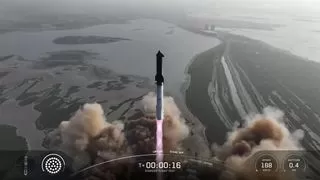 SpaceX Starship megarocket lifts off from the launchpad during Flight 9 test.
Starship Upper Stage Issues
The Starship upper stage demonstrated its ability to reach space, a key step towards orbital capability. However, the failure of the payload door to open and the critical fuel system leak highlight vulnerabilities that still need to be addressed. These issues prevented key tests like the in-space engine relight and resulted in the loss of the vehicle during reentry. Previous Ship failures on Flights 7 and 8 had different root causes (harmonic response leading to leaks vs. engine hardware failure), indicating that multiple complex systems require robust solutions for reliability.
Elon Musk commented on the flight via social media, noting the “big improvement over last flight” by reaching engine cutoff but attributing the loss to “Leaks caused loss of main tank pressure during the coast and re-entry phase.”
The Path Forward: Learning and Iterating
SpaceX emphasizes that these are test flights designed to push the limits and gather data rapidly. As Dan Huot of SpaceX communications stated during the webcast, they are “trying to do something that is impossibly hard” and expect “bumps” along the way. Reaching space with Ship was highlighted as a significant moment.
SpaceX implemented notable hardware changes and conducted extensive ground testing following issues on Flights 7 and 8. Flight 9 was a test of these improvements and new experiments. While the vehicle was lost, the data collected on booster reuse performance, the experimental reentry, Ship’s flight through stage separation and into space, and the nature of the failures provides crucial information for the next iterations. Components like the heat shield tiles, some of which were intentionally removed or varied for testing, also provided data despite the vehicle’s loss.
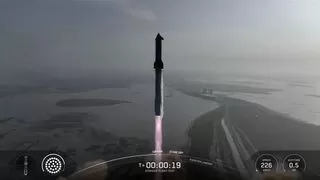 SpaceX Starship rocket ascends into the sky during its ninth test flight from South Texas.
Next Steps and Outlook
The “SpaceX way,” as manufacturing engineering manager Jessie Anderson put it, is to “learn, iterate, and iterate over and over again until we figure it out.” This suggests that despite the setbacks on Flight 9, the pace of development will likely remain high.
Elon Musk indicated that the next three Starship test launches could happen quickly, potentially lifting off every three to four weeks. This aggressive schedule underscores the company’s commitment to rapid iteration and learning from failures to accelerate progress towards a reliable, reusable system capable of orbital flights and beyond. Each test flight, even those ending in stage loss, provides invaluable data that informs design changes and operational procedures for future missions. The ultimate goal is to perfect the system needed for large-scale space transport, impacting future satellite deployment (like Starlink), lunar missions (NASA’s Artemis program), and eventually, crewed missions to Mars.
While Starship Flight 9 ended with the loss of both stages, it represented tangible progress in SpaceX’s rapid development cycle. The successful test of booster reuse and Ship reaching space highlight key advancements, even as challenges with landing, payload deployment, and fuel systems remain. SpaceX’s focus on iterative testing means more flights are expected soon, with Elon Musk indicating launches could occur every 3-4 weeks. As the company pushes toward full reusability, these test flights provide critical data to refine the design and operations for future missions to orbit, the Moon, and Mars.
For more insights into Starship’s development and SpaceX’s ambitious plans, explore our related articles.