After years of dedication, collector Tom Maoli’s stunning 1932 Duesenberg Model J has claimed the prestigious Best in Show award at the Greenwich Concours d’Elegance. This win celebrates not just a beautiful classic car, but a vehicle that was a true technological powerhouse of its time, proving that groundbreaking engineering from nearly a century ago can still capture hearts today.
Contents
Key Takeaways:
- A 1932 Duesenberg Model J owned by Tom Maoli won Best in Show at the 2025 Greenwich Concours.
- The Model J was a pinnacle of pre-war automotive technology and luxury.
- Unique features include a “disappearing top,” advanced engine engineering, and a sophisticated dashboard.
- The winning car has a rich history, including significant restorations.
The Journey to Best in Show
For Tom Maoli, a collector from Mendham, New Jersey, this victory is the culmination of significant effort. Having entered cars at Greenwich before, taking home the top prize feels like a major achievement. As he put it, holding a celebratory glass, “To finally get across the finish line… is an honor. There’s nothing better.”
Maoli boasts an impressive collection of around 40 cars, with seven Duesenbergs among them. He holds a special place for the Model J, considering it potentially “the greatest car built in American history.” The specific car that won is a “disappearing top” version, which he calls one of the nicest.
 Tom Maoli accepts the Best in Show award for his 1932 Duesenberg Model J at the 2025 Greenwich Concours d'Elegance.
A Car Packed With Innovation (For the 1930s!)
When E.L. Cord acquired the Duesenberg company in 1925, his vision was bold: build cars that surpassed the finest European luxury brands like Rolls-Royce. Fred and August Duesenberg rose to the challenge, creating the Model J, first released in 1928. This wasn’t just a car; it was a statement of American ambition and engineering prowess.
The “Disappearing Top” and Custom Flair
One of the most visually striking features of this winning Model J is its custom “disappearing top.” This isn’t just a standard convertible roof; the mechanism is designed to fold completely out of sight into the car’s body, creating a clean, seamless look when open. This particular car is one of about 25 bodied by the Walter M. Murphy Co. of Pasadena, California, known for their bespoke craftsmanship. Other high-end touches include Murphy’s signature “Clear-View” windshield pillars, elegant mahogany running boards, chrome trim that runs the full length of the body, stylish 19-inch chrome wire wheels, and a charming rumble seat complete with entry steps.
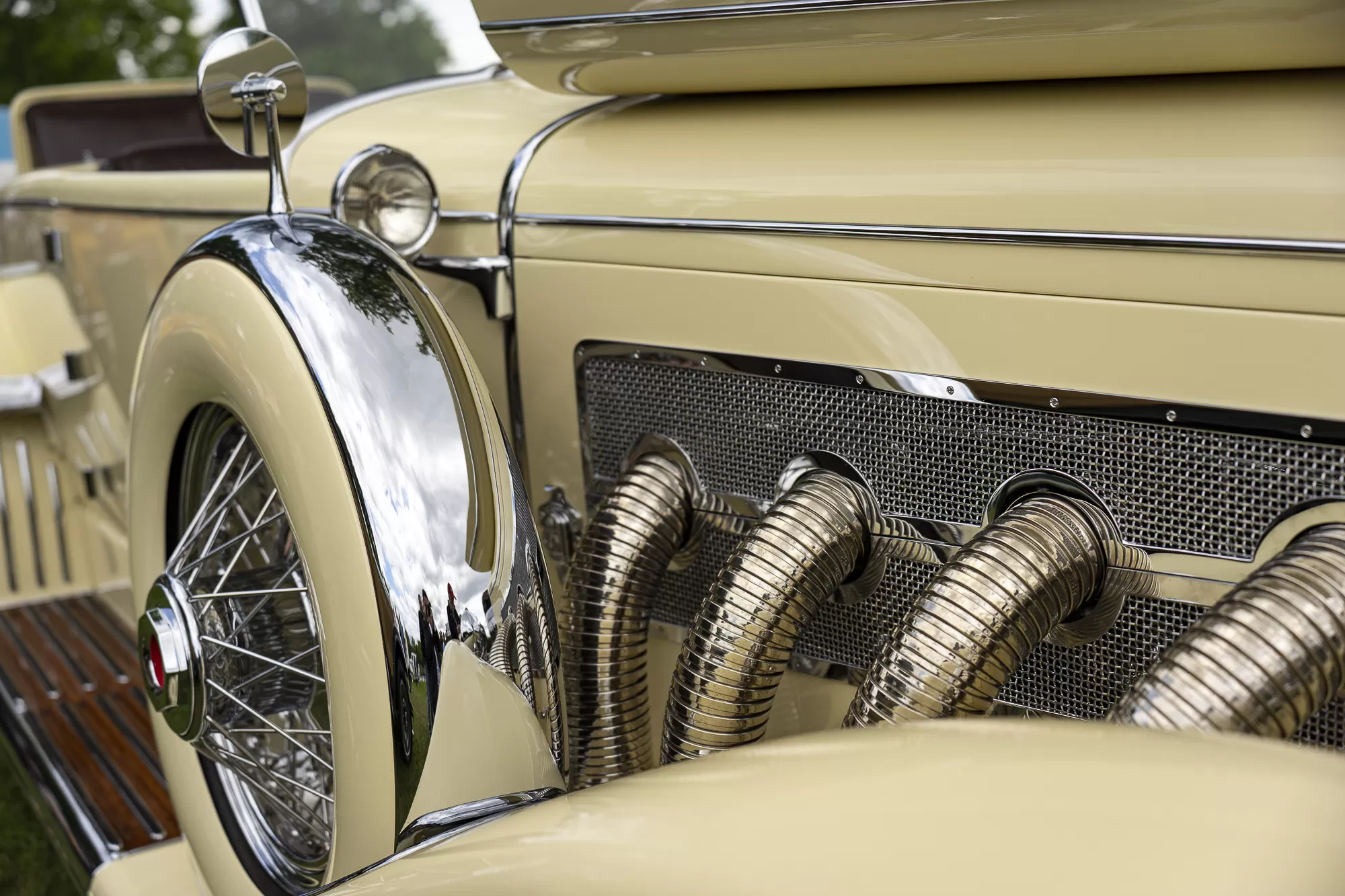 Detailed view of the striking side-exit exhaust pipe on the award-winning 1932 Duesenberg Model J.
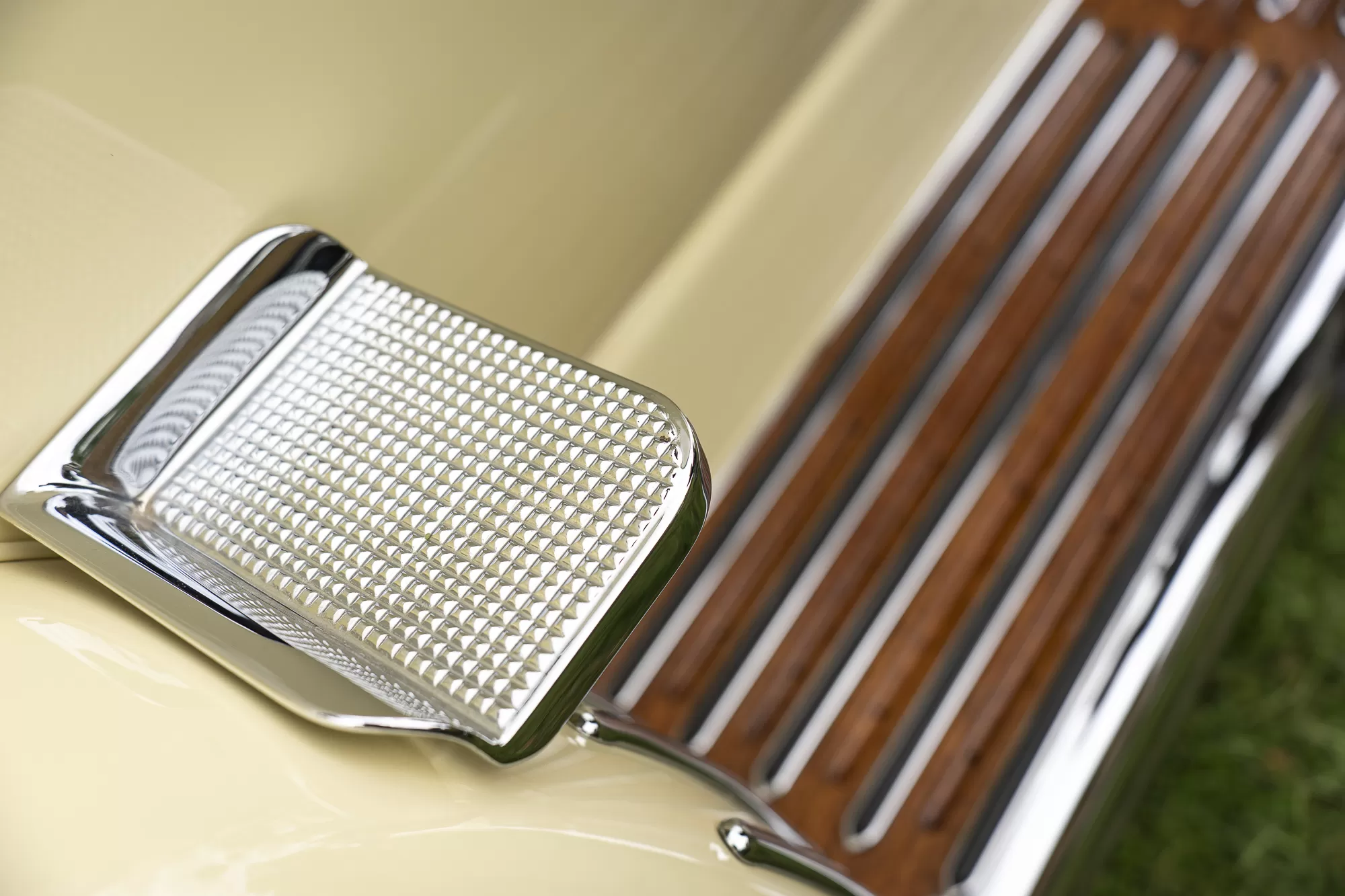 Close-up of the elegant step leading up to the rumble seat on the custom-bodied 1932 Duesenberg Model J.
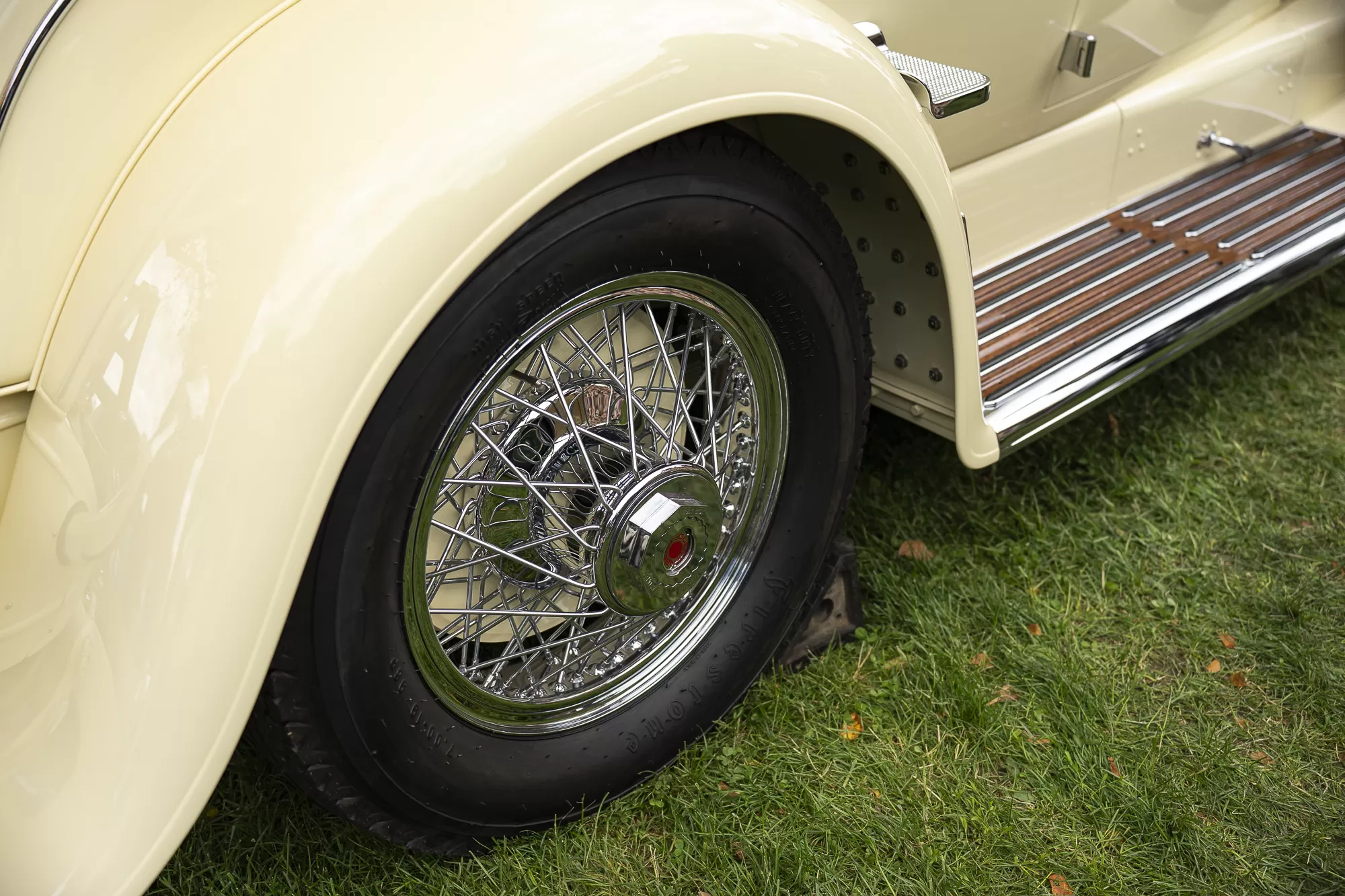 Shining 19-inch chrome wire wheel and white wall tire on the 1932 Duesenberg Model J Best in Show winner.
Engineering Prowess Under the Hood
Beyond its stunning looks, the Model J was a marvel of mechanical engineering. Power came from a massive Lycoming-built straight-eight engine. This nearly 7-liter (420 cubic inch) beast produced a remarkable 265 horsepower in naturally aspirated form – a huge number for the era. To put that in perspective, it was 80 horsepower more than the contemporary Cadillac V16 engine, despite having half the cylinders!
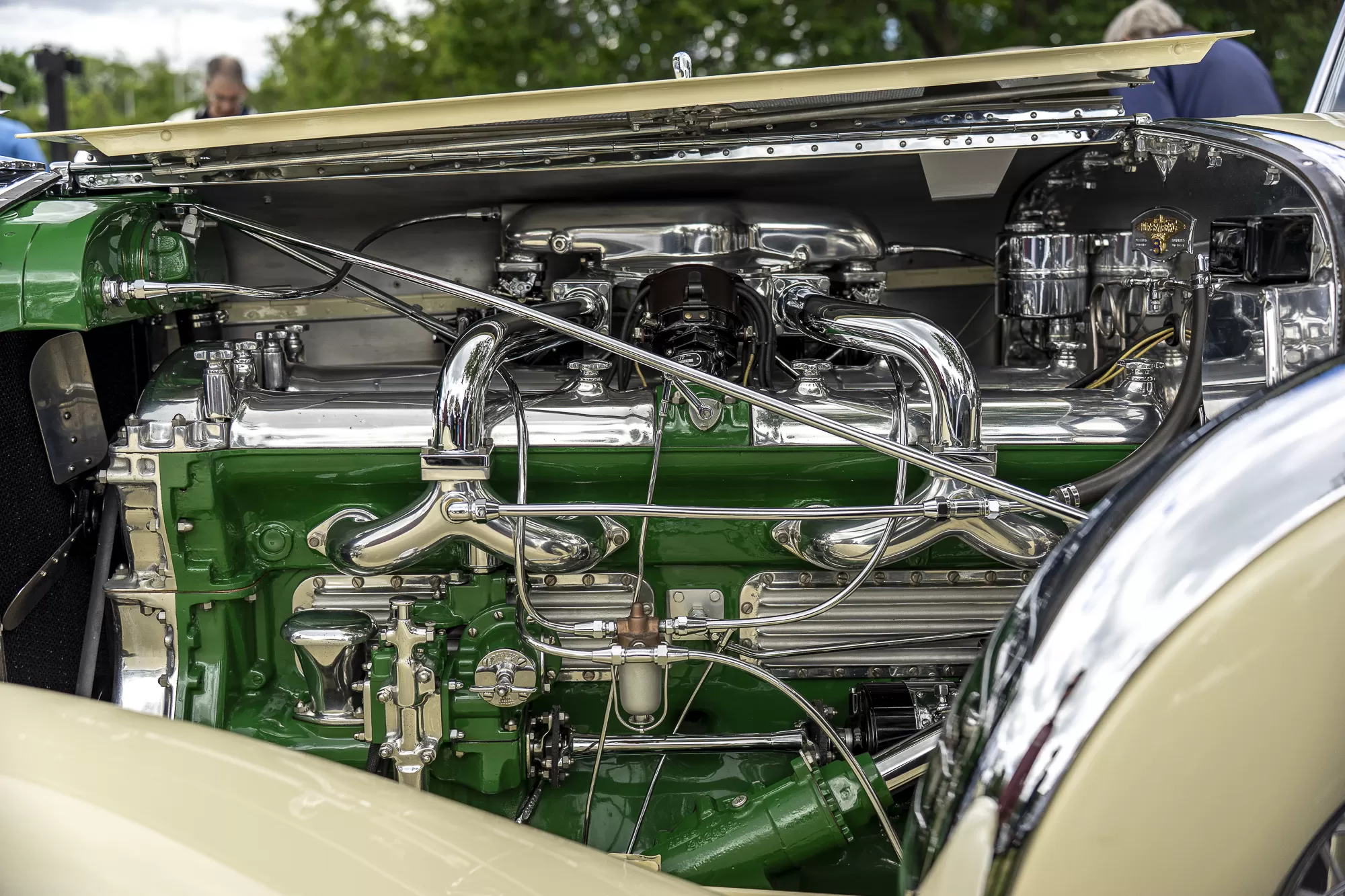 Detailed view of the Lycoming straight-eight engine in the 1932 Duesenberg Model J, showcasing its vibrant green block.
This performance was thanks to advanced features like dual overhead cams and four valves per cylinder – technology that was cutting-edge for a road car at the time. The engine block itself was painted a distinctive bright green. According to the Museum of American Speed, it even used mercury-filled cartridges bolted to the crankshaft to dampen vibrations, a truly ingenious (and perhaps surprising) solution for smooth running.
The Futuristic Dashboard
Step inside, and you’re greeted by an instrument panel that looks like something out of an early aircraft or a science fiction novel for the 1930s. It included not just the usual speedometer and tachometer, but also an altimeter-barometer (measuring altitude/air pressure), a stopwatch-chronometer, a brake-pressure gauge, and even four warning lights for things like chassis lubrication and fluid change intervals. This was advanced diagnostics and instrumentation decades before it became commonplace in cars.
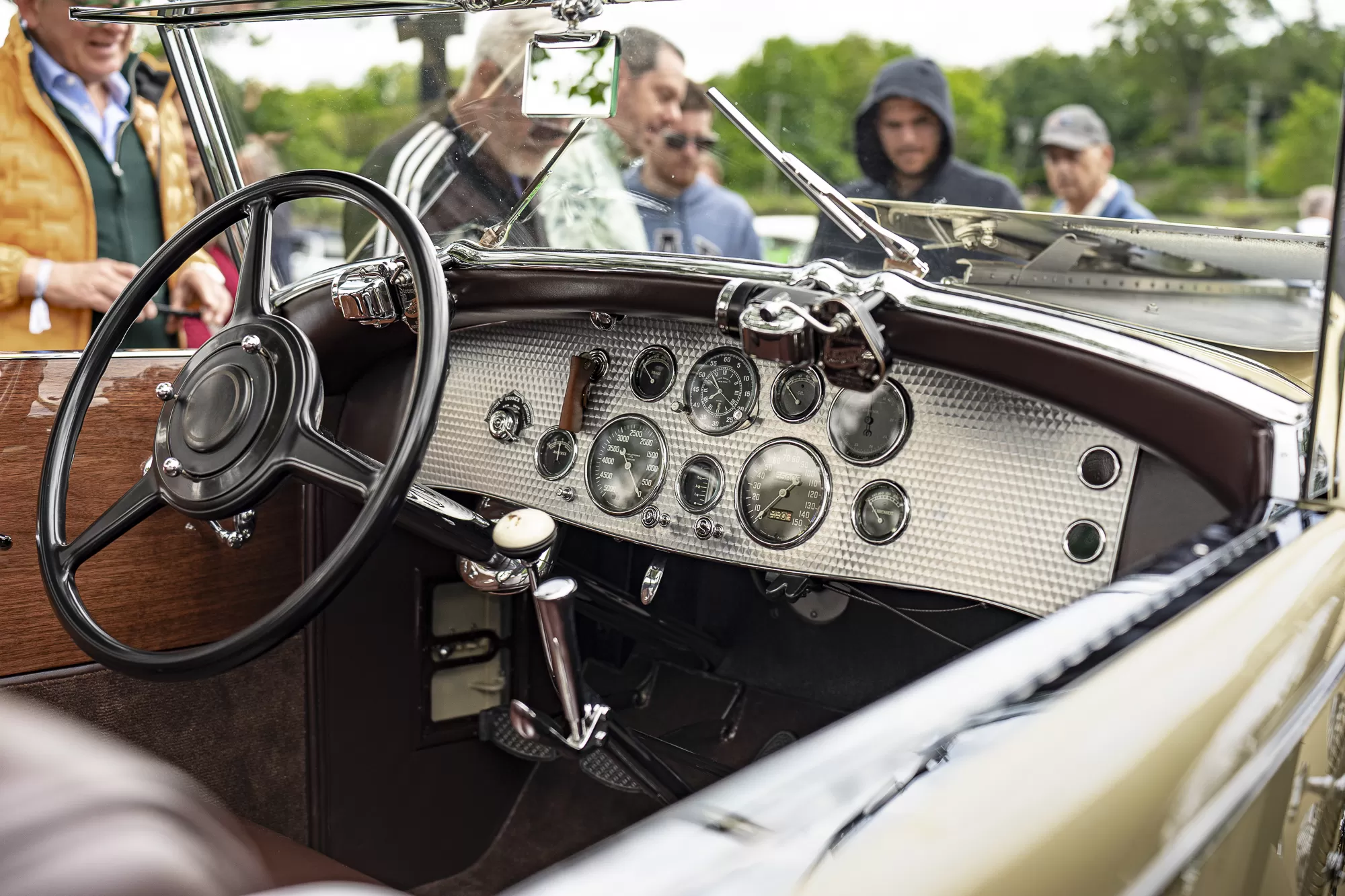 View of the luxurious and complex interior dashboard of the 1932 Duesenberg Model J, featuring multiple gauges.
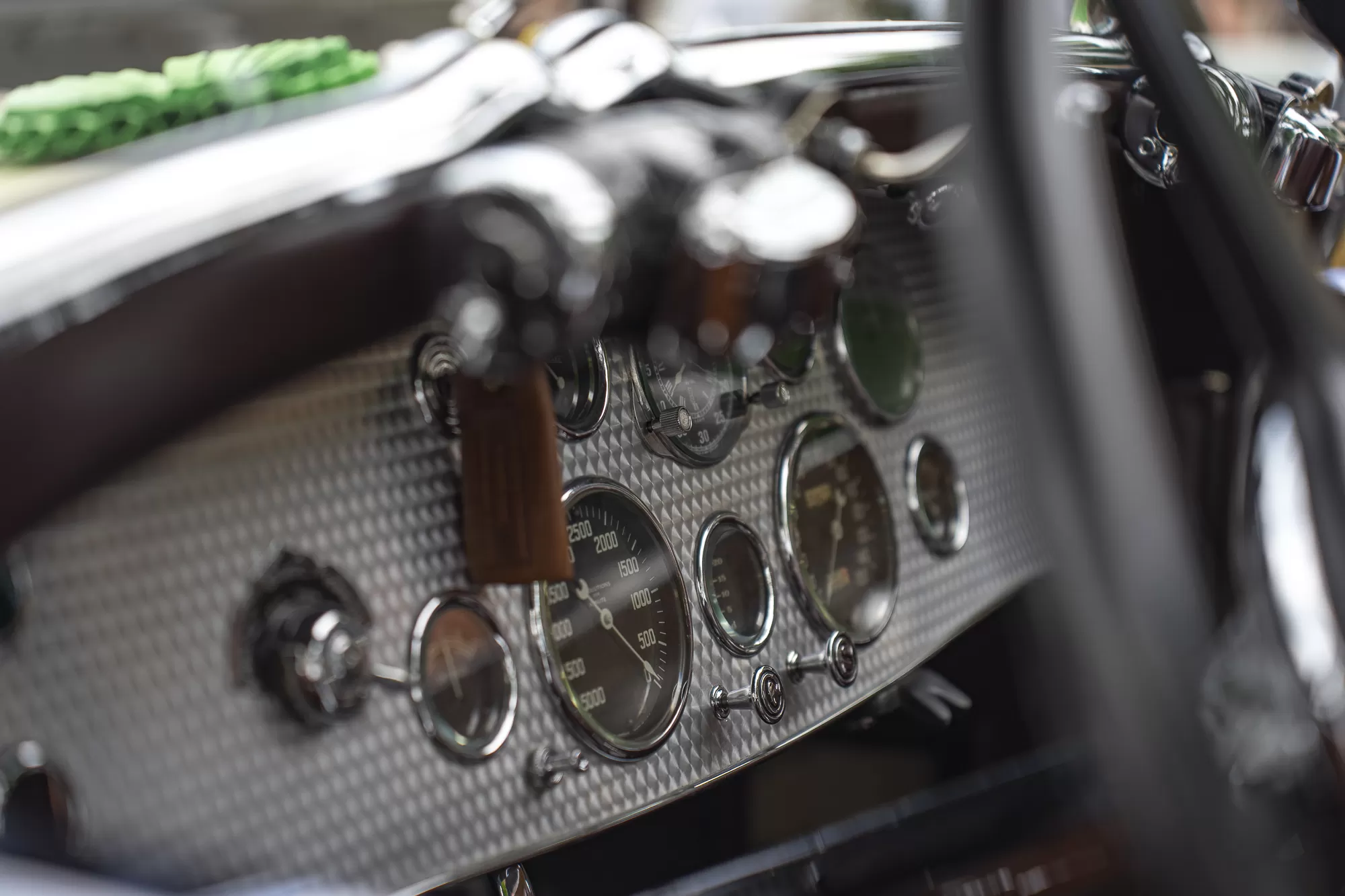 Close-up on the array of advanced gauges on the dashboard of the 1932 Duesenberg Model J, including stopwatch and altimeter.
Built for the Elite, Built to Last
Duesenberg wasn’t shy about the Model J’s capabilities, famously advertising, “The only car that could pass a Duesenberg is another Duesenberg—and that was with the first owner’s consent.”
This level of engineering and luxury came at a price. The chassis alone cost $8500, which translates to about $159,000 in today’s money. With a custom body, the total cost could easily exceed $13,000 (over $240,000 today). That the Model J remained in production until 1937, despite being launched just months before the 1929 stock market crash, speaks volumes about its desirability among the world’s wealthy elite. Fewer than 500 were ever built.
If the standard car’s 116 mph top speed wasn’t enough thrill, Duesenberg also offered a supercharged version (dubbed the “SJ”) boosting output to 320 horsepower and pushing the top speed close to 130 mph – incredible performance for the 1930s.
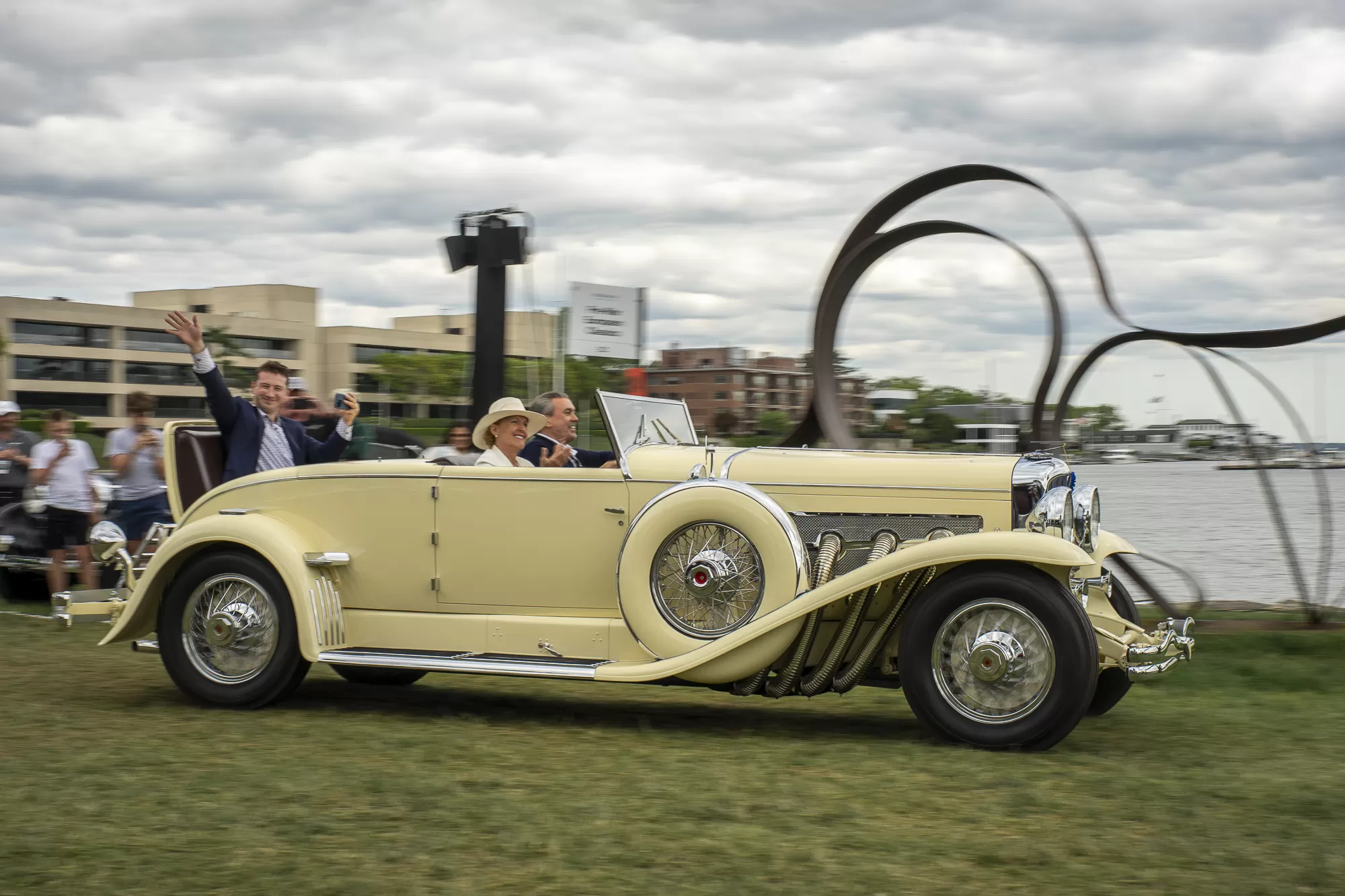 The striking profile of the 1932 Duesenberg Model J with its disappearing top, showcasing its luxurious design.
This Car’s Story
The winning car began its life in 1932, originally delivered to Duesenberg’s Los Angeles branch. After not selling there, it went to New York City, where it was purchased by JWY Martin of Maryland. It changed hands several times over the decades, receiving a red paint job in 1962. A significant restoration in the 1970s added a factory supercharger and side-exit exhaust sourced from another Model J.
Later owners included General William “Bill” Lyons. In 2012, Terry Adderly acquired the car and undertook a four-year restoration, during which it received its current elegant cream color.
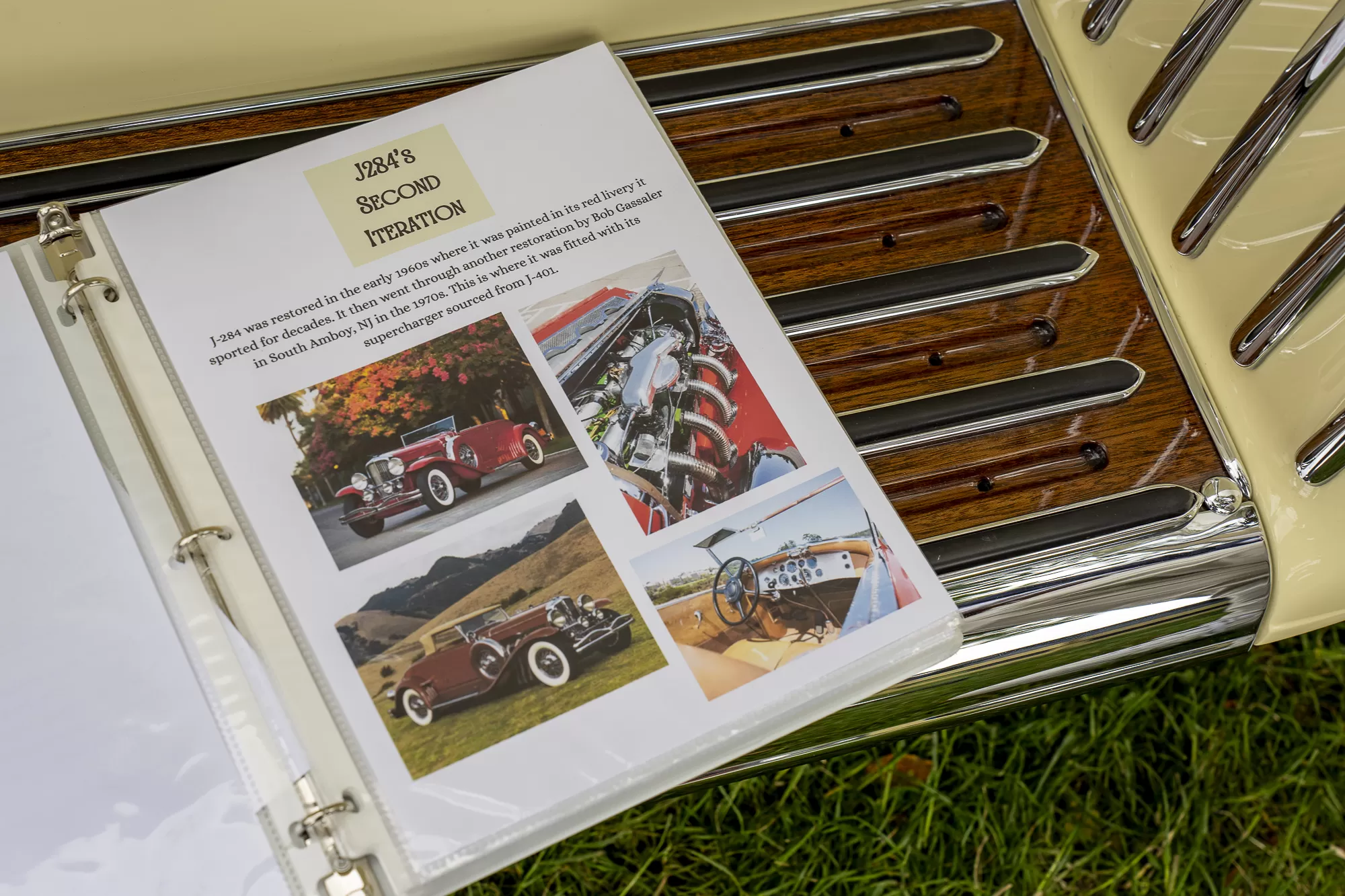 Historical documentation and paperwork detailing the journey of the 1932 Duesenberg Model J through its ownership history.
Maoli bought the car about three years ago. According to the car’s build book, he’s a passionate enthusiast who enjoys driving it regularly, not just displaying it. His collection manager, Kevin Nickiel, notes that Maoli often drives the car to shows if they are within a reasonable distance.
Nickiel’s enthusiasm is palpable, even among a collection of pristine classics. He considers Duesenbergs peerless: “They were the fastest, most expensive, most powerful vehicles of the time. As far as I’m concerned, none of the European automakers could tie Duesenberg’s shoes.”
At the Greenwich Concours, this 1932 Duesenberg Model J certainly proved him right, standing out as a true icon of automotive history and engineering excellence.
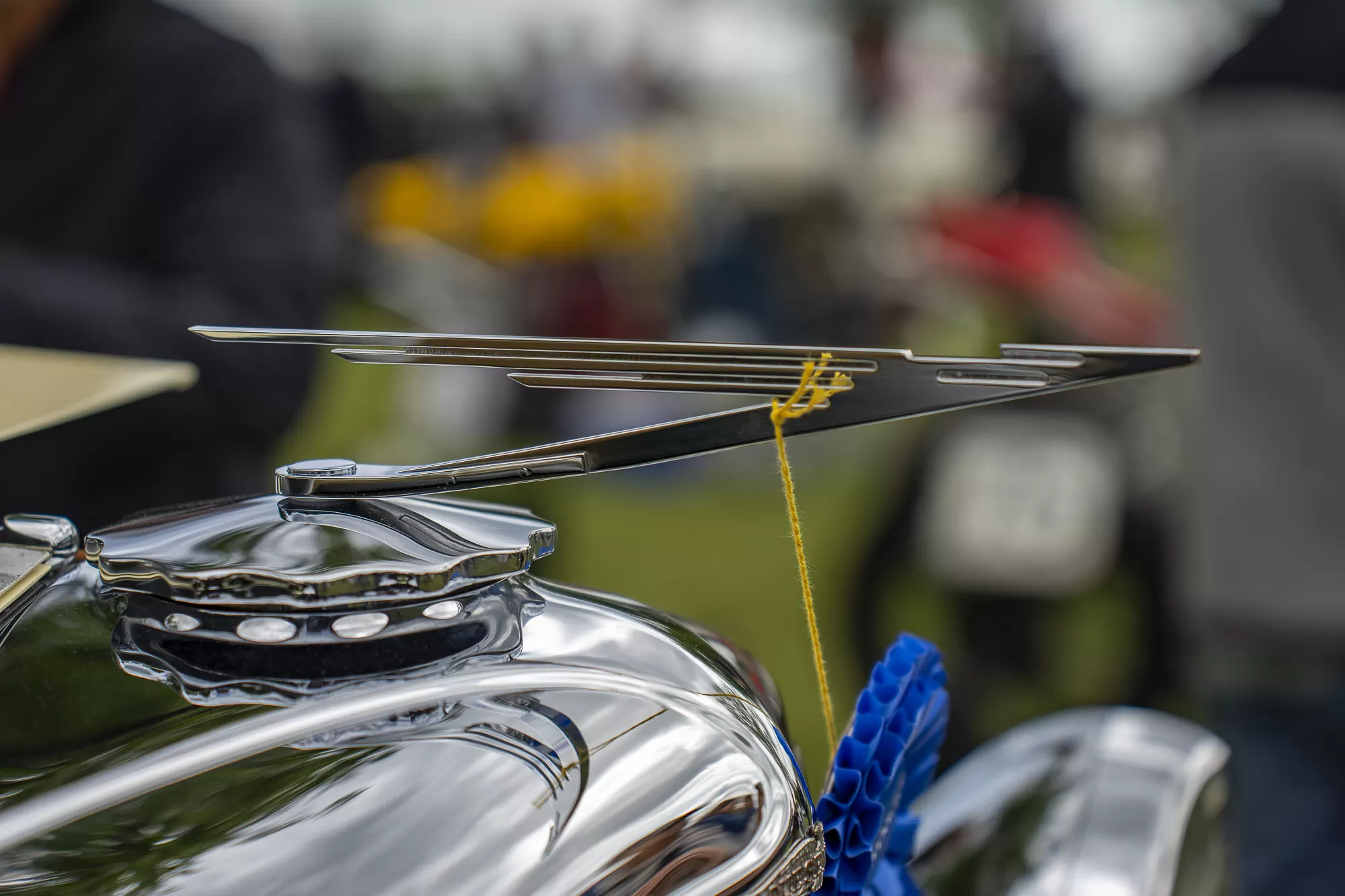 The beautifully restored 1932 Duesenberg Model J in its cream livery, ready for show or a spirited drive.