Get ready, skygazers! A “moderate” geomagnetic storm is currently impacting Earth’s magnetic field, and that means the stunning Northern Lights (auroras) could become visible in parts of the United States much further south than usual, potentially across up to 18 states.
Contents
This space weather event began on Friday, June 13th, and is expected to continue through Sunday or perhaps into Monday, June 16th. While classified as a G2 (moderate) storm, there’s a chance it could escalate to a G3 (strong) over the weekend. This forecast offers an exciting opportunity for many to witness the usually elusive auroras without traveling to polar regions.
What Exactly is a Geomagnetic Storm?
Think of Earth like a giant magnet with its own protective bubble – that’s our magnetic field, or magnetosphere. Geomagnetic storms are essentially big disturbances to this bubble. They happen when energetic material from the sun slams into our magnetosphere.
Most often, these disturbances are caused by massive explosions on the sun called coronal mass ejections (CMEs), which hurl huge clouds of charged particles into space. However, this particular storm has a different trigger.
Why This Storm is Happening Now
Instead of a CME, this storm is caused by something called a “co-rotating interaction region.” This happens when a fast-moving stream of solar wind catches up to and collides with slower solar wind ahead of it, creating turbulence. This high-speed stream originated from a large “coronal hole” on the sun’s surface – essentially a region where the sun’s magnetic field lines open up, allowing solar wind to escape faster than usual.
What Does This Mean for You?
The most exciting effect for most people is the potential for seeing auroras! When the sun’s particles hit Earth’s magnetic field during a storm, they excite atoms in our atmosphere, causing them to glow in those beautiful greens, pinks, and purples we know as the Northern (or Southern) Lights. Stronger storms push the aurora oval further from the poles, making them visible at lower latitudes.
While severe storms can impact technology like power grids or satellites, a G2 or even G3 storm is unlikely to cause widespread problems. You might hear about temporary glitches or minor disruptions, but major issues are rare at this level. It’s nothing like the powerful G5 storm we experienced back in May 2024, which was truly exceptional and caused some interesting side effects, like affecting GPS signals used by farm equipment.
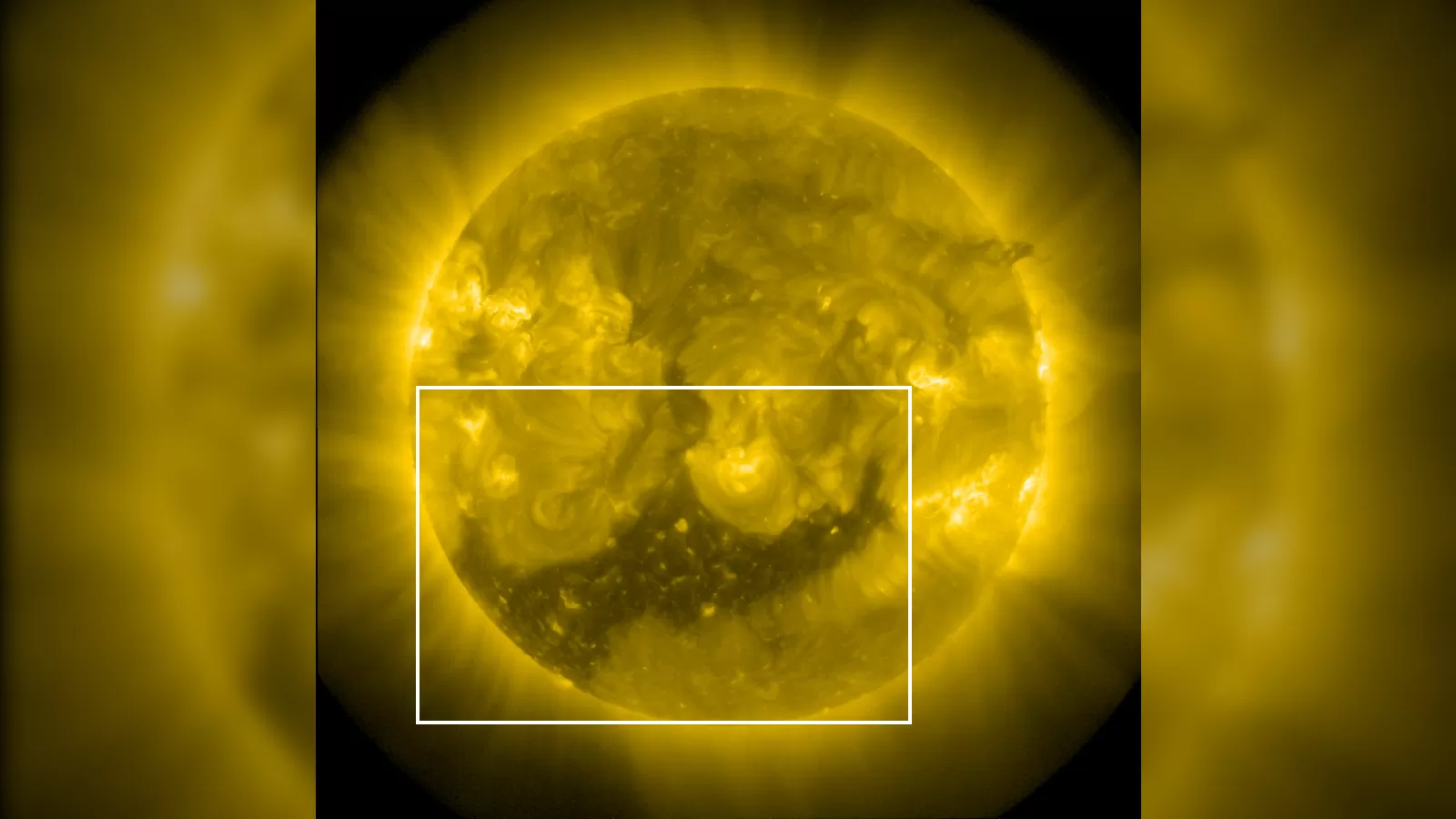 The sun showing a large dark region known as a coronal hole in its southern hemisphere.
This image shows the sun with a prominent coronal hole in its southern hemisphere. This type of feature is the source of the fast solar wind stream causing the current geomagnetic storm.
Where Might You See the Auroras This Weekend?
Based on the current forecast, the auroras could potentially be visible across a wide band of the northern United States. The 18 states identified as having the best chance include:
- Alaska
- Montana
- North Dakota
- Minnesota
- Wisconsin
- Michigan
- South Dakota
- Maine
- Vermont
- New Hampshire
- Idaho
- Washington
- Oregon
- New York
- Massachusetts
- Connecticut
- Rhode Island
- Wyoming
People in the U.K. and parts of Europe might also have a chance to see the display. Keep in mind that viewing depends heavily on local conditions – clear skies are essential, and avoiding areas with significant light pollution will dramatically improve your chances. Check local weather forecasts and dedicated aurora prediction websites for the best times to look up.
Space Weather Lately: What’s Going On?
The sun has been particularly active over the past couple of years. We are currently in a period known as solar maximum, which is the peak of the sun’s roughly 11-year cycle of activity. During solar maximum, the sun’s magnetic field gets more chaotic, leading to more sunspots, solar flares, and CMEs.
While the peak of solar maximum might be starting to pass, solar activity can remain high for some time. The recent extreme G5 storm in May 2024 was a prime example of how powerful these events can be, producing auroras visible across much of the globe and causing temporary tech impacts. This current G2 storm is a much milder event by comparison, but still strong enough to bring the wonder of the Northern Lights to potentially millions of people.
Get Ready to Look Up
A moderate geomagnetic storm is active this weekend, increasing the chances of seeing the Northern Lights across many northern US states and parts of Europe. While not as intense as some recent events, it offers a fantastic opportunity for a natural light show. Find a spot away from city lights, hope for clear skies, and enjoy the spectacle!
Want to learn more about space weather or auroras? Explore our other articles on solar activity and its effects on Earth.