Imagine not just living longer, but staying active and healthy well into your later years. Scientists are constantly researching ways to combat aging, and a recent study from Europe has revealed exciting results from a combination of two existing drugs. Tested on mice, this drug cocktail didn’t just add time to their lives – it also significantly improved their health as they aged.
Contents
Here’s the scoop: Researchers saw an average lifespan boost of around 30 percent in mice treated with a specific mix of drugs. More importantly, these animals showed signs of delaying age-related problems like chronic inflammation and even delayed the start of cancer. While this isn’t a magic pill for humans yet, the findings offer a compelling look at potential strategies for improving our “healthspan” – the period of life spent in good health.
The Drugs Behind the Breakthrough
The two main players in this study are rapamycin and trametinib. If those names sound familiar, it’s because both are already used in medicine today, primarily for treating different types of cancer. Rapamycin is also used to prevent organ rejection in transplant patients and has previously hinted at life-extending potential in various animal tests. Trametinib has also shown promise, extending the lifespan of fruit flies, but its effects on larger animals were less known until now.
A team led by scientists at the Max Planck Institute in Germany decided to explore the effects of these drugs, both individually and together, on the lifespan of mice.
Testing the Combo: What the Mice Revealed
The study involved feeding hundreds of mice regular doses of either rapamycin, trametinib, or a combination of both, starting when the mice were six months old (roughly equivalent to early adulthood in humans). They then tracked how long the mice lived.
As expected from earlier studies, rapamycin alone nudged up mouse lifespan by about 17 to 18 percent. Trametinib also added time, boosting longevity by 7 to 16 percent. But the real excitement came when the drugs were combined: the treated mice saw a significant increase in lifespan, ranging from about 26 to 35 percent compared to untreated control mice.
For a clearer picture, median lifespans increased by nearly 35 percent in female mice and over 27 percent in males with the combined treatment. Maximum lifespans also saw similar impressive gains.
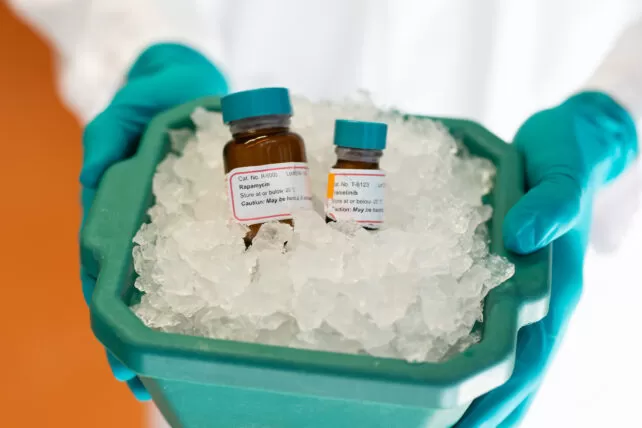 Illustration showing the concept of extending healthy aging through drug treatment
More Than Just Extra Years: Improved Healthspan
Crucially, the added years weren’t spent in poor health. The combination treatment actively delayed age-related decline. The mice treated with the drug cocktail showed less chronic inflammation in key areas like the brain, kidneys, spleen, and muscles. They also had a delayed onset of liver and spleen tumors, suggesting the treatment could help push back the development of cancer.
The treated animals appeared more active as they aged, maintained lower body weight, and experienced a slower decline in heart function compared to their counterparts who didn’t receive the drugs. This focus on improving the quality of later life – extending healthspan – is perhaps the most significant takeaway for future human applications.
Why Does This Combination Work?
Scientists believe the combined power comes from the fact that while both drugs affect the same critical signaling pathway (called the Ras/Insulin/TOR network), they hit different points within it. This targeted approach seems to create unique changes in gene expression that aren’t seen when either drug is used alone, leading to a more profound anti-aging effect.
Importantly, the researchers found no new or unexpected side effects when combining the drugs beyond those already known for each medication on its own.
What This Means for Humans
It’s vital to remember that results in mice don’t directly translate to humans, and we’re not about to start popping these pills to live to 130. As geneticist Linda Partridge, co-senior author of the study, notes, the immediate goal isn’t necessarily to make humans live dramatically longer, but rather to help people “stay healthy and disease-free for longer late in life.”
The good news is that both rapamycin and trametinib are already approved for use in humans in the US and European Union for other conditions. This significantly speeds up the possibility of future human trials specifically testing their effects on aging and healthspan. Previous human studies have already hinted at anti-aging benefits from one of the drugs; for example, rapamycin recently seemed to extend the fertility of perimenopausal women by several years in one study.
This promising mouse study, published in the journal Nature Aging, adds another piece to the complex puzzle of aging and highlights the potential of drug combinations to help us not just live longer, but live better in our later years.
Want to learn more about extending lifespan and health? Check out these related articles on experimental drug cocktails and the latest research on cancer treatments.