We all look up at the moon, our familiar companion in the sky. But the Full Moon is more than just a bright circle. From ancient calendars to special events like Supermoons, our lunar neighbor holds some surprising secrets and a rich history woven into its phases and appearance.
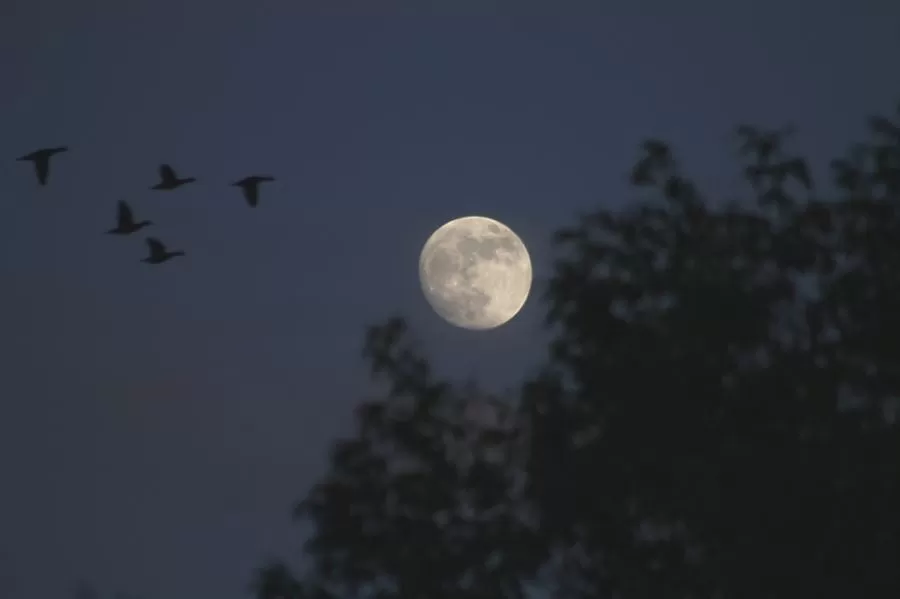 Full Moon in the night sky with geese flying past
Understanding the Moon’s Changing Look
You might notice the moon looks different each night. That’s because as it orbits Earth over about 29.5 days, we see varying amounts of the sunlit side. These are the lunar phases.
When the moon is just a sliver (crescent) or half-lit, you can see amazing details like craters and mountains near the ‘terminator’ – that’s the dividing line between the lit and dark parts. The long shadows cast by the low-angle sunlight here really make the lunar landscape pop when viewed through a telescope or binoculars.
But when the moon is ‘full’ – fully illuminated by the sun from our perspective – it appears perfectly round and flat. While undeniably beautiful, this bright, shadowless view actually makes it harder to see those fine details with a telescope. It’s less like a detailed map showing topography and more like a dazzling, two-dimensional disk with faint marks.
The Rich History Behind Full Moon Names
For centuries, people have tracked time and seasons using the moon. Many cultures, including early Native American tribes, gave unique names to each month’s Full Moon, often reflecting seasonal changes or what was happening in nature at that time of year.
These traditional names, like those recorded in the Farmer’s Almanac, offer a fascinating peek into how past societies connected with the natural world and the lunar cycle.
Here are some of the most common names you might hear for each month’s Full Moon:
- January: The Full Wolf Moon
- February: The Full Snow Moon
- March: The Full Worm Moon
- April: The Full Pink Moon
- May: The Full Flower Moon
- June: The Full Strawberry Moon
- July: The Full Buck Moon
- August: The Full Sturgeon Moon
- September: The Full Corn or Harvest Moon
- October: The Full Hunter’s Moon
- November: The Full Beaver Moon
- December: The Full Cold Moon
Beyond the Ordinary: Blue Moons and Supermoons
Sometimes, special circumstances give the Full Moon unique labels:
Blue Moon: This isn’t about color! A Blue Moon is simply the term for the second Full Moon that occurs within a single calendar month. Because the lunar cycle is about 29.5 days, slightly shorter than most months, occasionally a month will start with a Full Moon and have another one just before it ends. This happens roughly every two to three years, making it a relatively rare event.
Supermoon: Coined by an astrologer in 1979, the term Supermoon refers to a Full Moon that happens when the moon is also at its closest point to Earth in its orbit. The moon’s path around Earth isn’t a perfect circle; it’s slightly oval (elliptical). This means the moon’s distance from us varies. When the Full Moon phase lines up with the point in its orbit where it’s nearest to Earth, it appears noticeably larger and brighter in our sky – up to 14% bigger and 30% brighter than when a Full Moon occurs at its farthest point.
 Close-up view of the moon's surface showing craters and dark areas
Why We Always See the Same Side of the Moon
Have you ever wondered why you never see the ‘dark side of the moon’? That’s because the moon is ‘tidally locked’ with Earth. This means it rotates on its axis at the exact same speed it orbits us. From our perspective, the same side is always facing us. This is why people hundreds or even thousands of years ago saw the exact same lunar landscape we do today! (Note: The far side isn’t always dark; it gets just as much sunlight over its cycle, we just never see that illumination from Earth).
So the next time you gaze up at the sky, especially during a Full Moon, remember there’s a lot more going on than just a bright disk. Each Full Moon has a story or a scientific explanation behind it, connecting us to history, seasonal changes, and the fascinating mechanics of our solar system. It’s a reminder that even the most familiar sight can hold fascinating secrets.