Imagine downloading the entire Netflix library – every movie, every show – not once, but 30 times over. Now imagine doing that in just one second. That’s the kind of mind-blowing speed a team of researchers in Japan just achieved using a single optical fiber no thicker than a strand of human hair.
Contents
This isn’t just a lab experiment; it’s a giant leap for how data travels across the globe. Scientists at Japan’s National Institute of Information and Communications Technology (NICT) and Sumitomo Electric Industries have broken previous limitations, transmitting data at an incredible 1.02 petabits per second over a distance of 1,808 kilometers. The best part? Their new fiber is designed to plug right into the internet infrastructure we already have.
The Breakthrough: More Lanes on the Data Highway
The secret sauce is a new type of optical fiber with 19 individual cores instead of the single core found in traditional fibers. Think of each core as a separate lane on a highway. Instead of a one-lane road, this new fiber is a 19-lane superhighway packed into the same tiny space (it still has the standard 0.125 mm diameter).
This design lets data travel through 19 independent paths simultaneously within a single cable. Previous multi-core fibers often struggled with interference or only worked over short distances or specific frequencies. This new 19-core design is smarter. It uses a refined arrangement of cores that dramatically cuts down on signal loss – about 40% less compared to older multi-core designs. Plus, it works perfectly with standard commercial frequency bands (called C and L bands) used worldwide, making it much more practical.
 Concept image illustrating the structure of the new 19-core optical fiber
Going the Distance: Simulating a Trans-Continental Journey
To prove this fiber could handle long distances, the researchers set up a complex experiment. They sent signals through an 86.1-kilometer length of the fiber 21 times, creating a loop that simulated a total journey of 1,808 kilometers. This is roughly the distance from Berlin to Naples or across Japan from Sapporo to Fukuoka – a serious long haul for data!
Keeping signals strong and clear over such a distance required some clever tech. They used a special system of amplifiers that boosted the signals in both the C and L frequency bands separately. This allowed them to send 180 different wavelengths of light at the same time, each carrying data. They also used a technique called 16QAM modulation, which is like packing more information into each blink of light sent down the fiber.
Making Sense of the Chaos: Advanced Processing
At the receiving end, things get even more complex. Imagine trying to understand 19 different conversations happening simultaneously in a crowded room. That’s kind of what happens with data traveling through multiple cores; signals can interfere with each other.
To untangle this, the researchers used a special 19-channel detector paired with sophisticated processing technology known as MIMO (multiple-input multiple-output). You might have heard of MIMO in your Wi-Fi router; it helps manage multiple signals. In this case, the MIMO processing dissected the interference between the 19 cores. A digital signal processor, using algorithms refined over years, extracted the usable data at incredibly high speeds while also correcting for any distortion accumulated over the 1,808 km trip.
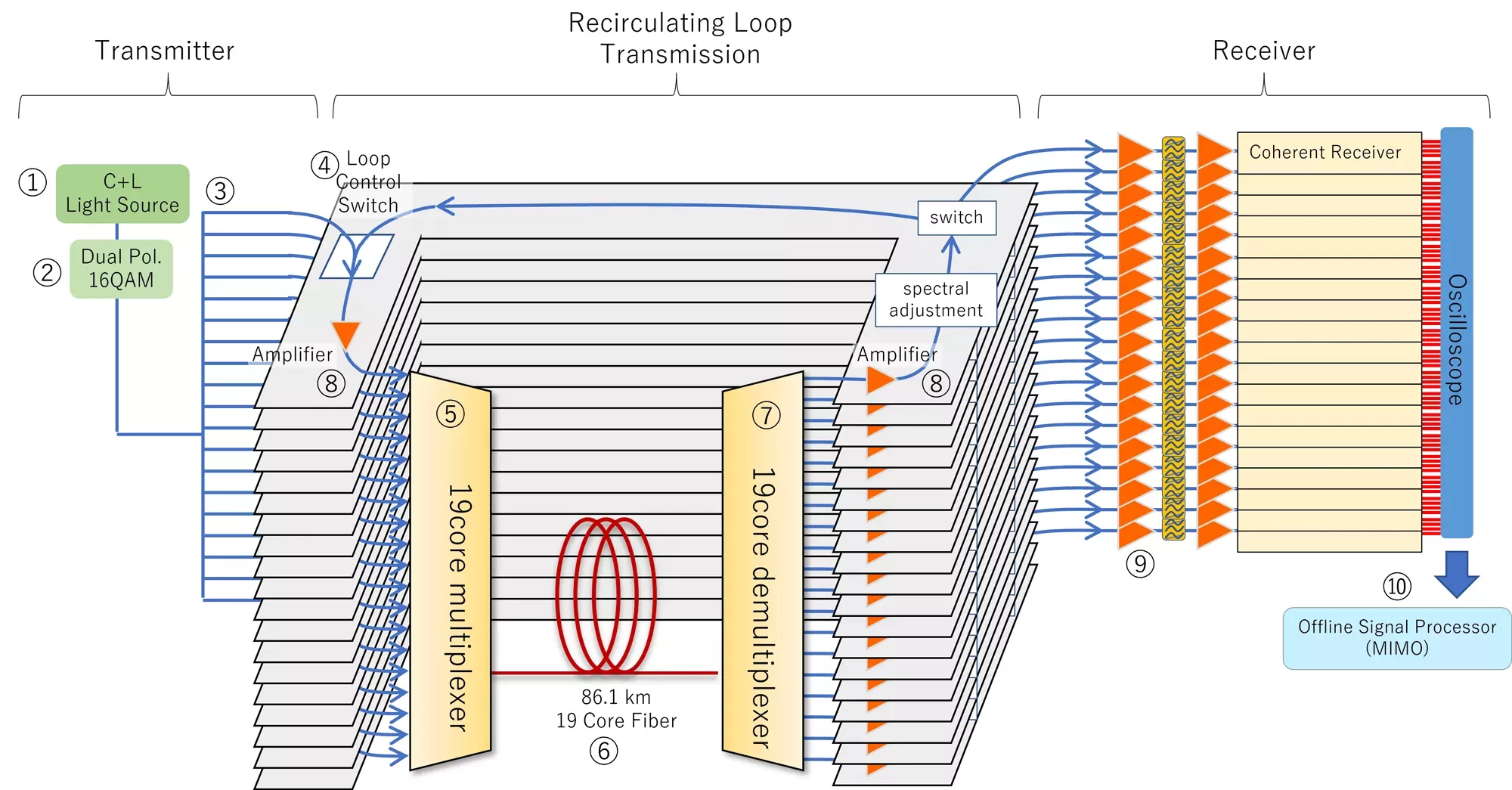 Schematic diagram illustrating the experimental fiber optic data transmission system
Why This Matters for Our Future
This achievement builds on years of research. While even faster speeds have been achieved in the past (like 1.7 petabits per second), they were only over much shorter distances (just 63.5 km). Other efforts covering longer distances used less standard technology or struggled with signal quality.
This new 19-core fiber strikes a crucial balance: incredibly high capacity (1.02 petabits/sec) over a substantial distance (1,808 km) using standard fiber dimensions and frequencies. This gives it a capacity-distance product that’s 14 times higher than previous records for standard fibers – a significant leap forward.
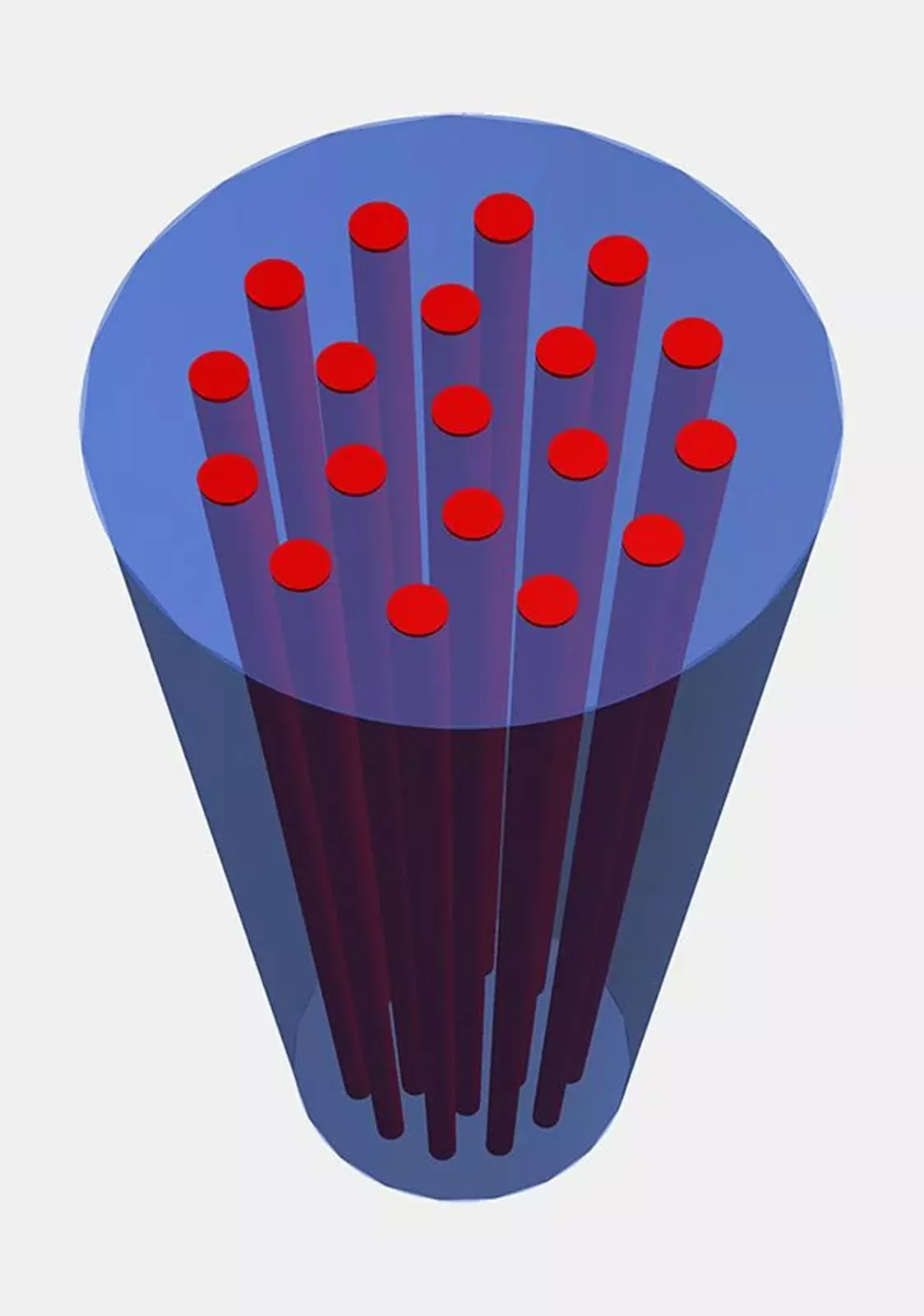 Image diagram showing the cross-section and layout of the 19-core optical fiber
This breakthrough comes at a critical time. Global data traffic is exploding and is expected to triple by 2030. Technologies like 6G mobile networks, AI, and quantum computing will require unprecedented amounts of data transfer.
The Road Ahead
While more work is needed, such as refining the signal amplifiers and making the complex processing more efficient for large-scale networks, this technology offers a realistic pathway to petabit-scale internet speeds.
The good news is that Sumitomo Electric, who designed the fiber, says their existing manufacturing equipment can be adapted to produce this new 19-core design without massive retooling. This hints that mass production might be more feasible than with some other experimental fibers. Meanwhile, the NICT team is exploring using AI to further boost speeds.
Ultimately, this isn’t just about faster downloads on your home connection (though that’s a nice thought!). It’s about upgrading the literal backbone of the internet. This new fiber technology could enable transoceanic cables that move astonishing amounts of data, potentially the equivalent of an entire data center’s information every hour. It positions fiber optics to be the central nervous system for the hyperconnected world of tomorrow.
Want to learn more about the future of internet speed and data transfer? Explore related research on 6G networks and advancements in data center technology.