Get ready for a massive leap in how your devices connect to your screens. HDMI 2.2 has officially been finalized, bringing a huge boost in bandwidth and new features designed to deliver even more stunning visuals and better audio synchronization. This new standard is set to redefine high-resolution gaming and cinematic experiences.
Contents
HDMI 2.2 doubles the maximum data transfer rate compared to the previous HDMI 2.1, jumping from 48 Gigabits per second (Gbps) all the way up to 96 Gbps. This gives it a significant lead even over the 80 Gbps offered by DisplayPort 2.1. What does all that speed mean for you? Think incredibly smooth motion and incredibly sharp detail on your future monitors and TVs.
What Can 96 Gbps Bandwidth Do?
The jump to 96 Gbps unlocks some truly impressive possibilities for resolution and refresh rates. With HDMI 2.2, you’ll be able to:
- Experience 4K resolution at a buttery-smooth 240Hz refresh rate. This is fantastic news for serious gamers who demand the absolute fastest response times and fluid visuals.
- Run 8K resolution at 60Hz, displaying pictures with incredible clarity and detail.
- Push boundaries even further with features like Display Stream Compression (DSC). Using DSC, HDMI 2.2 can support resolutions up to a staggering 12K at 120Hz or even 16K at 60Hz. While these resolutions might seem far off for most people, they show the future-proofing power of the standard.
This increased bandwidth also supports deep color depths up to 12 bits, ensuring richer, more accurate colors, especially important for HDR content.
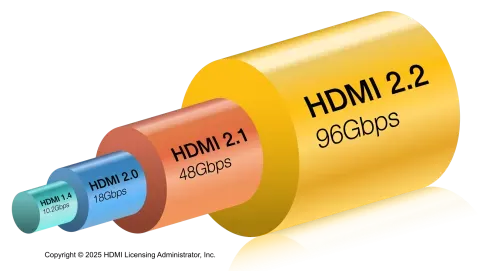 Diagram illustrating the increased bandwidth of HDMI 2.2 (96 Gbps) compared to HDMI 2.1 (48 Gbps) and DisplayPort 2.1 (80 Gbps), showing the doubling of speed.
Introducing Ultra96 Cables: A Solution to Past Headaches
With great bandwidth comes the need for great cables. To handle the full 96 Gbps speed and take advantage of HDMI 2.2’s best features, you’ll need new cables specifically designed for the standard. These are being introduced as Ultra96 cables.
One major point of frustration with the HDMI 2.1 rollout was cables being sold that didn’t actually meet the standard’s specifications. The HDMI Forum is tackling this head-on with Ultra96 cables.
- Clear Labeling: Ultra96 cables will be clearly labeled with the name.
- Mandatory Testing: Manufacturers are required to test each individual cable.
- Official Certification: The cables will be certified by the HDMI Forum.
To give buyers peace of mind, the HDMI Forum’s labeling program will allow you to scan a QR code on the Ultra96 Certified Cable box to verify its authenticity. This is a significant step towards ensuring you get the performance you pay for.
Better Audio Sync with LIP
Beyond just picture quality and speed, HDMI 2.2 also introduces a new feature called Latency Indication Protocol (LIP). This is designed to improve audio and video synchronization, particularly in complex setups involving devices like AV receivers or soundbars.
Have you ever noticed the dialogue in a movie not quite lining up with the actors’ mouth movements? LIP aims to fix this common annoyance by providing more precise control over synchronization across multiple devices in your home theater system. It’s a small but crucial improvement for a seamless viewing and listening experience.
Backward Compatibility and Availability
Good news: HDMI 2.2 is designed to be backward compatible. This means your new Ultra96 cables will still work with devices that only have older HDMI ports (though you’ll only get the performance capabilities of the older standard). Similarly, your existing older HDMI cables will plug into new HDMI 2.2 ports, but they won’t be able to handle the full 96 Gbps bandwidth or features requiring it.
So, when can you expect to get your hands on this new tech? The first devices featuring HDMI 2.2 ports are anticipated to start arriving towards the end of 2025.
Chip makers are already working on implementing the standard. While not officially confirmed, rumors suggest AMD’s next generation of Radeon UDNA GPUs might include HDMI 2.2 support, though potentially limited to a still-impressive 80 Gbps in some configurations.
The transition to widespread adoption for HDMI standards typically takes a few years, but the improvements in speed, resolution capabilities, and the focus on reliable cables make HDMI 2.2 an exciting step forward for display technology.
Want to dive deeper into display tech? Check out our guides on understanding refresh rates or the difference between various display cables.