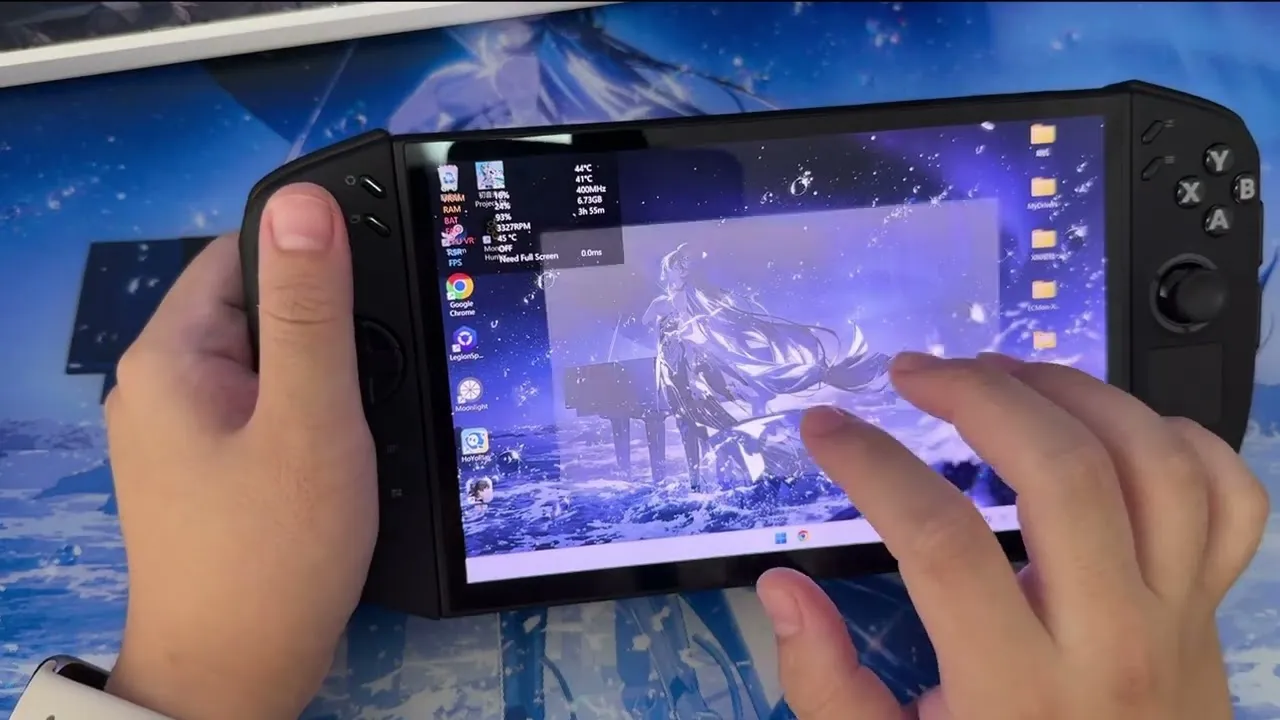
Good news for handheld PC gaming fans! The Lenovo Legion Go S, first seen with Windows, now comes natively running SteamOS. And let’s just say, swapping the operating system makes a world of difference. It transforms a good-but-clunky device into a seriously compelling handheld gaming machine, finally proving that Valve’s own OS might be the perfect fit for these portable powerhouses. Think of it as giving a powerful engine the smooth, intuitive controls it deserves.
Contents
Key Takeaways:
- The Lenovo Legion Go S now ships with SteamOS out-of-the-box.
- SteamOS offers a much smoother, controller-friendly user experience compared to Windows.
- Powered by the capable AMD Z1 Extreme chip, it boasts performance significantly exceeding the Steam Deck.
- It features a sharp 8-inch, 1200p, 120Hz display.
- While performance is great, battery life remains a challenge, similar to other high-power handhelds.
Design and What’s New
Physically, this SteamOS version of the Legion Go S is largely the same solid, all-in-one unit we saw before, unlike the original Legion Go’s detachable controllers. The most obvious external change? The color! This SteamOS model sports a slick ‘Nebula Nocturne’ purple finish that looks fantastic.
You still get the clicky back paddles and adjustable triggers (though an extra level of trigger customization would be welcome). Up top, you’ll find the power and volume buttons, plus two conveniently placed USB-C ports for charging or hooking up accessories.
The face buttons feel familiar, but there’s one major upgrade. The ‘Legion’ button has been replaced by a dedicated Steam button, just like on the Steam Deck. Pressing this instantly brings up the Steam Menu, making it super easy to exit a game or access chats without wrestling with touch controls or complex button combos. This simple change is a big win for usability.
Similarly, the quick settings button, found near the top-right of the screen, now pulls up the same easy-to-navigate panel seen on the Steam Deck. This gives you quick access to brightness, power profiles, and notifications without cluttering the screen with too many options, a common issue with some Windows handheld quick menus.
 Lenovo Legion Go S in Nebula Nocturne purple next to a Steam Deck for size comparison
Beyond the software, the screen is a big differentiator from the standard Steam Deck. While Valve offers an OLED Steam Deck with a beautiful display, its resolution is fixed at 1280×800. The Legion Go S counters with an 8-inch LCD screen boasting a sharper 1920×1200 (1200p) resolution. Even as an LCD, it’s a gorgeous panel with great colors, and the fast 120Hz refresh rate with Freesync Premium keeps things looking smooth.
Some might argue that 800p is a better match for handheld chips, but the extra resolution on the Go S really shines on its larger screen, making compatible games look stunning. You might need to dial down the resolution in newer, demanding titles, but it’s great to have the option.
The larger screen does mean a slightly bigger and heavier device than the Steam Deck – it’s about half an inch taller and 0.2 lbs heavier. That weight difference might sound small, but it becomes noticeable during longer gaming sessions.
The small, returning touchpad is still here. While it was a minor annoyance on the Windows version, I barely needed it with SteamOS. If you rely heavily on trackpads for certain games or tasks, this tiny one might be a sticking point, but for general menu navigation and typing, it’s adequate.
SteamOS Changes Everything
This is where the magic happens. The Lenovo Legion Go S is the first handheld from a different manufacturer to ship with SteamOS installed right out of the box. While technically you could install SteamOS on other devices like the Asus ROG Ally X or the original Legion Go, having it pre-loaded avoids the hassle for most people.
SteamOS was built with controllers in mind, and it shows. Booting up takes you straight into Steam’s Big Picture Mode interface. Log in, and you’re ready to play your Steam library. Compare this to the Windows version, where you boot into Lenovo’s Legion Space app and then need to navigate Windows, download Steam and other launchers (often via touch screen), sign in, and install games. That Windows layer, while familiar to PC veterans, was a barrier for many new handheld users.
 SteamOS interface on the Lenovo Legion Go S screen showing the Steam library
The smooth sailing of SteamOS does have a trade-off: it’s primarily built for Steam. Getting other game launchers like the Epic Games Store or PC Game Pass to run on the Linux-based OS requires extra tweaking and effort that many users won’t want to tackle. If access to Game Pass is a must, you might still prefer a Windows-based device, or you can always install Windows 11 on the Legion Go S yourself. Thankfully, Lenovo is now offering the Windows version with the same Z1 Extreme chip reviewed here, giving you a clear choice from the start.
Powering Up: Performance with Z1 Extreme
Under the hood, the Lenovo Legion Go S comes in two flavors: one with the AMD Z2 Go chip and the version reviewed here with the Z1 Extreme. Don’t let the names fool you; the Z1 Extreme is the far more powerful and newer chip, featuring modern Zen 4 CPU cores and RDNA 3 graphics, compared to the Z2 Go’s older Zen 3/RDNA 2 architecture.
Lenovo sent us the Z1 Extreme model, which is significantly more powerful than the processor in the standard Steam Deck, despite running the same OS. It also doubles the Steam Deck’s memory, packing 32GB of fast LPDDR5X RAM. By default, the Go S dedicates a generous 10GB of this to graphics, versus the Steam Deck’s 6GB. This extra power and memory make more demanding games much more playable on the Go S.
 Screenshot showing performance benchmark results comparing Lenovo Legion Go S and Steam Deck
While Valve hasn’t released a true “Steam Deck 2” with updated hardware yet, this Legion Go S with SteamOS feels like a peek at what that could be, performing more like a “Steam Deck 1.5”.
In synthetic tests like 3DMark, the difference is clear. The Legion Go S scored 3,433 in Time Spy, nearly double the Steam Deck’s 1,715. In Fire Strike, the gap widened further with the Go S hitting 7,865 compared to the Deck’s 4,322.
Real-world gaming performance backs this up. In a demanding title like Cyberpunk 2077, the Legion Go S managed a smooth 61 frames per second at 800p resolution with High settings and FSR on Performance, more than twice the Steam Deck’s 28 fps under the same conditions. Monster Hunter Wilds also showed a significant lead for the Go S (31 fps average) over the Steam Deck (19 fps), with the Go S experiencing fewer crippling frame drops during intense moments.
Pushing the Go S to its native 1200p resolution shows its limits, especially in the most demanding games like Monster Hunter Wilds, where average frame rates drop to around 27 fps with more noticeable stutters. This confirms that 800p is likely still the sweet spot for demanding games on a handheld. However, less intensive games like Hollow Knight run flawlessly at the full 1200p resolution, hitting a perfect 120 fps.
This performance boost is thanks to the Z1 Extreme’s larger GPU (12 cores vs. Steam Deck’s 8) and its higher power budget. While the Steam Deck typically uses up to 15W for better battery life, the Legion Go S can push up to 30W into its chip, unlocking significantly higher performance. More power means better frames, but it also impacts how long the device lasts away from a charger.
Battery Life: The Usual Handheld Challenge
Battery life remains the biggest hurdle for powerful handheld gaming PCs. While devices like the ROG Ally X are improving, you’re still looking at a couple of hours of intense gaming at most when the system is pushed hard.
The Legion Go S is no exception. It lasted a respectable 6 hours and 25 minutes in the PCMark10 battery test (which is less demanding than gaming), but real-world gaming tells a different story. Playing Baldur’s Gate 3 at full power (1200p, 30W TDP) drained the battery in about an hour and a half. You can significantly extend this by lowering the resolution or limiting the power draw, but you’ll sacrifice performance.
 Lenovo Legion Go S charging via one of its top USB-C ports
The Steam Deck, with its lower-power chip and more conservative 15W limit, did last longer in PCMark, but only by about two extra hours, while offering significantly less gaming performance.
Ultimately, battery life requires managing expectations. The Steam Deck offers better longevity for its power profile, but the Legion Go S delivers much higher performance when you need it, even if it means sticking closer to an outlet.
The Verdict
Pairing the powerful AMD Z1 Extreme chip with native SteamOS transforms the Lenovo Legion Go S. It takes the solid hardware of the Go S and gives it the seamless, controller-first software experience it deserves. While Windows handhelds offer flexibility, SteamOS simply makes the device easier and more enjoyable for playing your Steam library out of the box.
With performance that handily beats the Steam Deck and a beautiful, higher-resolution screen, the Legion Go S with SteamOS feels like a true evolution in the handheld space. It’s not perfect – the battery life is typical for this class, and the touchpad is small – but the combination of power and a native SteamOS experience makes it a compelling choice, especially for those who found Windows too fiddly on a small screen. It might just be the closest thing we have to a “Steam Deck 1.5” right now.
Want to learn more about other handheld gaming options? Check out our guide to the best handheld gaming PCs or dive into our full Asus ROG Ally X review.