Big news in the world of handheld gaming PCs! Lenovo has finally launched the SteamOS version of its Legion Go S device, and early tests suggest it blows the Windows model out of the water. If you’ve been waiting for a true competitor to Valve’s popular Steam Deck, this could be it.
Contents
What Happened?
Lenovo first showed off two versions of the Legion Go S last year: one running Windows and another with Valve’s Linux-based SteamOS. While the Windows version came out first, the SteamOS model, featuring nearly identical hardware, has just started shipping. Initial benchmarks from tech reviewer Dave2D show the SteamOS version performing noticeably better and offering significantly longer battery life.
SteamOS vs. Windows: A Performance Boost
Why the difference? It seems SteamOS is simply better optimized for handheld gaming performance on this hardware. Benchmarks show impressive gains in demanding titles.
For example, in Cyberpunk 2077, the Windows version managed around 46 frames per second (fps) on low-medium settings. The SteamOS model jumped to a much smoother 59 fps. Similarly, The Witcher 3 went from 66 fps on Windows to 76 fps on SteamOS, and Doom Eternal saw an increase from 66 fps to 75 fps. While Helldivers 2 also showed improvement, the gains were less dramatic. The only tested game where SteamOS didn’t match or beat Windows was Spider-Man 2, which saw a slight dip in frame rate.
 Chart comparing FPS performance across different games on Legion Go S (Windows), Legion Go S (SteamOS), and Steam Deck
The Battery Life Edge
Performance isn’t the only area where SteamOS shines. Battery life on the SteamOS Legion Go S is reportedly much better than on the Windows model, despite both having the same 55Wh battery.
The likely reason? Unlike Windows 11, SteamOS has fewer background tasks constantly running and doesn’t collect as much telemetry data. Plus, SteamOS is known for its highly optimized sleep and suspend functions, which work much better for quick pick-up-and-play gaming sessions on a handheld device.
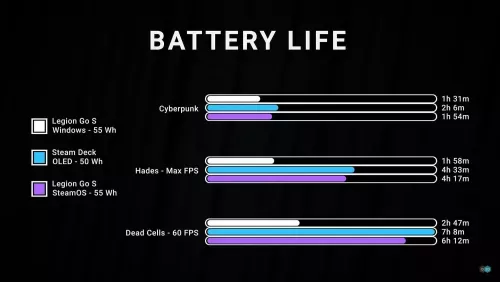 Chart comparing battery life on Legion Go S (Windows), Legion Go S (SteamOS), and other devices
Stepping Up to Challenge the Steam Deck
The SteamOS Legion Go S also offers a performance edge over the original Steam Deck in most games tested. It’s worth noting, though, that the Lenovo device uses significantly more power to achieve these higher frame rates, potentially drawing up to 40 watts when plugged in compared to the Steam Deck’s 15 watts limit.
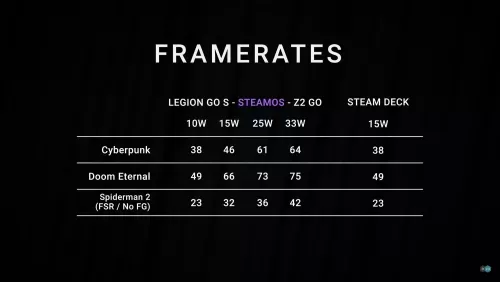 Chart comparing power draw and wattage across different handheld gaming PCs including Legion Go S models and Steam Deck
These early results support the idea that Windows was limiting the Legion Go S’s potential. With the SteamOS version now hitting the market, Lenovo officially has a strong contender ready to challenge the Steam Deck’s dominance.
Price Check: Why SteamOS is Easier on Your Wallet
Beyond performance and battery life, the SteamOS version also has an advantage in price. The Windows-powered Legion Go S typically costs over $700. In contrast, the SteamOS model is currently listed at a more accessible $600 at Best Buy.
While we’ll need to see full, in-depth reviews, early benchmarks strongly suggest that if you’re interested in a Lenovo gaming handheld, the SteamOS Legion Go S is clearly the version to consider.
Conclusion
The arrival of the Lenovo Legion Go S with SteamOS is a big moment for handheld gaming. It offers better performance, significantly improved battery life, and a lower price tag compared to its Windows counterpart, positioning it as a serious challenger to the Steam Deck. If you’re looking for a powerful new way to game on the go, this new SteamOS option is definitely worth checking out.
Want to learn more about handheld PCs or Valve’s Steam Deck? Explore our related coverage.