
Indoor cycling has come a long way, but most smart bikes keep you bolted in place. The Muov Smart Bike aims to change that by adding realistic movement, going beyond simple rocker plates to mimic how a real bike leans and steers. After spending considerable time with different versions, the latest production model is now shipping, bringing a unique dynamic to your virtual rides. If you’re looking for a premium indoor experience that feels more like riding outdoors, the Muov bike’s movement system is its biggest differentiator.
Contents
 Muov Smart Bike set up in an indoor training space.
Key Takeaways:
- Unique Movement: Mimics real bike lean and handlebar twist, unlike typical rocker plates.
- Premium & Custom: Built in the UK with a carbon fiber frame, offering custom paint options.
- Strong Performance: Accurate power, responsive resistance, and fast data transmission (30Hz).
- Feature Rich: Includes integrated Zwift control buttons and useful USB-C ports.
- High Price Tag: Positioned at the top end of the smart bike market (£4,995).
Let’s dive into what makes the Muov bike stand out.
What Sets the Muov Bike Apart?
The most obvious feature is the bike’s ability to move. While accessories like rocker plates have been around for years, they usually just tilt the whole bike side-to-side or allow some front/back slide. The Muov bike is different because the frame itself leans, and crucially, the handlebars twist in conjunction with that lean, more closely simulating the feel of steering a real bike by shifting your weight.
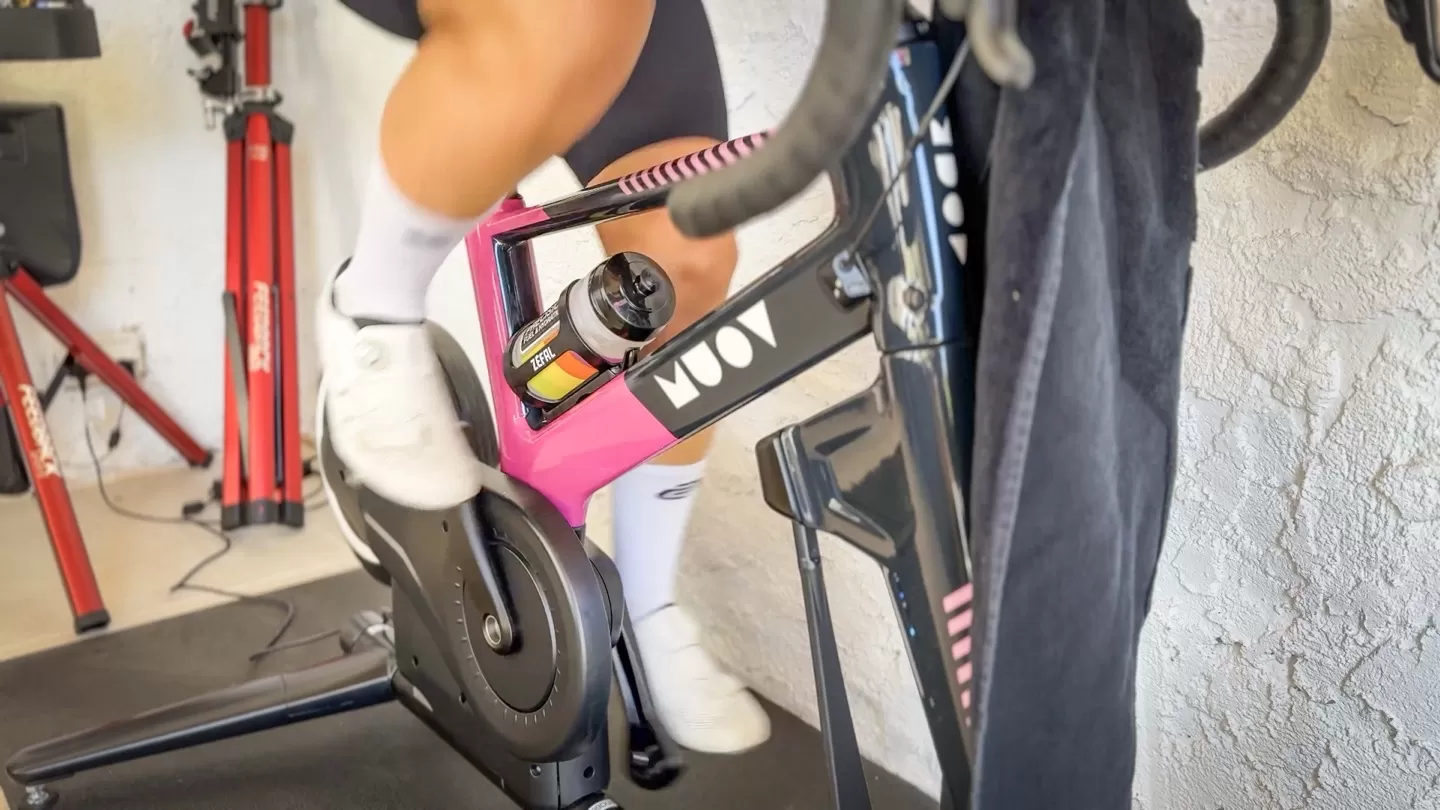 Close-up view of the Muov Smart Bike handlebars, shifters, and USB-C charging ports.
Beyond the movement, Muov emphasizes its high-end smart bike aspects. This means quality construction, with the frame made from carbon fiber and much of the product sourced and manufactured in the UK. It’s a premium product with a premium price, sitting above many competitors.
Understanding the Bike’s Hardware
The Muov bike is essentially two parts: a solid base and a detachable bike frame. This design is clever because it allows you to swap out frames of different sizes easily – useful if multiple riders in a household need different bike fits. Swapping takes under a minute.
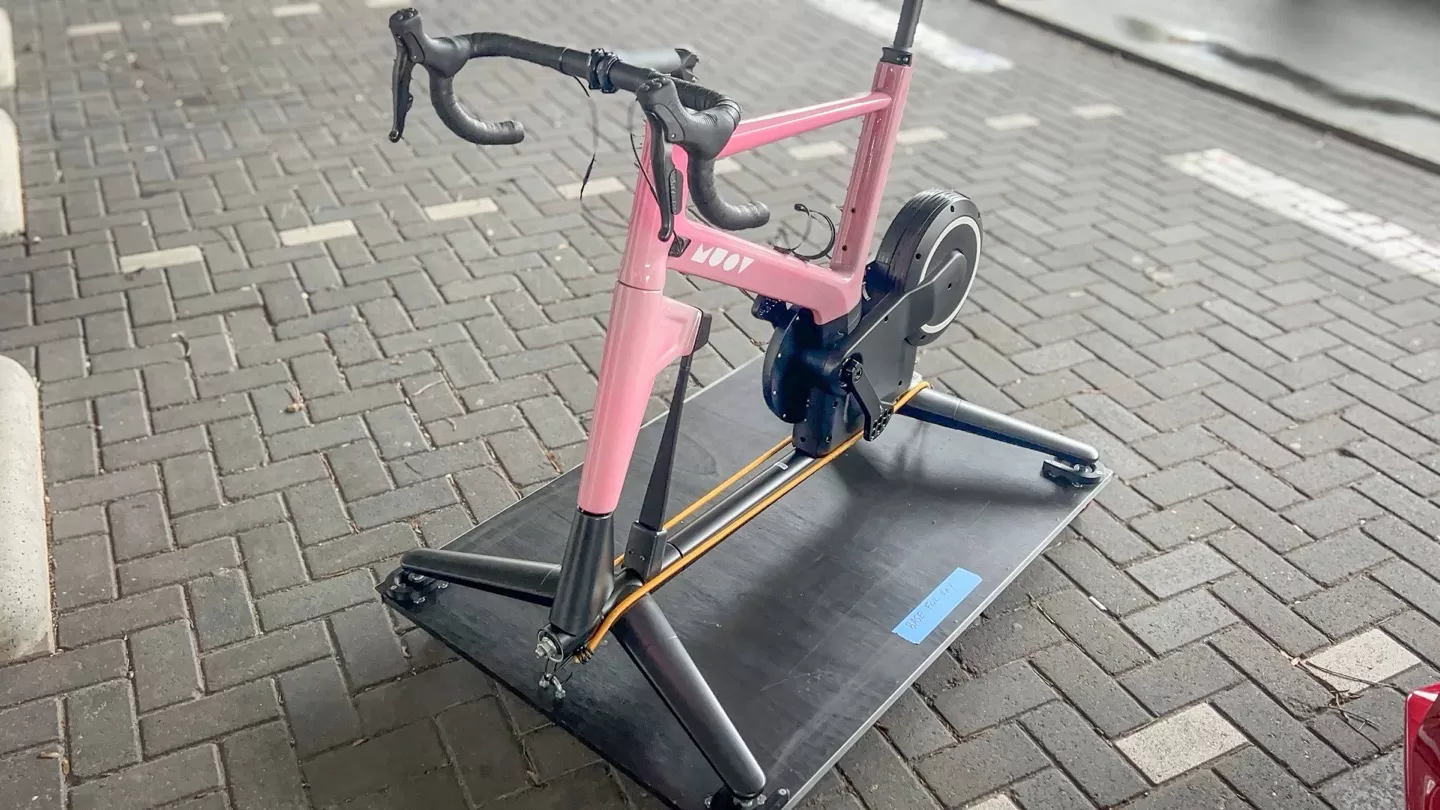 Muov staff assembling the premium indoor smart bike during initial setup.
Initial bikes are even delivered and set up by Muov staff in the UK. When shipped via courier, it comes in two boxes: one for the lighter frame and one for the heavier base.
 The Muov Smart Bike in full view, highlighting its carbon fiber frame and base.
The base houses the flywheel and electronics. The crankset attaches to the base and features a ‘bear-claw’ design, letting you quickly choose from several crank arm lengths (150mm to 175mm). This is great for individual riders but means you’ll need to manually change the pedal position if different users need vastly different crank lengths.
 Bear-claw crankset on the Muov Smart Bike, allowing for multiple crank arm length adjustments.
Around the back of the base, you’ll find the power connection (with a hefty power brick) and an Ethernet port, though the Ethernet isn’t active yet. There’s also a very bright LED status light that can be seen across the room.
 Rear view of the Muov Smart Bike base, showing power port and ethernet port.
 Ethernet port and bright LED status light on the Muov Smart Bike base unit.
A small knob on the base lets you release the frame. Rotating it allows the base unit to slide back, detaching from the frame. This adjustable connection point is smart, accommodating frames of different sizes.
 Knob used to detach the Muov Smart Bike frame from the base for swapping.
At the front, the frame connects to the base via a unique ‘fork’ system. This two-piece design is key to the movement, allowing the frame to rotate (lean) while a secondary band acts as a stabilizer. Twisting the handlebars shows this system in action, with the rear piece counter-rotating like an elbow.
 Close-up of the Muov Smart Bike's unique dual fork system for movement simulation.
 The Muov Smart Bike's front mechanism demonstrating the leaning and steering movement.
The handlebars are a standard size, meaning you could potentially swap them out. The crucial electronics are in the shifter units.
 Handlebars and electronic shifters on the Muov Smart Bike with integrated control buttons.
Above the shifters are extra buttons designed to integrate with apps like Zwift, similar to Zwift Play controllers. These let you control things like in-game menus, Power Ups, and U-turns. This adds a layer of interaction beyond just pedaling.
 Detailed view of the multi-function buttons on the Muov Smart Bike shifters for app control.
Shifting itself uses real paddle shifters, currently mimicking Shimano Di2 style, with SRAM style coming in a future update.
 Paddle shifter view on the Muov Smart Bike's right side.
Near the front of the frame, you’ll find two 20W USB-C ports, one on each side. These are handy for charging your phone or tablet while you ride – a nice touch not found on most smart bikes.
 Dual 20W USB-C charging ports located near the handlebars on the Muov Smart Bike.
Sizing is handled primarily through the frame size (Small, Medium, Large, covering riders from 5’0″ to 6’7″) and adjustable components like the stem and seatpost. The stem is a standard size, allowing for easy swapping, but unlike some smart bikes, stem height/reach isn’t quickly adjustable for different riders on the same frame. The seatpost uses standard saddle rails and is height adjustable with bolts under a rubber cover.
 Standard bike stem and handlebar attachment point on the Muov Smart Bike for custom fitting.
 Selle Italia saddle and adjustable seat post on the Muov Smart Bike.
Finally, the bike is impressively quiet during use, making it a good neighbor for anyone else in the house.
Connectivity and App Integration
The Muov bike connects to training apps mainly via Bluetooth, supporting the standard Bluetooth Smart FTMS protocol (for power, control, cadence) and the specific Zwift Protocol (adding steering and button controls). WiFi connectivity is planned for a future update.
 Screenshot showing Bluetooth connectivity options for the Muov Smart Bike on a device screen.
In Zwift, this means you get full steering control just by leaning the bike, plus the added button functions for interacting with the game. The virtual gear display also works straight away, which surprisingly isn’t common for new smart bikes.
 Zwift pairing screen interface showing the Muov Smart Bike connected for power, control, and steering.
One current limitation is the lack of ANT+ support and a ‘clean’ Bluetooth power data stream (separate from the control signal). This means some older bike computers or watches might not be able to record your power data directly from the bike for training analysis, though Muov says adding the clean Bluetooth feed should be straightforward in a future update. ANT+ seems less of a priority for now.
Ride Feel and That Movement
The movement is the headline feature. It’s designed to feel like your bike is leaning beneath you while the handlebars turn naturally with that lean. This is different from flat rocker plates and is arguably the closest simulation yet to how a road bike moves when you steer.
 The Muov Smart Bike demonstrating its unique leaning movement simulation.
 Side view of the Muov Smart Bike showing the lean mechanism in action.
Initially, the movement might feel a bit wobbly, but Muov has adjusted the tension in production units, and over time, it starts to feel quite natural. It provides just enough subtle sway during normal riding to feel less static than a fixed bike, and allows for bigger leans when you sprint or want to steer in Zwift.
 Four-panel view showing slight natural sway during relaxed riding on the Muov Smart Bike.
You’re not constantly rocking the bike wildly; the movement is subtle during steady riding, becoming more pronounced only when you intentionally lean, sprint, or stand up.
 Quad-camera perspective illustrating the lean angle during a simulated sprint on the Muov Smart Bike.
 Muov Smart Bike shown at maximum lean angle in a multi-camera layout.
The bike has a very wide base, making it feel incredibly stable. You’d be hard-pressed to tip this thing over accidentally. Like any rocker system, ensuring the base is level is important for the bike to center itself correctly.
 Wide, stable base of the Muov Smart Bike designed to prevent tipping.
When sitting upright and still, the bike remains stable, not flopping around. The movement is tied to your body’s lean and steering input.
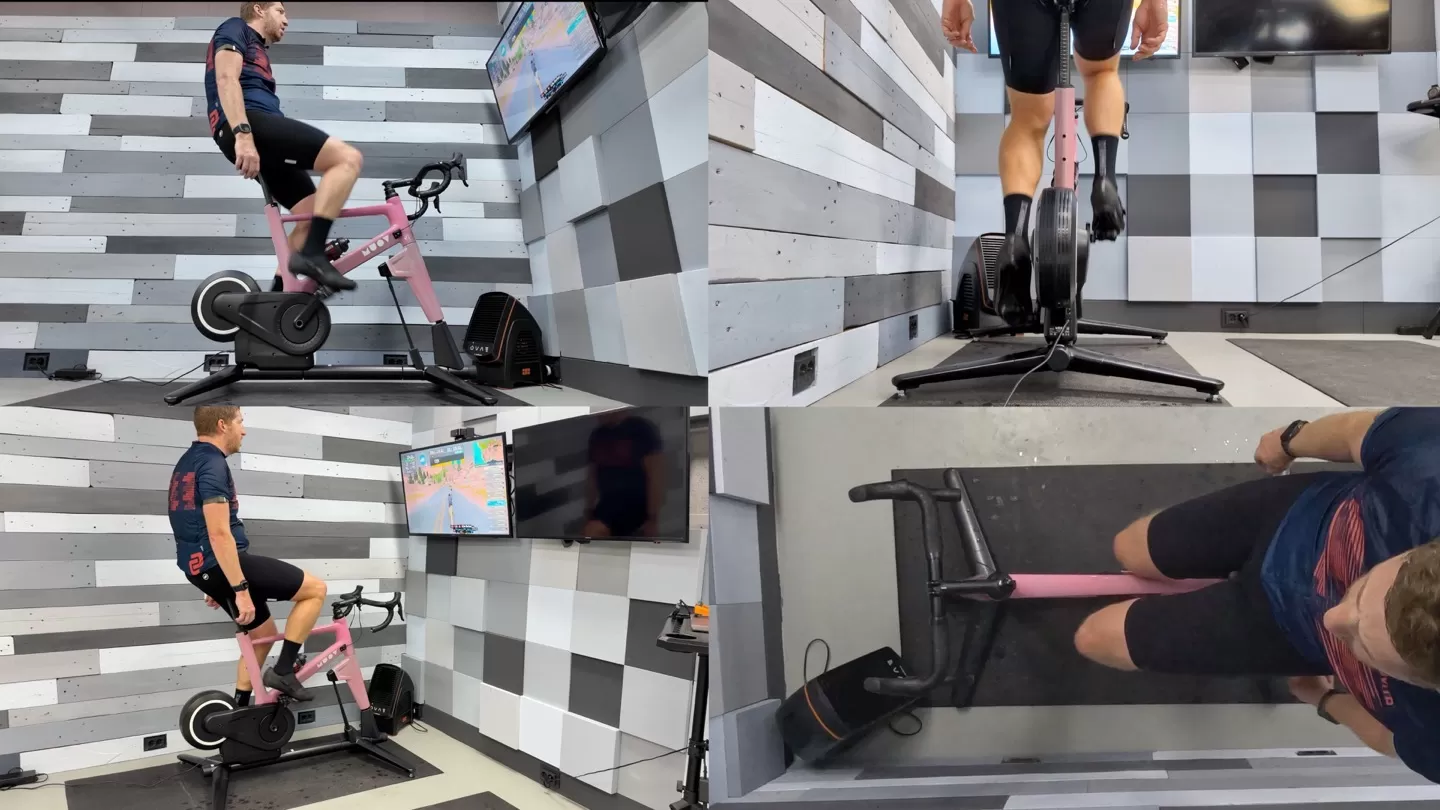 Four-panel view showing the Muov Smart Bike remains stable while sitting upright.
Riders who’ve spent significant time on the Muov bike report being happy with the movement feel. The system provides a more engaging and comfortable experience, especially on longer rides, compared to a completely static setup.
 Rider using the Muov Smart Bike during a long indoor training session.
Beyond the movement, the core riding feel from the flywheel and electromagnetic motor is solid. Resistance changes in simulation mode feel good, and the responsiveness is excellent. Muov claims it’s the fastest responding smart bike at 30Hz, which is noticeable, particularly in Zwift’s Race Mode.
 View of the belt drive and flywheel system inside the Muov Smart Bike base.
In ERG mode (where the bike holds a target wattage), the Muov bike does a good job. It allows for some natural variation in your pedal stroke rather than locking you rigidly to a number, which feels more natural. While the displayed wattage might fluctuate slightly second-to-second, it accurately reflects your output variations while keeping you near the target. This is different from bikes that struggle to hold the target power at all.
 TrainerRoad graph showing power output during an ERG mode workout on the Muov Smart Bike.
Compared to some other smart bikes, the Muov appears to hold the set point in ERG mode quite precisely, offering a good balance between smoothing and showing your actual power output nuances.
Power Accuracy: Consistent and Reliable
Power accuracy is critical for a smart bike, and the Muov bike performs very well here. Across numerous rides and tests, comparing its data to trusted power meter pedals like the Favero Assioma or Garmin Rally, the numbers consistently match up.
 Power accuracy comparison graph showing Muov Smart Bike data against Favero Assioma pedals during longer ERG intervals.
Whether doing steady-state ERG intervals or free riding in simulation mode with lots of power changes, the Muov bike’s power output closely tracks external meters. This indicates reliable and accurate data for training.
 Data comparison graph from a second ERG mode workout testing Muov Smart Bike power accuracy.
Even when zoomed in on short, intense intervals or sprints, the agreement between the Muov bike and comparison power meters is exceptionally close, often within just a few watts.
 Zoomed-in view of power data showing close agreement between Muov Smart Bike and power meter pedals during short, intense intervals.
In simulation mode, riding varied terrain like hills and flats, the power accuracy remains impressive, even during dynamic changes and sprints.
 Zwift simulation ride data showing initial power output comparison on the Muov Smart Bike.
 Graph comparing Muov Smart Bike power data to external power meters during variable riding in simulation mode.
 Smoothed power data graph highlighting peak wattage accuracy during a sprint simulation on the Muov Smart Bike.
During testing, an early unit did hit a thermal limit during a long, moderate workout in warmer conditions. This highlights the reality of early production models sometimes having unforeseen issues. However, Muov’s response was thorough: they investigated the failure, redesigned components for better sealing and heat dissipation, and extensively tested new thermal limits.
 Graph showing initial thermal limit testing data from the Muov Smart Bike.
 Data report excerpt detailing thermal performance testing and analysis for the Muov Smart Bike.
The updated limits can now handle extreme conditions (like 40°C ambient temperature at 300W for two hours), far exceeding typical indoor training scenarios. This level of detailed response to issues is reassuring for potential buyers.
 Graph illustrating the updated thermal limits and sustained wattage capacity of the Muov Smart Bike.
While minor bugs might pop up with any complex tech product, Muov appears committed to addressing them promptly and rigorously.
The Bottom Line
The Muov Smart Bike is undeniably a premium piece of indoor cycling equipment. It’s expensive, positioned for riders who want the best possible indoor simulation experience and appreciate high-quality, locally-sourced manufacturing (in the UK).
 Front view of the assembled Muov Smart Bike, showcasing its design.
Its defining feature, the dynamic movement system that mimics real bike lean and steering, is unique and well-executed. It offers a level of immersion and comfort that fixed bikes or simple rocker plates can’t match. Combine this with solid power accuracy, responsive resistance, useful features like integrated app controls and USB-C charging, and you have a compelling package.
It’s not perfect for everyone; the premium price is a significant barrier, and some users might miss ANT+ connectivity or height adjustability for multi-rider setups. Unlike some competitors, it doesn’t simulate uphill/downhill grade changes physically (though resistance adjusts).
Ultimately, if you value a realistic indoor riding feel provided by unique movement simulation and appreciate premium design and manufacturing, the Muov Smart Bike delivers. It’s a high-performance trainer that makes indoor riding more engaging and comfortable, standing out in a crowded market.