Nvidia has officially announced the GeForce RTX 5050 graphics card, bringing its latest “Blackwell” architecture and gaming features like DLSS 4 with Multi Frame Generation and ray tracing to a more accessible price point for both desktop PCs and gaming laptops. This new GPU aims to offer a significant upgrade for mainstream gamers looking to step into the world of advanced graphics technologies without breaking the bank.
Contents
Meet the Desktop RTX 5050
For desktop PC builders and upgraders, the RTX 5050 is positioned as the new entry point into the latest generation. It arrives with a starting price of $249, aiming for a balance between cost and modern gaming capabilities.
Under the hood, the desktop RTX 5050 includes 2,560 CUDA cores based on Nvidia’s new Blackwell architecture. It’s designed to draw up to 130W of power, which is manageable for many standard PC power supplies. Interestingly, this desktop version uses 8GB of GDDR6 video memory (VRAM).
These cards won’t be made directly by Nvidia but by their usual partners like Asus, Gigabyte, MSI, Zotac, and others. You can expect to see them hitting the market in the second half of July. Nvidia plans to release updated Game Ready Drivers in early July to ensure full compatibility and performance optimization for the new hardware.
And the Laptop Version
Gaming on the go is also getting an upgrade with the RTX 5050 Laptop GPU. Designed to fit into a wider range of notebooks, this version has a flexible power draw ranging from 35W up to 100W. This allows laptop manufacturers to put the 5050 into everything from slimmer, power-efficient models to slightly beefier machines.
Like its desktop sibling, the laptop 5050 features 2,560 Blackwell CUDA cores and comes with 8GB of VRAM. However, here’s a key difference: the laptop GPU uses the newer GDDR7 VRAM. GDDR7 is generally more power-efficient than GDDR6, which is a crucial benefit for laptops where managing heat and battery life is paramount.
Laptops equipped with the RTX 5050 are expected to start around $999. Some models are even available for purchase starting now, ahead of the general driver release. These early bird laptops will come with the necessary drivers pre-installed.
The choice of GDDR7 for the laptop and GDDR6 for the desktop might seem counterintuitive at first glance, especially since the desktop version typically has a higher power budget allowing for better cooling and potentially higher clock speeds. However, GDDR7’s efficiency is a big win for mobile devices, helping the laptop 5050 perform well within tight thermal limits. Despite the older VRAM tech, the desktop 5050 with its higher potential power draw should still generally outperform the laptop variant.
Performance Expectations and Realities
Nvidia is positioning the RTX 5050 as a card capable of delivering a “ray-traced experience with high settings” in demanding games, specifically mentioning titles like Cyberpunk 2077 and Avowed. They highlight the role of DLSS 4 with Multi Frame Generation (MFG) in achieving this.
Their performance charts show impressive numbers, like achieving over 150 frames per second (fps) in such demanding titles with 4x MFG enabled. This sounds fantastic, but it’s important to look at the details. This specific claim was based on testing the RTX 5050 while paired with a very high-end CPU – a $479 AMD Ryzen 7 9800X3D – and running at 1080p resolution. Your actual performance will vary depending on the rest of your PC’s components.
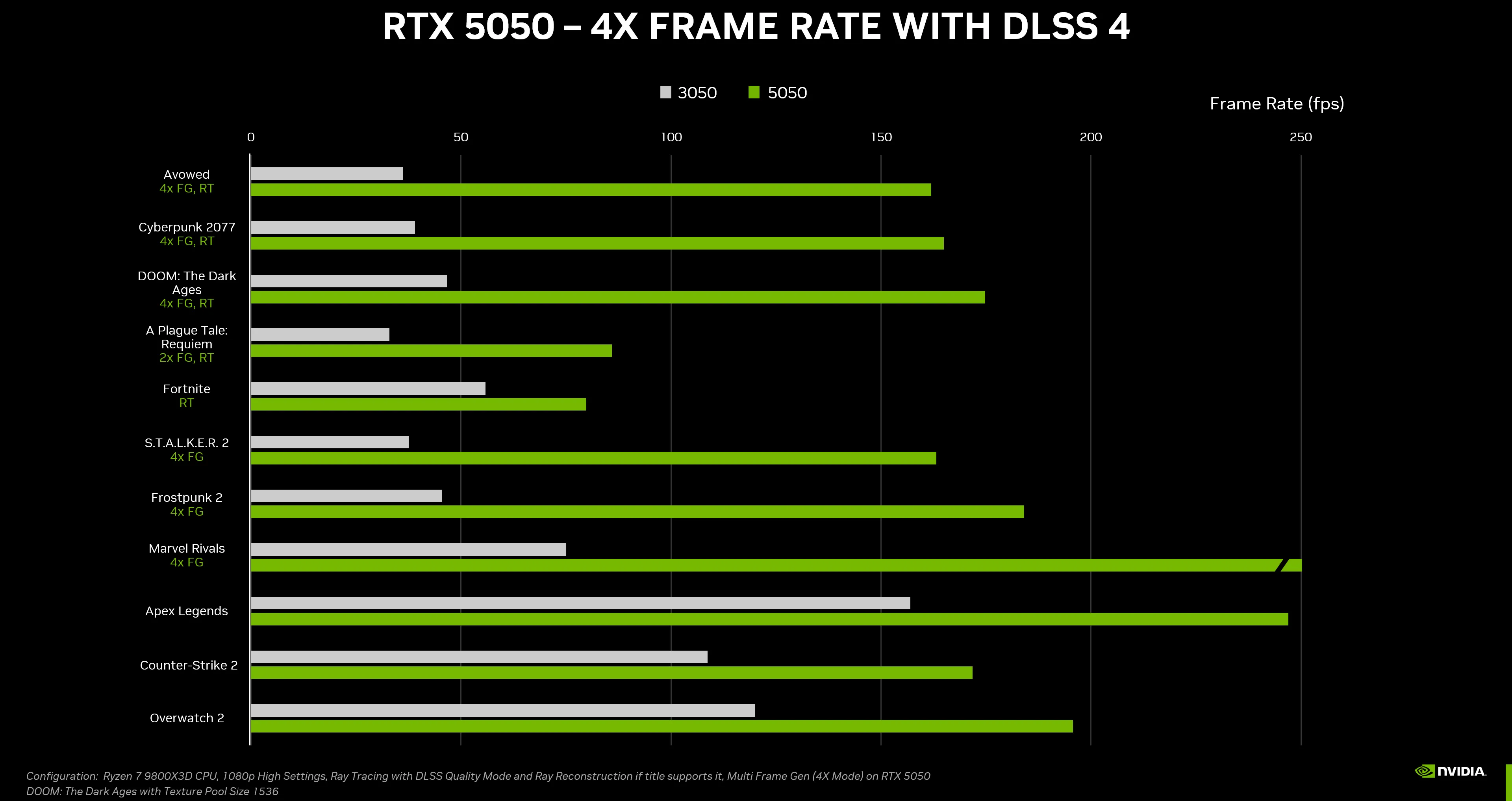 Nvidia chart showing GeForce RTX 5050 gaming performance with DLSS 4 and Multi Frame Generation enabled
Beyond performance with DLSS, Nvidia claims the RTX 5050 offers a solid step up in traditional “rasterization” performance (rendering graphics without ray tracing or advanced AI upscaling). They state it’s approximately 60 percent faster than the two-generations-old RTX 3050.
This comparison is significant because the RTX 5050 is the direct successor to that very popular RTX 3050, which remains one of the most widely used GPUs according to hardware surveys like the one on Steam. Nvidia skipped launching a desktop RTX 4050, making the 5050 the first entry-level desktop card in the 50-series.
While it boasts the same 8GB of VRAM as the step-up RTX 5060 (though the 5060 uses GDDR7 and has more CUDA cores), the desktop 5050’s use of GDDR6 and lower core count ensures there will be a clear performance gap between it and the 5060, positioning it firmly in the entry-level category.
What This Means for You
The launch of the RTX 5050 is good news for gamers on a budget or those looking to buy an affordable new gaming PC or laptop. It brings modern graphics features like ray tracing and the powerful DLSS 4 suite down to a price point that’s more accessible than the higher-end 50-series cards.
You can expect a decent gaming experience at 1080p resolution, especially in titles that support DLSS and Frame Generation. However, it’s crucial to remember that achieving the best performance shown in marketing materials will likely require a powerful CPU to avoid bottlenecks, even at this resolution.
For those still using older cards like the RTX 3050 or even older models, the RTX 5050 looks like a compelling upgrade candidate, offering a noticeable boost in performance and access to the very latest in Nvidia’s graphics technology. Keep an eye out for reviews and benchmarks closer to the July release date to get a clearer picture of its real-world capabilities across different PC configurations.
Explore the full range of new graphics cards and how they stack up in our detailed guides to the latest PC hardware trends.