Getting a clear look at distant planets orbiting other stars, known as exoplanets, is a major challenge for astronomers. But thanks to groundbreaking work in adaptive optics technology, seeing these elusive worlds is becoming much easier. Dr. Maaike van Kooten, a research officer at Canada’s NRC Herzberg Astronomy and Astrophysics Research Centre (HAA), has been awarded the prestigious 2025 New Horizons in Physics Prize by the Breakthrough Prize Foundation for her significant contributions to this field. She shares this honor with Dr. Rebecca Jensen-Clem and Dr. Sebastiaan Haffert.
Contents
This award recognizes early-career researchers who have already made impactful discoveries. Dr. van Kooten’s work, in collaboration with her colleagues, demonstrates new adaptive optics techniques that promise to enable the direct detection of even the smallest exoplanets, opening up exciting new possibilities in our search for other worlds.
 Dr. Maaike van Kooten receiving the 2025 New Horizons in Physics Prize
The Challenge: Looking Through a Shimmering Sky
Imagine trying to look at something very far away through heat haze rising from a hot road – everything looks distorted and blurry. That’s similar to the problem astronomers using ground-based optical telescopes face. Earth’s atmosphere isn’t perfectly still; it has turbulent pockets of air that act like tiny, constantly shifting lenses, distorting the light from stars and planets before it reaches the telescope mirror. This atmospheric blur makes it incredibly difficult to get sharp images and precise measurements, especially when trying to spot a faint exoplanet next to a dazzlingly bright star.
The Solution: Smart Mirrors and Predictive Tech
Adaptive optics (AO) systems are designed to counteract this atmospheric distortion. They work by using a flexible mirror in the telescope’s light path. Sensors analyze the incoming light distortions in real-time, and tiny actuators rapidly push and pull on the back of the flexible mirror, changing its shape thousands of times per second to perfectly cancel out the atmospheric wobble. This sharpens the image dramatically, allowing astronomers to see details that would otherwise be lost.
Dr. van Kooten’s key contribution involves advancing a novel algorithm called “predictive wavefront control.” Instead of just reacting to how the atmosphere is distorting light now, this algorithm predicts how the atmosphere will change in the immediate future. By predicting the distortions, the system can adjust the flexible mirror even more accurately and quickly, leading to significantly better image stability and clarity.
Putting the Tech to the Test
To prove the effectiveness of their predictive algorithm, Dr. van Kooten and Dr. Jensen-Clem conducted rigorous “on-sky” testing using the Keck II telescope. On-sky testing is the crucial step where laboratory technology is taken to a real, working telescope – the ultimate test of performance. Over multiple nights, they tested the technology on Keck’s adaptive optics system, using both dedicated engineering time and actual science observation time.
The results were impressive. The algorithm improved image clarity and contrast, making it much easier to distinguish faint objects, like small exoplanets, even when they are located very close to extremely bright stars. This is a critical capability for directly imaging exoplanets.
Ultimately, the goal is for the W. M. Keck Observatory to make this predictive AO mode available to all astronomers, and for future generations of instruments designed to directly image exoplanets to rely on this algorithm for peak performance.
Canada’s Role in Pushing Boundaries
Canada, and specifically the NRC, has a long-standing history of leading advancements in optical astronomy instrumentation. The NRC Herzberg Astronomy and Astrophysics Research Centre has been instrumental in developing and implementing adaptive optics systems for major international telescopes, such as Gemini North.
Dr. van Kooten joining the NRC HAA team immediately after her groundbreaking postdoc work further strengthens this tradition. Her research, recognized by the Breakthrough Foundation, is a testament to the caliber of researchers at the NRC. As Luc Simard, Director General of HAA, notes, researchers like Dr. van Kooten are not just pushing the boundaries of instrumentation but are fundamentally redefining what is possible in astronomical observation.
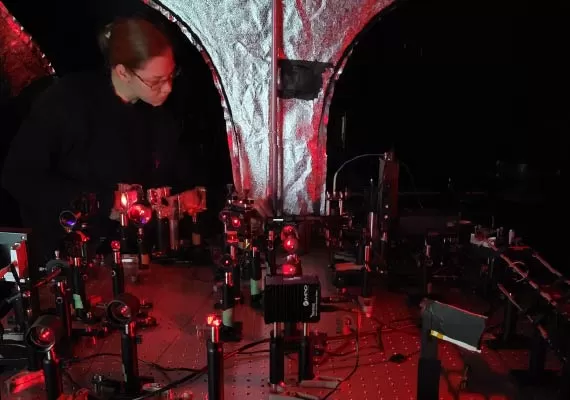 Researchers stand near a large piece of complex optical equipment on a table within a light-blocking enclosure at the REVOLT test bed.
Dr. van Kooten continues to be involved in cutting-edge projects. She provides real-time computing support for adaptive optics upgrades on the Gemini Planet Imager and its calibration unit for the Gemini North telescope. She is also developing and testing emerging AO technologies using REVOLT, the NRC’s dedicated test bed for on-sky adaptive optics development. Her work includes designing and testing new wavefront sensor systems and leading a project using super high-speed cameras called single-photon avalanche diode (SPAD) arrays, capable of capturing 96,000 images per second. She’s also exploring the use of machine learning to further improve adaptive optics systems.
Looking Ahead
The recognition from the Breakthrough Prize Foundation highlights the profound impact that innovative technology, like predictive adaptive optics, can have on fundamental science. By overcoming the limitations imposed by Earth’s atmosphere, astronomers are gaining unprecedented views of the cosmos. This breakthrough brings us closer than ever to directly observing small, rocky exoplanets and potentially finding answers to some of humanity’s biggest questions about our place in the universe.