Forget everything you thought you knew about retro gaming handhelds. The new Sinclair GamerCard looks like a novelty – a sleek, credit card-sized slab with a tiny screen and a few buttons. But don’t let its appearance fool you. This isn’t just another gadget; it’s a surprising and refreshing return to the roots of pure gaming, offering a delightful alternative to today’s increasingly complex and often overwhelming consoles.
Contents
In an era where many new retro consoles feel functional but bland, the GamerCard stands out by redefining what a gaming device can be. It prioritizes minimalist design and an immediate, no-fuss play experience, echoing the bold, idiosyncratic choices of classic systems like the ZX Spectrum.
Beyond the Gimmick: A Fresh Take on Retro Gaming
For many of us, the joy of retro gaming has become a bit complicated. What started as a nostalgic trip has evolved into a multi-billion dollar industry, leading to a flood of new retro handhelds that, while technically capable, often lack soul. Devices like the Retroid Pocket 4 Pro or the popular Miyoo Mini Plus are great for playing classic titles, but they sometimes feel more like a means to an end rather than a celebration of gaming culture. The sheer volume of “me-too” devices can make it hard to find something truly special.
This is precisely where the Sinclair GamerCard shines. Designed by Grant Sinclair, son of computing pioneer Sir Clive Sinclair, this device isn’t about chasing specs or counting “teraflops.” Instead, it offers a distinct, “lo-fi design-first” approach that feels uniquely retro while embracing modern sensibilities. It challenges the idea that more power and features always equate to a better experience.
 Close-up of the compact Sinclair GamerCard, a credit card-sized retro gaming device, held in a hand.
Designed for Pure Play
The GamerCard’s genius lies in its simplicity and focus on user experience. It’s a prime example of “design by subtraction,” stripping away the unnecessary bloat that plagues much of modern tech. This pocket-sized powerhouse boots instantly, its battery lasts for days (not just hours), and it operates without any noise, heat, or nagging updates. You simply press a button, and you’re in the game – just like in the old days. There are no ads, no complex menus, and no hidden algorithms nudging you toward microtransactions. It’s gaming in its purest form.
Despite its nostalgic roots, the GamerCard feels surprisingly modern. Its operating system is clean and intuitive, and games load quickly. Every aspect of the device feels intentional and refined, proving that a console doesn’t need to be overpowered to be effective. Unlike many nostalgia-driven gadgets, the GamerCard has a genuine purpose beyond merely collecting dust.
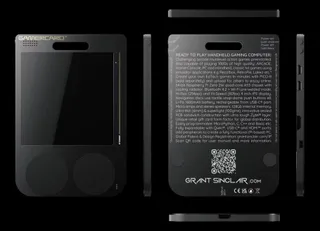 Front and back view of the sleek black Sinclair GamerCard, highlighting its minimalist design as a portable retro console.
Gaming, Reimagined: New Life for Small, Smart Games
The Sinclair GamerCard isn’t just for playing old ROMs; it supports a vibrant and growing ecosystem of dedicated games. It runs real, high-quality titles, not knock-offs. A passionate community of developers is already creating games specifically for this unique device. You’ll find everything from fast-paced arcade shooters to thoughtful puzzle games.
For instance, the console comes with Bloo Kid 2 and AstroBlaze DX pre-installed – titles that originally found success on platforms like the Nintendo Switch but have been expertly reworked to fit the GamerCard’s distinctive 4-inch square IPS display. What’s more, games developed using PICO-8 – a popular “fantasy console” that lets users create minimalist retro-style games – are also fully compatible. This means the GamerCard is a platform not just for “old” games, but for new, inventive, and minimalist experiences where “every byte matters.”
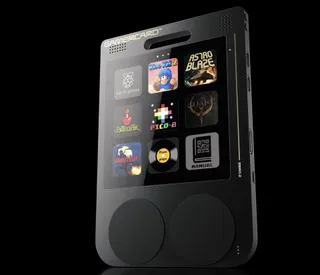 The black Sinclair GamerCard handheld console displaying a game, showcasing its compact form factor for an engaging retro gaming experience.
Is the Sinclair GamerCard Right for You?
The GamerCard feels like a true spiritual successor to the ZX Spectrum, carrying forward the idea that constraints can breed creativity, and that small games can be just as meaningful as big blockbusters. It’s a reminder that the best hardware often works quietly and beautifully, without needing to shout for attention.
At around $170 / £125, and packing a Raspberry Pi Zero 2W with a quad-core ARM Cortex-A53 processor and 128GB of storage, its technical specs might not seem to offer the most bang for your buck compared to other devices. For example, the Retroid Pocket 4 Pro delivers more raw power, and affordable handhelds like the Evercade’s £50 Hyper Mega Tech Super Pocket offer pre-installed classic games from legendary publishers like Neo Geo and Capcom.
However, the Sinclair GamerCard isn’t trying to compete on price-to-performance ratios. It’s not aiming for mass-market dominance. Instead, it’s designed for a very specific audience: those who appreciate innovative design, cherish a pure gaming experience, and perhaps fondly remember the joy of discovering something wonderfully weird on an old shareware disc. It resonates with anyone who loved the quirky charm of past consoles like the Neo Geo Pocket or WonderSwan.
The Sinclair GamerCard isn’t trying to be a console for everyone. It’s trying to be the perfect console for the right someone. If you’re looking for a simple, engaging, and uniquely designed handheld that brings back the magic of unadulterated play, this could be the device you’ve been waiting for.