Back in the early 1980s, motorcycle engineers were chasing speed in exciting new ways. Among the most thrilling experiments was bolting a turbocharger onto a bike engine. While others tried it, Kawasaki was the last of the major Japanese brands to jump into the turbo game with their highly anticipated ZX750 Turbo. This wasn’t just another bike; it was Kawasaki’s statement, a powerful machine that delivered performance with a unique surge and pushed the boundaries of what a motorcycle could be, even if its moment was brief.
Contents
This article dives into the story of the ZX750 Turbo, exploring its groundbreaking technology, the challenges it faced (including those famous gravel trap moments!), and why this innovative bike remains a fascinating chapter in motorcycle history.
When Turbochargers Were the Future
The early 1980s saw a brief but intense fascination with turbocharging motorcycles. Honda had the CX500/650 Turbo, Yamaha the XJ650 Turbo, and Suzuki the XN85. Adding a turbocharger promised a big boost in horsepower from a smaller engine, seen as the next frontier for superbike performance.
Kawasaki was a bit late to this party. They had dipped a toe in with a special, US-only Z1-R TC Turbo based on an aftermarket kit in 1978. This bike was a raw beast, pushing a 1015cc engine from 90 hp to around 125 hp, but it lacked refinement and came with no engine warranty. Still, it showed a potential appetite for forced induction among riders.
The official Akashi-factory ZX750 Turbo was a completely different animal. Kawasaki took their time, reportedly waiting to perfect the design while rivals released their models. This delay meant the ZX didn’t hit showrooms until 1984, making Kawasaki the last of the “Big Four” to launch a turbo bike.
Engineering the Boost: Kawasaki’s Turbo Approach
Getting turbocharging right on a motorcycle wasn’t easy, especially dealing with “turbo lag.” This is the frustrating delay between twisting the throttle and the engine delivering power, caused by waiting for exhaust gases to spin the turbo up to speed.
Kawasaki’s engineers tackled this head-on. Unlike some competitors who placed the turbo behind the engine, Kawasaki put the Hitachi turbo unit in front of the 738cc inline-four motor, right near the exhaust outlet. This shorter path for exhaust gases helped significantly reduce lag, making the power delivery much quicker and smoother than many rival turbo bikes.
 Profile view of the 1984 Kawasaki ZX750 Turbo motorcycle
This forward placement wasn’t without challenges. It required complex routing for heat-resistant exhaust pipes and dictated an unusual air filter position on the engine’s left side. Air traveled a convoluted path: from the filter down and around to the turbo’s compressor, then upward around the left side for pressurization in the airbox before reaching the fuel injectors. It was a complex system for the time.
The engine itself was based on a detuned and strengthened version of Kawasaki’s conventional air-cooled GPz750 unit. It used a Z650 cylinder head to lower the compression ratio (better suited for forced induction) and featured stronger internal parts and an increased oil pump capacity to handle the extra stress of the turbo.
One clever design touch: Kawasaki built an aluminum brace into the full fairing at the front. This silver strip acted as both a frame reinforcement for rigidity and added protection for the vulnerable turbo unit positioned just behind it in case of a spill.
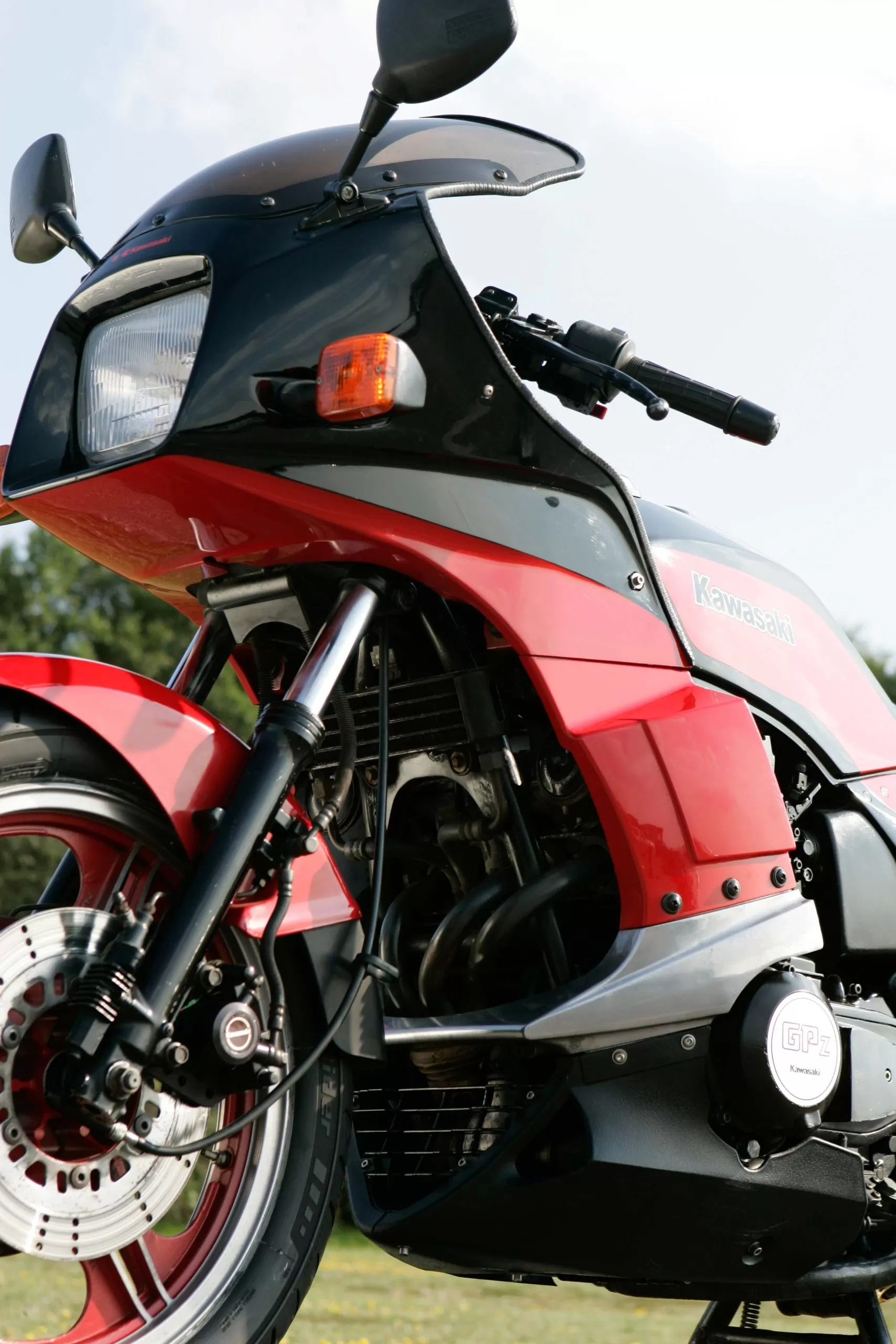 Front view of the Kawasaki ZX750 Turbo's fairing and headlight
Riding the Wave: Power and Handling
The ZX750 Turbo was rated at 112 horsepower at 9000 rpm. While this was slightly less than Kawasaki’s own naturally aspirated GPz1100 (120 hp), the turbo motor felt stronger below 7000 rpm. And critically, its smooth, rev-happy nature and reduced lag made it incredibly addictive to ride. The rush of acceleration when the boost kicked in was unlike anything else.
Experiencing the ZX750 Turbo on a track, like the Salzburgring circuit during its press launch, highlighted its unique character. Despite being labeled a 750, its power put it in contention with open-class bikes. Riders quickly learned to respect the sudden “torrent of horsepower” when the turbo came on song, as evidenced by a couple of memorable excursions into the gravel traps during the press event! On the long straights, the Turbo easily matched the speeds of the GPz1100s Kawasaki brought along for comparison.
 Close-up view of the Kawasaki ZX750 Turbo's fuel tank and engine area
The chassis largely borrowed from the GPz750 but with some key updates, including a longer steering head and a stronger box-section aluminum swingarm. It featured air-adjustable forks with anti-dive technology and a Uni-Trak monoshock rear suspension, also with air assistance. Weighing in at 514 pounds dry, it was a substantial machine, sitting between the GPz750 and GPz1100 in weight.
While not the most flickable bike by modern standards, especially in tight corners where it required some effort, the ZX750 Turbo handled remarkably well for a bike of its size and era. Its stability, even through high-speed bends, impressed riders. The riding position was relatively relaxed for an ’80s sportbike, with a protective fairing and slightly raised handlebars making it surprisingly capable as an all-rounder, not just a speed machine.
Living With a Turbo: Reliability and Legacy
Early concerns about the complex turbocharger, spinning at up to 200,000 rpm, causing reliability problems were largely dispelled over time. While requiring diligent maintenance like frequent oil changes (every 1500 miles!) and a recommended idle period after hard rides to protect the turbo, the ZX proved reasonably dependable under normal road use.
Despite its technical innovation and thrilling performance, the ZX750 Turbo wasn’t a massive sales success. Its price tag was comparable to larger, conventional bikes like the GPz1100 and Suzuki GS1100 Katana. Many riders opted for the known reliability and simpler tech of these established models.
More significantly, 1984 saw the arrival of Kawasaki’s game-changing GPZ900R “Ninja.” This bike, with its compact, liquid-cooled, 16-valve engine, pointed clearly towards the future of superbike design. Turbochargers, with their complexity, cost, and inherent lag issues, became a technological path not taken for mainstream sportbikes.
 The 1984 Kawasaki ZX750 Turbo motorcycle cornering on a road
The ZX750 Turbo, like the other Japanese turbo bikes, was relatively short-lived, exiting production by the end of 1985. The era of forced induction motorcycles was over, at least for several decades.
Today, the ZX750 Turbo remains a cool and unique classic. Riding one, even decades later, delivers that same addictive rush as the boost gauge climbs and the bike surges forward. It’s a tangible piece of motorcycle history, representing a bold, innovative experiment from a time when manufacturers were willing to try almost anything to build the fastest, most exciting bikes on the planet. It might not have been the future, but it was certainly a thrilling ride.
Interested in other classic Kawasaki models or the history of sportbikes? Explore more stories from this exciting era!