California Gov. Gavin Newsom has publicly challenged former U.S. President Donald Trump to arrest him, escalating a dispute over immigration enforcement and the deployment of troops to Los Angeles. The challenge came after Trump endorsed the idea amid heightened tensions and protests following extensive immigration raids in California and the deployment of thousands of National Guard troops and Marines. This event highlights the deep divide between state and federal authorities on immigration policy and the use of federal force within states.
Contents
Troop Deployment and Los Angeles Protests
Tensions surged in Los Angeles following several days of protests sparked by the Trump administration’s intensified immigration enforcement. On Sunday, 2,000 National Guard troops were sent to the city as violence escalated during demonstrations. By Monday, an additional 2,000 National Guard troops and 700 Marines were deployed.
These deployments coincided with sweeping citywide raids by Immigration and Customs Enforcement (ICE). Critics argue these enforcement actions are detrimental to migrant families.
 Demonstrators protest outside a downtown jail in Los Angeles following immigration raids
Monday’s protests saw a reduction in violent clashes compared to previous days. Thousands marched peacefully at city hall, while hundreds gathered outside a federal detention center holding some immigrants detained in the recent raids.
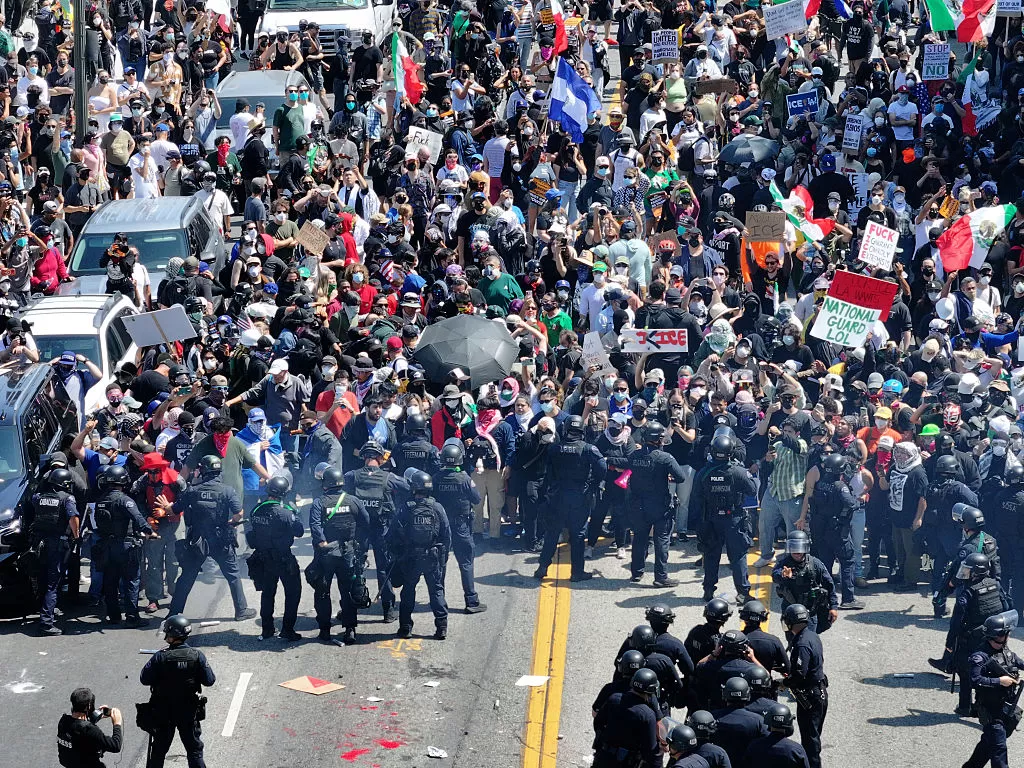 Hundreds protest workplace raids by Immigration and Customs Enforcement in Los Angeles
The Exchange Between Newsom and Trump
The verbal conflict intensified when Trump publicly endorsed the suggestion by U.S. border czar Tom Homan that Newsom should be arrested. Speaking to reporters, Trump stated, “I would do it, I think it’s great.”
Newsom responded to Trump’s comments in a television interview on Tuesday. He directly challenged Trump, saying, “Get it over with, arrest me.”
Newsom further elaborated, urging the federal government to target him instead of immigrant families. “If you need some head to scalp, do it with me, but stop messing with these kids, stop messing with four-year-olds, kids in elementary school,” he stated. He mentioned that fear of detention was preventing hundreds of students in California from attending graduation ceremonies.
Context of Prior Arrests of Officials
The suggestion of arresting Newsom follows a pattern of federal action against state and local officials who have challenged or allegedly interfered with federal immigration enforcement.
In recent weeks, the Trump administration has arrested several political and judicial figures. These included Ras Baraka, the Democratic mayor of Newark, N.J., who was arrested during a visit to a detention center he claimed violated safety protocols. Similarly, Democratic U.S. House member LaMonica McIver was charged after visiting an ICE facility in New Jersey.
In April, a sitting Wisconsin judge, Hannah Dugan, was also taken into custody and charged with obstructing the detention of an undocumented immigrant, according to the FBI. Homan had previously warned that state and local officials interfering with federal agents could face arrest and criminal charges.
Despite Trump’s endorsement of his arrest, Newsom has not been formally accused or charged with any crimes by the government, nor is there public evidence suggesting he has committed an offense that would lead to criminal charges, as reported by NBC News.
The issue of immigrant detention has also affected individuals directly. Last week, Marcelo Gomes Da Silva, an 18-year-old from Massachusetts, was detained by ICE on his way to volleyball practice, causing him to miss his girlfriend’s graduation where he was scheduled to perform.
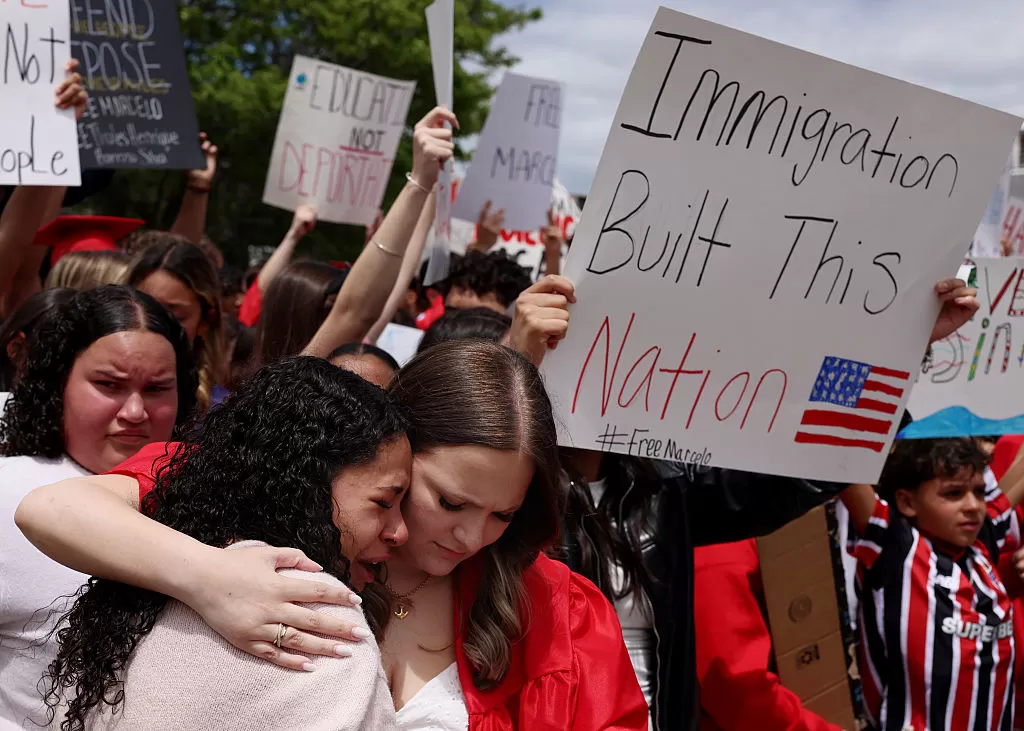 Family and classmates protest outside Milford Town Hall for Marcelo Gomes Da Silva
Students rallied for his release after the ceremony. Gomes Da Silva was subsequently released on bond on June 5.
Official Justifications and Rhetoric
United States Secretary of Defense Pete Hegseth stated before the House Committee on Tuesday that military personnel would remain in Los Angeles for 60 days. He indicated their purpose was to “ensure that those rioters, looters and thugs on the other side assaulting our police officers know that we’re not going anywhere.”
Trump continued his strong rhetoric regarding the protests on social media, referring to protesters as “violent insurrectionist mobs” attacking federal agents. He vowed that “order will be restored and the Illegals will be expelled.” Earlier, he had posted, “Looking really bad in L.A. BRING IN THE TROOPS!!!”
Newsom responded to comments from Deputy Chief of Staff Stephen Miller, who accused the governor of overseeing “a criminal sanctuary for millions of illegal alien invaders, cartel killers, foreign terrorists, transnational gangs and insurrectionist mobs.” Newsom countered by referencing Trump’s actions: “The only people defending insurrectionists are you and @realDonaldTrump…or, are we pretending like you didn’t pardon 1500 of them?”
This exchange referred to Trump’s January action, on his first day of his second term, when he pardoned 1,500 individuals charged for their roles in the January 6, 2021, U.S. Capitol attack, including some convicted of assaulting police officers.
Legal Challenge and Historical Context
On Monday, Newsom confirmed that California intends to sue the Trump administration over the deployment of the National Guard to suppress protests without the state governor’s consent.
The deployment of the National Guard within a state without the governor’s permission is a significant federal action. According to the Brennan Center for Justice, the last instance of a president invoking such authority was in 1965 when Lyndon B. Johnson sent troops to protect a civil rights march in Alabama.
The ongoing situation highlights the intensifying conflict between federal immigration enforcement policies and state-level sanctuary or non-cooperation stances, set against a backdrop of protests and the rare use of federal military power within a state.
For more context on related events, explore stories on US immigration raids and Trump’s immigration policies.