NATO leaders concluded a two-day summit in The Hague this week, agreeing to significantly increase defense spending targets. Members committed to spending 5 percent of their economic output on defense and security, a major jump from the current goal of 2 percent of GDP. This ambitious new target aims to boost collective security amid rising geopolitical tensions.
Contents
What is the New Defense Spending Target?
The agreement sets a goal for NATO member states to allocate 5 percent of their Gross Domestic Product (GDP) to defense and security over the next 10 years. This target replaces the previous commitment of 2 percent of GDP, which was agreed upon in 2014.
The 5 percent target is structured into two components:
- 3.5 percent: Allocated for core defense spending, covering areas like military personnel, equipment, and operations.
- 1.5 percent: Earmarked for broader security investments, including critical infrastructure upgrades (roads, bridges, ports), military vehicle modernization, cybersecurity initiatives, and protection for energy infrastructure.
This revised target signifies a substantial increase in planned investment across the alliance, potentially amounting to hundreds of billions of dollars annually compared to the current spending levels based on the 2 percent goal.
Context: The Evolution of NATO’s Spending Goals
The 2 percent target was first agreed upon by NATO defense ministers in 2006, but compliance was low for years. Following Russia’s annexation of Crimea in 2014, alliance members at the Wales summit pledged to meet the 2 percent guideline by 2024.
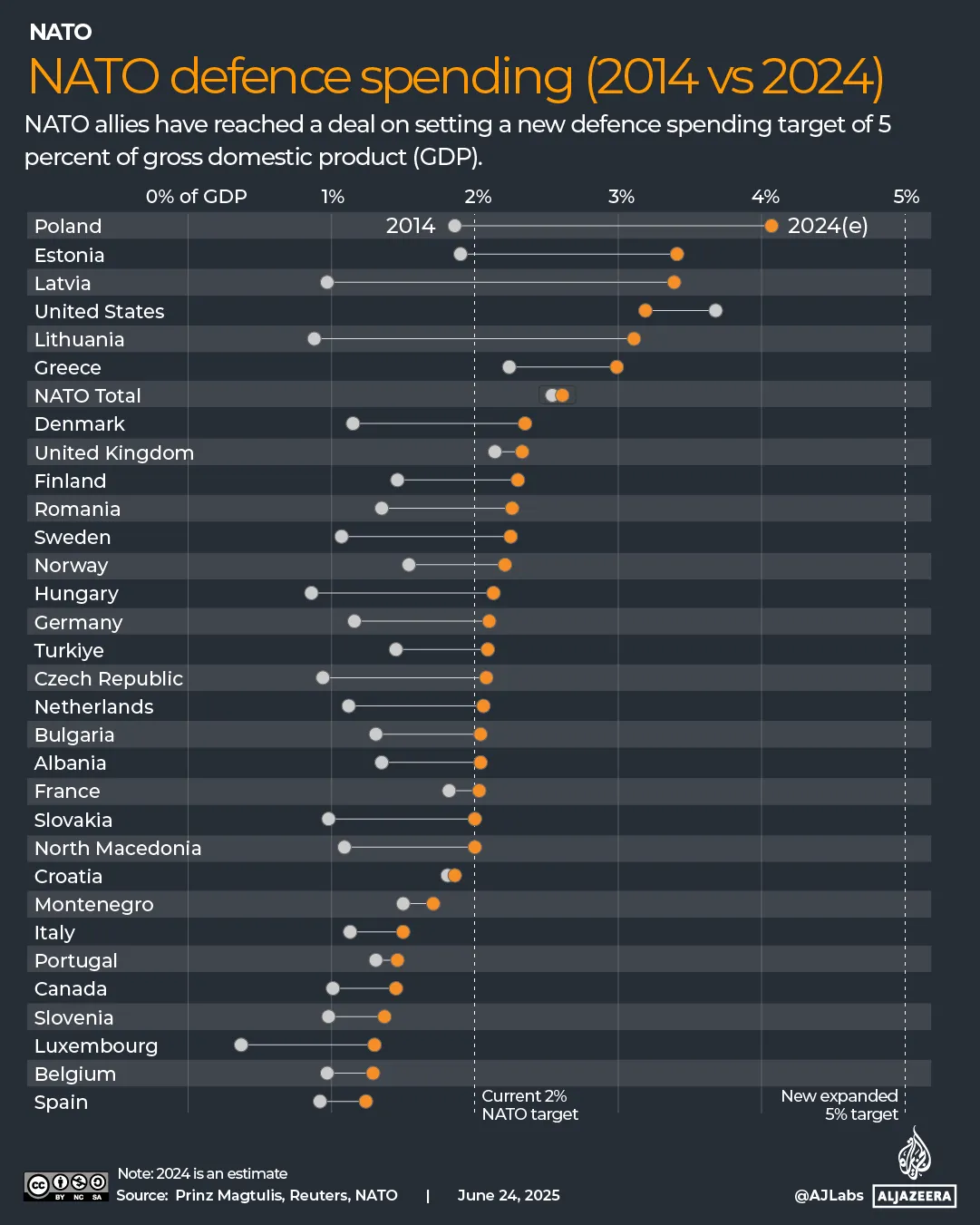
As of 2024, 23 out of NATO’s 32 member countries have met or exceeded the 2 percent threshold. Collectively, NATO countries spent approximately 2.61 percent of their combined GDP on defense last year.
Countries bordering Russia have significantly increased their defense spending in recent years. Poland currently leads all NATO nations, spending 4.1 percent of its GDP on defense. Estonia and the United States follow at 3.4 percent each, then Latvia at 3.2 percent, and Greece at 3.1 percent. Notably, the United States’ defense spending as a percentage of its GDP in 2024 was lower than in 2014.
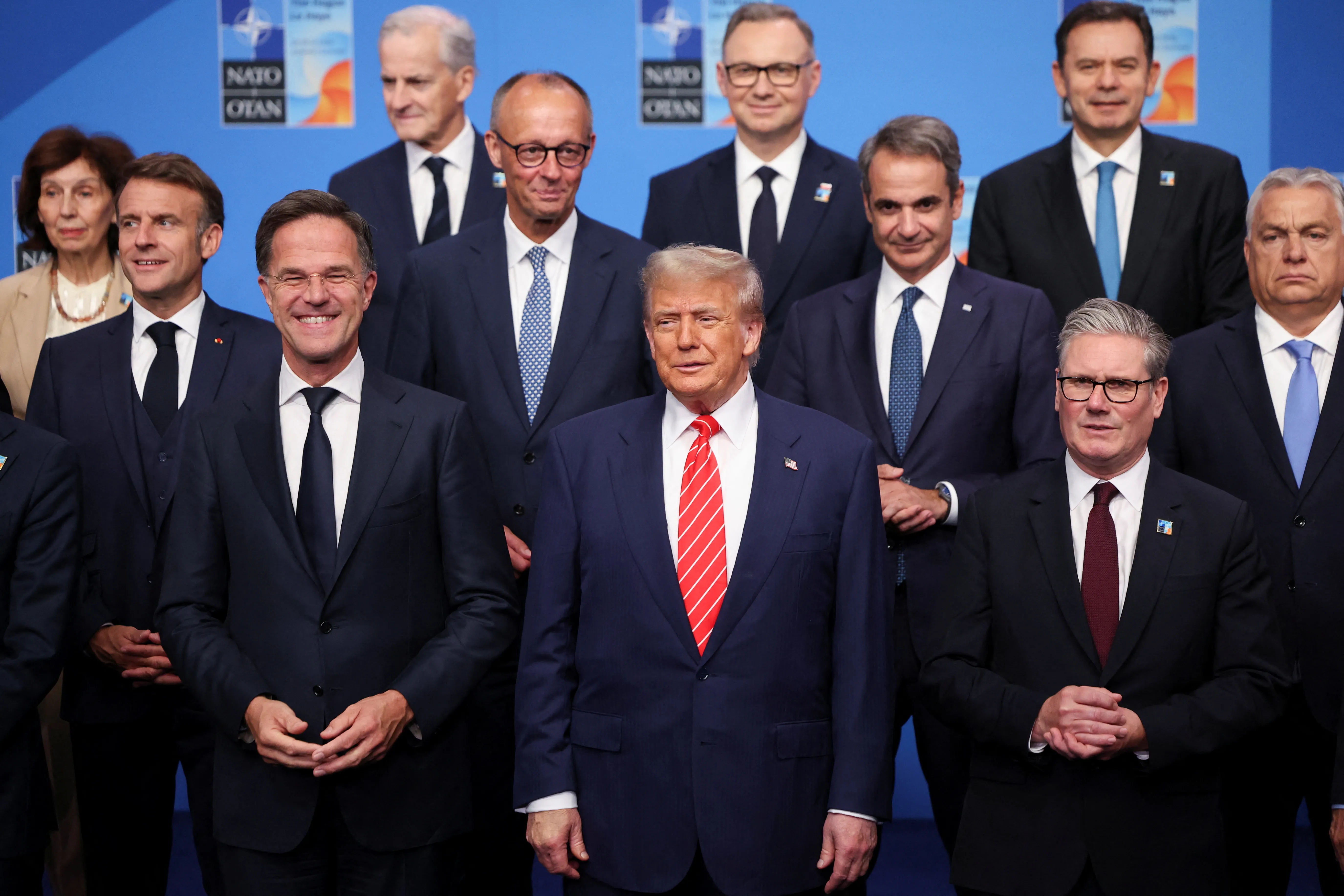 NATO Secretary General Mark Rutte, U.S. President Donald Trump, Britain
Why the Increase?
The push for a higher spending target comes amidst the ongoing Russia-Ukraine war and heightened concerns about regional security. NATO Secretary General Mark Rutte described Russia as “the most significant and direct threat” to the alliance, underscoring the perceived need for strengthened collective defense capabilities.
The new target is expected to be met by 2035, with a review planned for 2029 to assess progress and adjust as necessary.
 INTERACTIVE-NATO-DEFENCE-SPENDING-GDP-1750784626
Funding the New Target
Implementing the 5 percent target will require member states to identify significant new sources of funding. While NATO leadership expressed confidence in members’ willingness to commit due to the security environment, national governments face decisions on how to allocate resources.
Some European Union member states are being granted flexibility within EU fiscal rules to increase defense spending. The EU has also approved plans for a €150 billion ($174 billion) fund, financed by borrowing, to provide loans for joint defense projects among member countries.
US President Donald Trump has strongly advocated for increased spending by NATO allies, stating his belief that they should meet the 5 percent target.
Implications and Trade-offs
Increasing defense spending to 5 percent of GDP could necessitate difficult choices for national budgets. Without overall budget expansion or new revenue sources, higher military expenditure can potentially impact funding available for other public services, such as healthcare and education.
Currently, no NATO member spends more on defense than on healthcare or education. However, analyses suggest that if the 5 percent defense target is fully adopted, many countries that currently spend less than 5 percent of their GDP on education could end up allocating more to defense than to schooling.
The agreement to the 5 percent target marks a significant shift in NATO’s financial commitments, reflecting a renewed focus on collective defense in response to perceived security threats in the region.