A Russian warship has reportedly escorted two stateless tankers through European waters towards the Baltic Sea, according to maritime intelligence analysts. This development is seen as a potential tactic to protect vessels involved in transporting Russian oil amidst increasing international scrutiny and sanctions enforcement against the “shadow fleet.”
The incident involves the Russian Steregushchy-class corvette Boikiy accompanying two tankers, Naxos (also identified as Selva) and Sierra. The vessels were observed traveling together as they transited the English Channel and entered the Kattegat, an area approaching the Baltic Sea.
The sighting was reported by maritime domain awareness analyst Mark Douglas of Starboard Maritime Intelligence, who shared the information based on open-source intelligence, including AIS data. Douglas suggested the timing of the rendezvous between the tankers and the Boikiy as they reached the English Channel appeared deliberate. Neither tanker currently displays an accurate destination via their AIS signals.
Both Naxos and Sierra have been subject to international sanctions. The United Kingdom has sanctioned both vessels, while the European Union has also sanctioned Naxos. According to the Equasis database, both tankers are listed with unknown flags and are linked to companies based in Dubai and India.
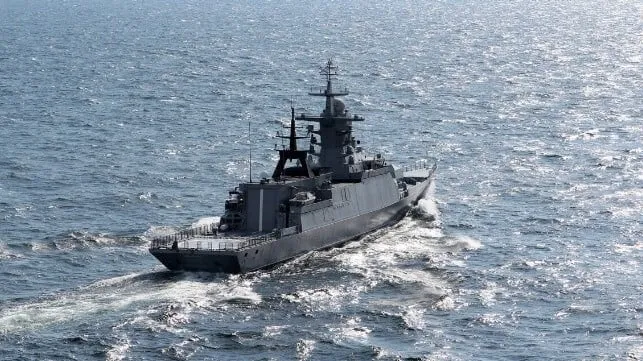 Russian Steregushchy-class corvette Boikiy at sea
Details about the tankers reveal a history of changing identities and registrations. The tanker Naxos, a vessel of 105,827 deadweight tons (dwt), is also known by the name Selva. It is currently showing Palau as its flag state, having previously used Panama. In 2022, its reported registries included the Marshall Islands and St. Kitts and Nevis.
The tanker Sierra, weighing 113,905 dwt, is currently displaying a flag of Malawi. Its registration history includes São Tomé & Principe in 2023, and prior to that, Barbados and Gabon. Before 2022, this vessel was known as Suvorovsky Prospect and was managed by the major Russian state-owned shipping company SCF (Sovcomflot).
The escorting warship, the Boikiy, is a corvette with a displacement of 2,100 tons commissioned in 2013. The vessel has previously been observed in escort roles. In mid-May, it was reportedly seen accompanying Russian-flagged cargo ships MV Siyanie Severa and MV Patria heading into the Atlantic. The UK’s Royal Navy has also reported tracking the Boikiy along with merchant ships during its transits of the English Channel in March and early May.
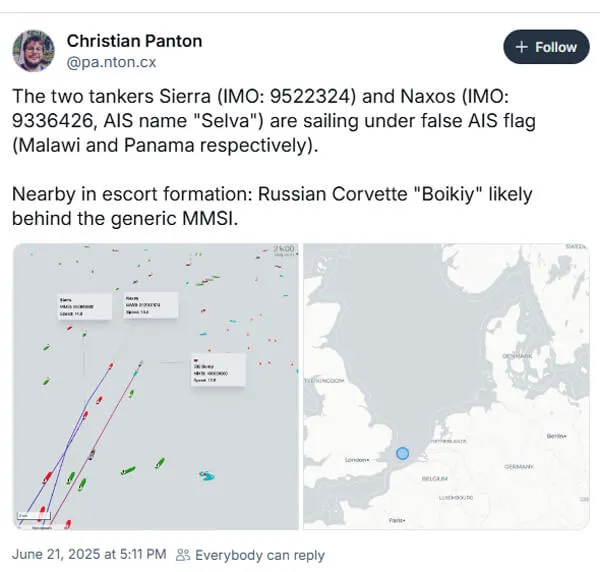 Maritime tracking data showing routes of tankers escorted by a Russian warship
This incident occurs in the context of increased efforts by Baltic nations and the European Union to address the movement of stateless tankers often associated with the “shadow fleet” transporting Russian oil. In late May, Finland’s Defense Minister Antti Häkkänen mentioned in an interview that tankers crossing the Gulf of Finland from Russia were receiving naval escorts.
Related incidents underscore the challenges in monitoring these vessels. Estonia previously attempted to inspect a different tanker suspected of being stateless, but the tanker refused to be directed into local waters, reportedly continuing its course after a Russian fighter jet briefly appeared. Last week, Denmark identified another stateless tanker inbound to Russia that had allegedly provided misleading registration information, tracking it through the Baltic without attempting to stop it.
Countries like Sweden have indicated they will increase efforts if stateless tankers enter their territorial waters. Both the EU and the UK have been expanding their lists of sanctioned tankers as part of broader measures to disrupt the shadow fleet and limit Russia’s oil export revenues.
The reported escort of sanctioned, stateless tankers by a Russian warship highlights the evolving tactics used to facilitate Russian oil exports amid international sanctions and the ongoing complexities of maritime security and enforcement in European waters.