Spain has formally rejected a proposal for NATO member states to commit to spending 5% of their gross domestic product (GDP) on defense, calling the target “unreasonable” just days before a critical alliance summit. The decision by Prime Minister Pedro Sánchez creates potential friction as leaders prepare to gather in The Hague next week, with discussions on defense spending expected to be a key focus.
Contents
Key Takeaways:
- Spain’s Prime Minister Pedro Sánchez has rejected a proposal for NATO members to target 5% of GDP for defense spending.
- Sánchez cited domestic reasons, including the potential impact on Spain’s welfare state and public services.
- Spain is currently one of the lowest defense spenders in NATO, though it committed to reaching the previous 2% target.
- The rejection comes ahead of a crucial NATO summit in The Hague, where defense spending targets will be debated.
Spain’s Stance on the 5% Target
In a letter sent to NATO Secretary General Mark Rutte, Prime Minister Sánchez stated that Spain “cannot commit to a specific spending target in terms of GDP” at the upcoming summit. He argued that pledging to a 5% target would be “unreasonable” and “counterproductive” for Spain.
Sánchez explained that meeting such a high target would necessitate significant cuts to public services and other essential spending areas, including efforts towards the green transition. He contended that a 5% commitment would be “incompatible with our welfare state and our world vision.”
Instead, Sánchez proposed a “more flexible formula” for setting defense spending targets, suggesting it either be optional or exclude Spain from its application. He emphasized Spain’s full commitment to NATO but indicated that its estimated defense needs could be met by spending 2.1% of GDP.
Spain’s Prime Minister Pedro Sánchez attends a press conference.
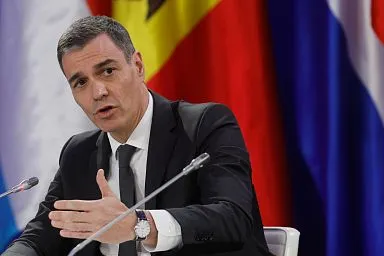 Spain Prime Minister Pedro Sánchez addresses media on defense spending
Context of NATO Defense Spending Discussions
NATO allies agreed in 2014, and reinforced in 2022 after Russia’s full-scale invasion of Ukraine, to move towards spending 2% of their GDP on defense annually. Many members are still working to meet this existing target.
However, discussions within the alliance have recently explored setting a higher baseline, particularly given the perceived increased threat from Russia. While a specific alliance-wide target above 2% has been debated, figures circulating include potential aims of 3%, 3.5% for core defense needs, and a total of 5% when including spending on supporting infrastructure and societal resilience. The 5% figure has been notably advocated by some, including former US President Donald Trump.
Spain currently ranks among the lowest spenders within NATO, directing less than 2% of its GDP towards defense last year. While Sánchez had previously announced plans to increase spending by €10.5 billion in 2025 to reach the existing 2% target, committing to a potential 5% goal represents a significant leap.
US President Donald Trump meets with members of the Juventus soccer club at the White House.
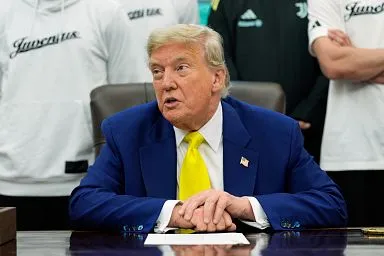 US President Donald Trump meets with group likely discussing international relations
Implications Ahead of the Summit
Any decision on a new defense spending guideline requires the consensus of all 32 NATO member states. Spain’s explicit rejection of the 5% figure risks disrupting efforts to present a united front on defense commitments at next week’s summit in The Hague.
The summit is expected to be attended by US President Donald Trump, who has long been critical of allies not meeting defense spending targets. While some allies, such as Poland and the Baltic states (Estonia, Latvia, Lithuania), have publicly committed to higher targets, including 5%, other nations like Belgium, Canada, and Italy may also face challenges in significantly increasing their defense budgets.
NATO officials have indicated that discussions among allies regarding a new defense spending plan are ongoing, with efforts underway to find a compromise before the leaders’ meeting. A key unresolved question remains the timeline countries would be given to achieve any newly agreed-upon target.
Domestic Factors in Spain
Prime Minister Sánchez’s stance on defense spending is also influenced by Spain’s domestic political landscape. The Spanish government is a coalition, and increased military spending is unpopular among some of Sánchez’s coalition partners on the political left. When Spain committed to reaching the 2% target in April, it reportedly caused dissatisfaction among some allies within the governing coalition.
Furthermore, Sánchez has faced pressure from recent domestic corruption scandals involving individuals close to him. This political context may add complexity to his position on significant public spending commitments like a large defense budget increase.
The debate over defense spending highlights the differing capacities and priorities among NATO members as the alliance seeks to adapt to current geopolitical realities and strengthen its collective defense posture.
Explore related articles on NATO’s defense spending goals and the upcoming summit in The Hague.