The International Atomic Energy Agency (IAEA) recently passed a resolution expressing concern over Iran’s compliance with nuclear safeguards. This development follows claims by the agency that it cannot fully verify the peaceful nature of Iran’s nuclear activities and comes amid escalating tensions and military actions targeting Iranian sites.
Contents
The situation raises questions about the future of international monitoring of the Iran nuclear program and the potential for further escalation.
Concerns Over Verification and Enrichment
Since February 2021, Iran has halted implementation of the Additional Protocol, which previously granted the IAEA enhanced inspection rights, including snap inspections and continuous surveillance at undeclared sites. While Iran continues to adhere to the Comprehensive Safeguards Agreement, allowing access to declared nuclear facilities like Natanz, Fordow, and Bushehr for routine monitoring, this reduced access limits the agency’s overall verification capabilities.
IAEA Director General Rafael Grossi stated in June that Iran’s failure to answer questions regarding man-made uranium particles found at three locations – Varamin, Marivan, and Turquzabad – significantly impacts the agency’s ability to confirm the program is entirely peaceful.
Grossi also voiced “serious concern” over Iran’s rapid accumulation of highly-enriched uranium. Iran has enrichment facilities at Fordow and Natanz operating at up to 60 percent purity. In 2023, the IAEA detected particles enriched to 83.7 percent at Fordow, close to the 90 percent needed for weapons. For more context on these sites, see: Are Israel’s attacks against Iran legal? and What is Iran’s Fordow nuclear facility?.
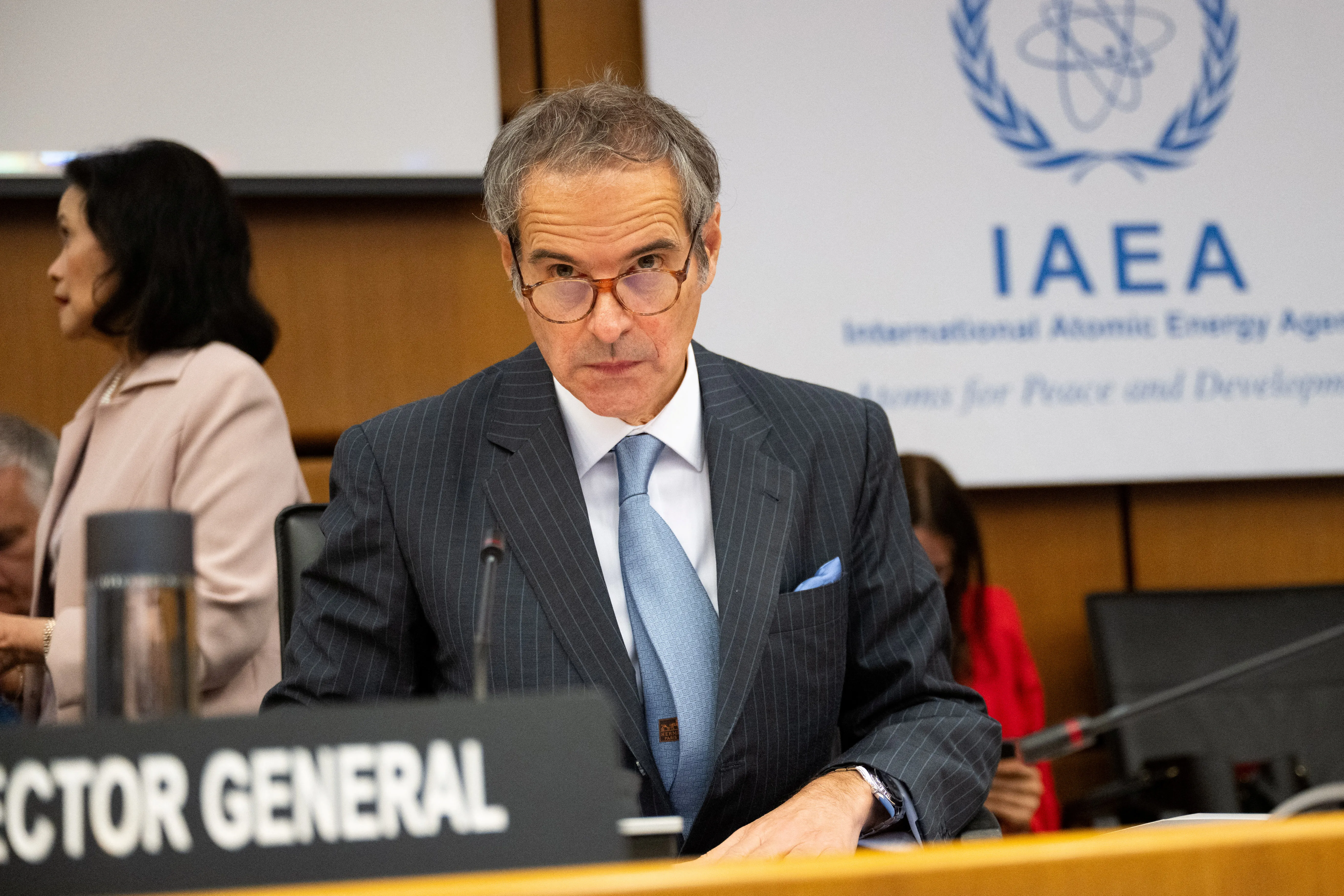 IAEA Director General Rafael Grossi attending a meeting concerning Iran's nuclear program.
On June 12, the IAEA Board of Governors passed a resolution stating Tehran was not complying with its non-proliferation obligations. An Al Jazeera report from Vienna on June 12 noted this was the first time in nearly 20 years the agency had made such an accusation against Iran.
Despite concerns over verification, Grossi has also emphasized that the IAEA has found no evidence indicating Iran is currently producing nuclear weapons. In a June 19 interview with Al Jazeera, Grossi stated, “We have not seen elements to allow us, as inspectors, to affirm that there was a nuclear weapon that was being manufactured or produced somewhere in Iran.”
Following the IAEA resolution, Israel launched strikes on Iranian military and nuclear sites on June 13. While Israel’s Foreign Ministry welcomed the resolution as confirmation of Iran’s “systematic clandestine nuclear weapons programme,” it did not explicitly use the resolution to justify the attack. The United States also carried out strikes on three Iranian sites on June 22, with Vice President JD Vance citing the IAEA resolution as support for military action.
Iran’s Response and Potential Future
Iran’s Ministry of Foreign Affairs and Atomic Energy Organization issued a joint statement condemning the resolution as “politically motivated” and claiming it “seriously undermines the credibility and integrity of the IAEA.” Tehran maintains its nuclear program is solely for civilian purposes and its facilities are monitored by the UN watchdog.
On June 23, Iran’s parliamentary national security committee approved a bill outline proposing the suspension of cooperation with the IAEA if the security of its nuclear facilities is not guaranteed. This bill, which parliament subsequently passed on June 25, could halt the installation of surveillance cameras, suspend inspections, and stop report submissions to the agency. Iran joined the IAEA in 1959. Read more: Iran passes bill to halt IAEA cooperation.
Iran asserts its right under the 1968 Non-Proliferation Treaty (NPT) to develop nuclear technology for peaceful purposes, including uranium enrichment. Tehran has historically argued that the NPT does not adequately protect it from potential attacks by nuclear-armed states like the US or Israel, widely believed to possess nuclear weapons.
Some Iranian authorities have also publicly questioned the motives of IAEA Director General Grossi, suggesting his actions are influenced by personal ambitions to become the next UN secretary-general rather than solely by technical considerations.
Past Precedents and Controversies
The IAEA has faced scrutiny in other instances involving complex political and technical issues.
Fukushima Water Release
In 2023, Japan began releasing treated water from the damaged Fukushima Daiichi nuclear plant into the Pacific Ocean. The IAEA reviewed the plan for two years and gave it approval, concluding that the discharges were consistent with international safety standards and would have a “negligible radiological impact.”
This plan faced strong opposition from Japan’s neighbours, particularly China, and Pacific island nations, as well as local fishing communities who feared for their livelihoods and the environment. China criticized the IAEA’s report, claiming it did not fully reflect expert views. The release began in August 2023, over a decade after the March 2011 tsunami that triggered the nuclear disaster.
Iraq WMD Claims (2003)
Prior to the 2003 US-led invasion of Iraq, the US and UK governments claimed Iraq possessed Weapons of Mass Destruction (WMDs) and was pursuing a nuclear weapons program. These claims were used to justify military action, presenting Iraq as an imminent threat.
The IAEA conducted inspections in Iraq in late 2002 and early 2003. While they identified high-tolerance aluminum tubes, which could theoretically be used to enrich uranium, the IAEA’s position refuted the US claim that these tubes were specifically intended for a nuclear weapons program. Despite the US government presenting the tubes as key evidence, extensive searches after the invasion found no active WMD programs in Iraq.
Conclusion
The recent IAEA resolution concerning Iran’s nuclear program highlights ongoing challenges in international verification efforts. While the agency states it has found no evidence of a nuclear weapons program, concerns over monitoring access and enrichment levels persist. Iran’s strong condemnation of the resolution and its parliamentary move to potentially limit cooperation underscore the deepening complexities and tensions surrounding its nuclear activities.
This situation reflects the delicate balance between international oversight, national rights under treaties like the NPT, and the geopolitical factors influencing regional stability. For more details on the unfolding events and related contexts, explore the articles linked throughout this report.