Washington D.C. lawmakers have voted to overturn a California regulation that would prohibit the sale of new gasoline-only cars by 2035. The measure, passed by both the House and Senate, seeks to nullify a waiver granted to California by the Environmental Protection Agency (EPA) that allows the state to set its own, stricter auto emissions standards. This action represents a significant political victory for Republicans and the auto industry, while marking a setback for environmental advocates and Democrats. President Trump is expected to sign the measure, likely initiating a legal challenge from California.
What Happened
The US Congress passed a resolution aimed at blocking California’s plan to phase out the sale of new internal combustion engine vehicles. The resolution specifically targets and seeks to repeal the EPA waiver that underpins California’s authority to implement stricter emissions rules than federal standards. This legislative move follows a similar attempt during the Trump administration’s first term, which led to a legal dispute before being reversed by the Biden administration.
Why Congress Acted
Supporters of the congressional action, including Republicans and automotive industry groups, argued that California’s mandated targets, such as requiring electric vehicles (EVs) to make up 35% of new sales by 2026, were unrealistic. Critics also voiced concerns about a related credit system where manufacturers selling fewer EVs would need to purchase credits from competitors like Tesla, potentially hindering their investment in their own EV production. John Bozzella, president of the Alliance for Automotive Innovation, stated, “The concerns were about the mandate – not the technology.”
The Other Side: Environmental and Economic Arguments
Opponents of the congressional block, including Democrats and environmental organizations, strongly criticized the move. They argue that California’s standards are crucial for reducing air pollution, combating climate change, and promoting domestic manufacturing. Manish Bapna, president of the Natural Resources Defense Council, called the halting of the standards illogical, saying they “reduce costs for drivers, boost domestic manufacturing, improve air quality, and help address the climate crisis.” He emphasized that other states were not required to follow California’s lead, and the federal government should not interfere with states’ ability to pursue cleaner environments.
California’s Unique Authority
For decades, California has been granted waivers by the EPA under the Clean Air Act to establish more stringent vehicle emissions standards than the federal government. This authority stems from the state’s historical challenges with air quality, particularly in areas like the Los Angeles basin. Approximately a dozen other states have historically adopted California’s auto emissions regulations, representing a substantial portion of the US car market.
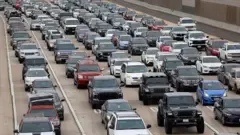 Traffic congestion on Interstate 805 near San Diego, California, showing a line of cars approaching the border crossing into Tijuana, Mexico.
In California, electric vehicles accounted for about a quarter of new car sales last year. This contrasts with the national picture, where EVs, including hybrids, made up roughly 10% of new sales last year. For comparison, electric vehicle adoption rates are higher in some other countries; for instance, EVs represented about 30% of new car sales in the UK last year. The UK government has announced its own plan to phase out sales of new petrol and diesel cars.
Political and Legal Outlook
The vote in Congress was largely along partisan lines, passing the Senate 51-44. Senate Democrats accused Republicans of using an unusual procedural tactic, sometimes referred to as a “nuclear option,” to bypass standard legislative processes and block the waiver. Both the Government Accountability Office and the Senate parliamentarian reportedly indicated Congress was not following typical procedure for repealing such a rule. With President Trump expected to sign the resolution, California Attorney General Rob Bonta stated the state would file a lawsuit to challenge the federal government’s action. Bonta called the move “illogical, politically motivated and it comes at the expense of Californian’s lives and livelihoods.”
Potential Impact
If upheld, the congressional action could significantly impact the US automotive market by preventing California and the states that follow its regulations from moving forward with the petrol car ban timeline. This could slow the pace of electric vehicle adoption across a large segment of the country, affecting industry investment strategies and environmental goals. The stage is now set for a legal battle to determine the fate of California’s plan and the state’s ability to set its own emissions standards.