
Imagine giant cosmic construction sites where planets are being built from scratch. For years, scientists have debated exactly how this happens. Now, thanks to a network of radio telescopes in the UK, astronomers have gathered crucial evidence by spotting vast quantities of centimeter-sized “pebbles” swirling around two young stars, strongly supporting a key theory of planet formation. This discovery offers a direct look at the raw materials coming together to build new worlds, potentially large planetary systems like our own.
Contents
The Mystery of Building Worlds
How do tiny specks of dust in space grow into colossal planets? It’s a fundamental question in astronomy. The disks of gas and dust surrounding newborn stars, called protoplanetary disks, are the cosmic nurseries where planets are born. Over time, the material within these disks must somehow clump together.
One leading idea, especially for forming massive worlds like gas giants, is called pebble accretion. Think of it like rolling a cosmic snowball. This theory suggests that dust grains first stick together to form objects about the size of pebbles – maybe an inch or two across. These pebbles then quickly gather more and more material, rapidly growing into larger bodies, which eventually become massive enough to pull in huge amounts of surrounding gas, forming giant planets.
 An illustration of a disk of dust and gas with a new star in the middle
However, getting dust to stick together in this way is tricky. Collisions could just cause particles to bounce off or even shatter. And finding direct evidence of these crucial centimeter-sized pebbles has been challenging. While smaller dust particles (millimeter-sized) have been seen by telescopes like ALMA, the Atacama Large Millimeter/submillimeter Array, the slightly larger pebbles remained elusive until now.
Enter the UK’s Radio Eyes
The breakthrough came from e-MERLIN, a unique network of seven radio telescopes spread across the UK, all linked by a high-speed fiber optic connection centered at Jodrell Bank Observatory. These telescopes are perfectly tuned to spot the faint radio waves emitted by cold, centimeter-sized objects in space.
Researchers from the PEBBLeS (Planet Earth Building Blocks – a Legacy eMERLIN Survey) project aimed e-MERLIN at two young stars in the nearby Taurus Molecular Cloud, about 430 light-years away: DG Tau and HL Tau. Both stars are surrounded by bustling protoplanetary disks.
The Discovery: A Sea of Pebbles
What they found was extraordinary. e-MERLIN detected widespread emission at radio wavelengths of about 4 centimeters, confirming the presence of vast amounts of centimeter-sized pebbles scattered throughout the disks of both DG Tau and HL Tau.
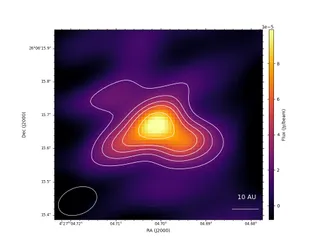 A heat map showing various shapes of purple, yellow and black on a grid.
These observations show that the raw materials for building planets in the form of pebbles are already present in these disks, extending out to regions comparable to Neptune’s orbit in our own solar system.
“This is potentially enough to build planetary systems larger than our own solar system,” said Katie Hesterly of the Square Kilometer Array (SKA) Observatory.
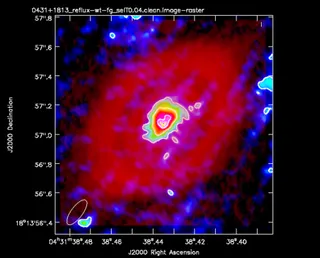 A heat map of various reds and blues over a grid
Finding these pebbles isn’t like finding loose change on the sidewalk. According to theory, once these pebbles form, they should rapidly start clumping together to form bigger planetary building blocks. This means they are a fleeting phase in the planet formation process.
“As the grains clump together to make planets, the surface area of a given mass gets smaller and harder to see,” explained Jodrell Bank’s Anita Richards.
What This Means and What Comes Next
The detection of these planet-building pebbles is a significant validation for the pebble accretion theory. It shows that this crucial step in the process – forming and distributing centimeter-sized material – is indeed happening in young planetary systems.
“Through these observations, we’re now able to investigate where solid material gathers in these disks, providing insight into one of the earliest stages of planet formation,” said Jane Greaves of the University of Cardiff, who led the PEBBLeS survey.
 An infographic showing various telescopes in the UK as part of the e-Merlin project
While e-MERLIN has shown what’s possible, the upcoming Square Kilometer Array (SKA) telescope, a massive international project with headquarters at Jodrell Bank, promises even more detailed views.
“The SKA telescope will take it further,” Hesterly noted. When the SKA begins science operations around 2031, astronomers will be able to study hundreds of these young planetary systems with unprecedented clarity, helping to unravel the full story of how planets like Earth and the gas giants in our solar system came to be. This research brings us one step closer to understanding our place in the cosmos and the incredible journey from cosmic dust to diverse worlds.
You can learn more about this fascinating research in related articles like Have astronomers found the ‘secret recipe’ for rapid planet growth? or Scientists chip away at secrets of planet formation, origin of life in bevy of new research.