Prepare to be amazed by the universe! The Royal Observatory Greenwich and ZWO have unveiled the spectacular shortlist for the 2025 ZWO Astronomy Photographer of the Year competition. Featuring breathtaking images from across the globe, these astronomy photographer entries capture everything from dancing auroras on Earth to distant galaxies billions of stars away, offering a unique window into the beauty and wonder of our cosmos.
Contents
- A Celestial Showcase: Exploring the Categories
- Auroras: Nature’s Cosmic Light Show
- Galaxies: Islands of Stars
- Our Moon: Earth’s Closest Companion
- Our Sun: The Star That Powers Our World
- People & Space: Our Place in the Cosmos
- Planets, Comets & Asteroids: Our Solar System Neighbors
- Skyscapes: Merging Earth and Sky
- Stars & Nebulas: Birthplaces and Remnants
- The Sir Patrick Moore Prize for Best Newcomer & ZWO Young Astronomy Photographer of the Year
- Annie Maunder Open Category
- What’s Next?
The annual competition, now in its 17th year, invites photographers of all levels to share their vision of the night sky. With over 5,500 submissions from 69 countries this year, the shortlist represents the pinnacle of celestial artistry and technical skill, sparking curiosity and connecting us to the vastness beyond our planet.
A Celestial Showcase: Exploring the Categories
The shortlisted images span a diverse range of astronomical subjects, categorized to highlight the different facets of space photography. Let’s journey through some of the stunning highlights.
Auroras: Nature’s Cosmic Light Show
Witness the ethereal dance of the auroras, caused by charged particles from the Sun interacting with Earth’s atmosphere. These photos capture their fleeting beauty from dramatic landscapes.
Filip Brebenda captured a swirling green aurora from a remote spot in northern Norway, framed by birch trees and reflected in still water.
 Vibrant green aurora reflects in still lake water over mountains
A rare sight was caught by Daniel Zafra: magenta and green auroras mirrored in the unique waters of California’s Mono Lake, dotted with rocky formations.
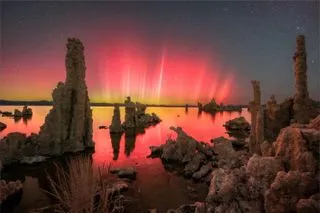 Vibrant ribbons of magenta and green light up the night sky over Mono Lake rock formations
Over snowy mountains in Norway, Vincent Beudez photographed an auroral display resembling an arctic flower unfurling in the sky.
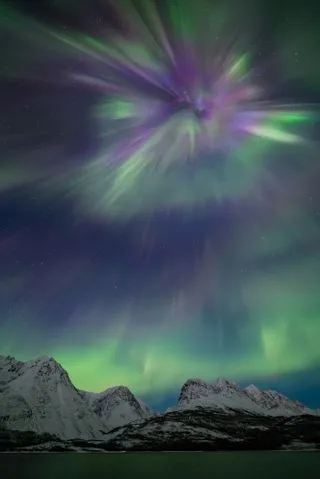 Purple and green aurora shimmers like a cosmic flower over snowy mountains
Galaxies: Islands of Stars
Explore the incredible structures of galaxies, vast collections of stars, gas, and dust. These images bring distant cosmic islands into sharp focus.
This striking image of the Triangulum Galaxy (M33) by Bence Tóth, Péter Feltóti, and Bertalan Kecskés shows intense star formation, looking like cosmic fireworks influenced by a galactic neighbor.
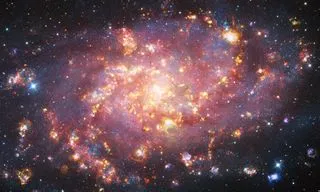 Spiral galaxy M33 glows like gold and pink fireworks amidst stars
The Andromeda Galaxy (M31), our closest large galactic neighbor, shines brightly in a detailed mosaic created by Chuhong Yu, Jingyao Hong, Xi Zhu, and Yaguang Wan. Taken over 216 hours, it reveals countless stars and nebulas in its spiral arms.
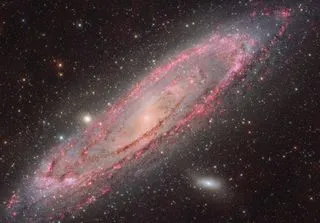 Pink and white spiral arms of the Andromeda galaxy against a starry background
Xinran Li captured the barred spiral galaxy NGC 2997, also known as the Antlia Cabbage Galaxy, from Chile. Located 35 million light-years away, it appears surrounded by glowing red cosmic clouds after 10 hours of observation.
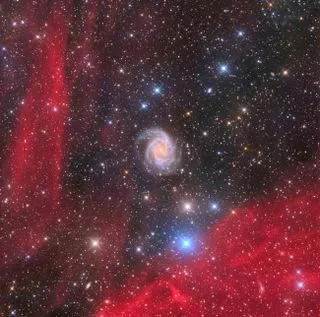 Spiral galaxy NGC 2997 is framed by red clouds of cosmic dust
Our Moon: Earth’s Closest Companion
From distorted phases to celestial alignments, these photos showcase the familiar face of our Moon in new and stunning ways.
Flavien Beauvais captured a distorted, rising full moon over the historic French château of Villebois-Lavalette, showcasing a unique perspective on the lunar cycle.
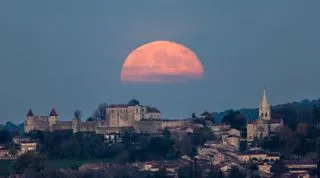 Full red moon hangs low over a French château at night
A remarkable composite by Chayaphon Phanitloet from Thailand shows a moment when the Moon passed directly in front of Saturn, temporarily blocking its light.
Karthik Easvur’s impressive mosaic stitches together 24 images to create a detailed portrait of a supermoon looming large over Delhi, India.
 Detailed close up of a supermoon with blueish areas and bright light
Our Sun: The Star That Powers Our World
See the dynamic beauty and power of the Sun, from transient events to its incredible scale.
Zhang Yanguang timed this composite perfectly to capture the International Space Station (ISS) silhouetted as it zipped across the Sun’s face, revealing stunning detail on our star’s surface.
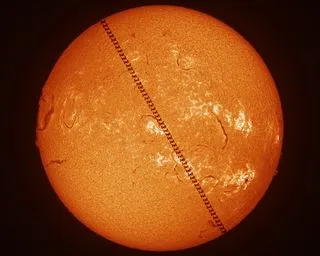 Composite image shows the International Space Station crossing the face of the Sun
PengFei Chou documented a massive 311,000-mile-long (500,000 km) solar prominence, a huge eruption of plasma from the Sun’s surface, captured over an hour.
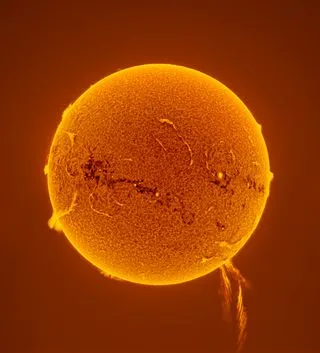 The Sun as a glowing sphere with a large jet of hot gas erupting from the side
Damien Cannane’s artistic view of a solar eclipse highlights Baily’s Beads, the effect of sunlight shining through lunar valleys just before totality.
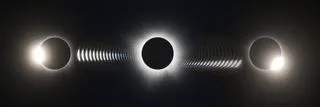 Composite photo showing different phases of a solar eclipse including Baily's Beads
People & Space: Our Place in the Cosmos
These images capture the connection between humanity and the vast universe above, often blending terrestrial landscapes with celestial wonders.
Tianyao Yang planned for five years to capture this dramatic shot of the July full moon rising behind skyscrapers in Shanghai’s Lujiazui district, making the Moon appear enormous.
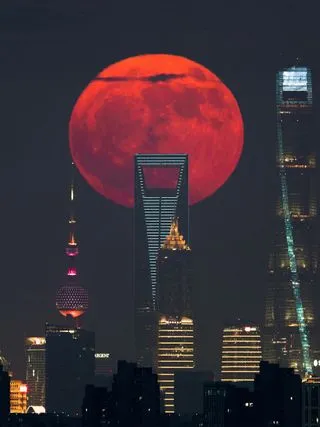 Large bright red moon rises behind tall city skyscrapers at evening
Yujie Zhang’s photo from China shows the bright band of the Milky Way arching over modern geometric buildings reflected in calm water, creating a “Gateway to the Galaxy.”
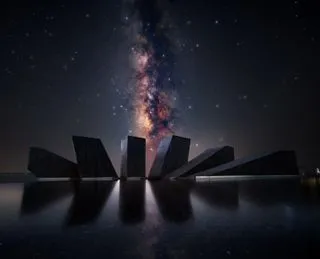 Milky Way galaxy arches over a man-made sculpture reflected in still water
In the U.K., Paul Joels captured the Milky Way glittering over a boathouse in Lulworth Cove, showcasing the peaceful coexistence of coastal life and cosmic grandeur.
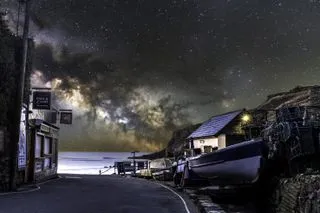 Milky Way galaxy in the night sky above a fishing village scene
Ran Shen photographed Comet C/2023 A3 (Tsuchinshan-ATLAS) streaking across the sky above the city lights of Honolulu, Hawaii.
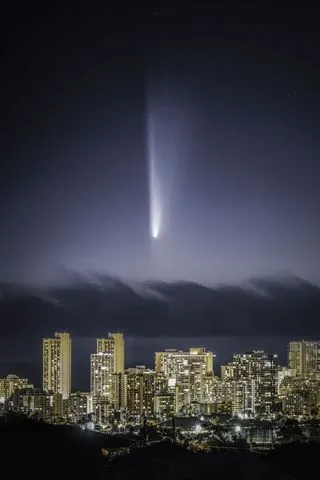 Large comet streaks over the brightly lit city of Waikiki with skyscrapers
From New Zealand, Chester Hall-Fernandez shows the Milky Way setting parallel to the horizon over the Mount John Observatory, including the large MOA-II telescope observing the southern night sky.
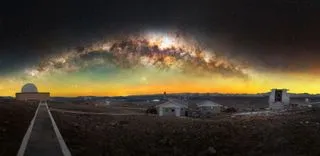 The Milky Way sets over the Mount John Observatory with city lights below
Planets, Comets & Asteroids: Our Solar System Neighbors
Closer to home, photographers capture the details and movements of objects within our solar system.
Gerald Rhemann and Michael Jäger captured a close-up of Comet Tsuchinshan-ATLAS from Namibia, showing its distinct dust (grey) and ion (blue) tails, the latter shaped by the solar wind.
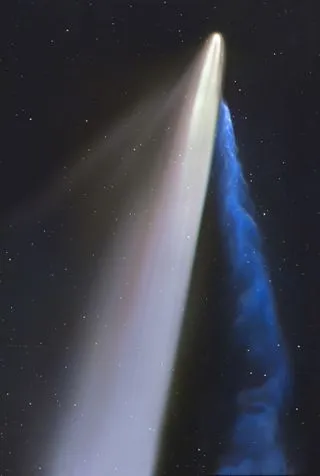 Comet Tsuchinshan-ATLAS streaks across space with distinct blue ion tail
Sophie Paulin created a remarkable composite “family portrait” of all the solar system planets (excluding Earth) captured from Germany over more than a year, showing them lined up.
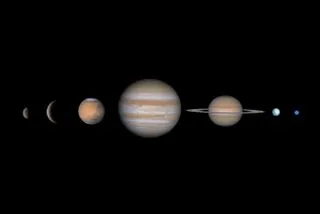 Composite image showing all solar system planets lined up against a dark background
Skyscapes: Merging Earth and Sky
These images combine earthly landscapes with the beauty of the night sky, creating stunning natural portraits.
Benjamin Barakat captured a lone tree against hypnotic star trails from Yemen, illustrating Earth’s rotation relative to the distant stars.
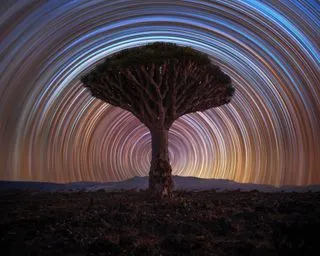 Long-exposure image of a lone tree in front of swirling star trails
Fabian Dalpiaz photographed a beautiful full moon rising over the Dolomite mountains in Italy, bathed in the last light of sunset.
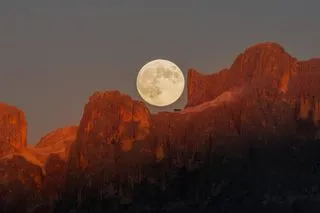 Full moon rises over the jagged peaks of the Dolomite mountains
Yoshiki Abe captured the Milky Way from inside a remote cave mouth in Japan, blending the earthly shelter with the cosmic expanse above.
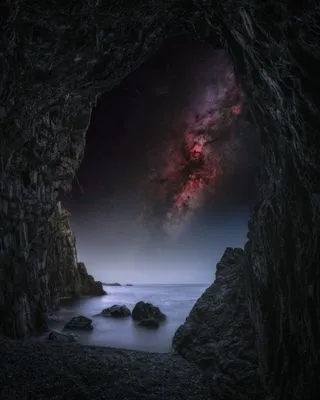 Night sky view of the Milky Way galaxy from inside a cave mouth
Jim Hildreth’s vast panorama of the Utah Desert at night shows the Milky Way arcing high overhead across a sea of stars, connecting the ancient landscape with ancient light.
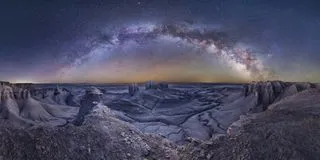 Composite image of the Milky Way galaxy arching over the Utah desert landscape at night
Andreas Karaolis captured the Milky Way’s Cygnus region over a hillside in Cyprus, using techniques to blend the foreground captured during the “blue hour” with the cosmic scene.
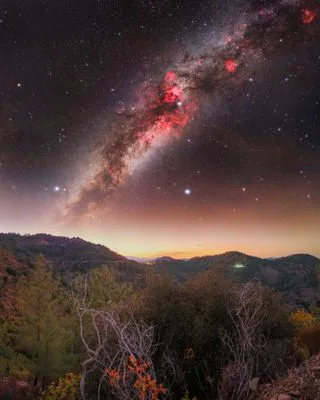 The Milky Way galaxy glows above a verdant forest hillside
Stars & Nebulas: Birthplaces and Remnants
Focusing on deep-sky objects, these images reveal the intricate structures of stellar nurseries and the explosive aftermaths of dying stars.
Shaoyu Zhang’s vibrant composite view of the Christmas Tree Nebula and Rosetta Nebula combines 150 hours of observation to reveal rich colors and detail in these star-forming regions.
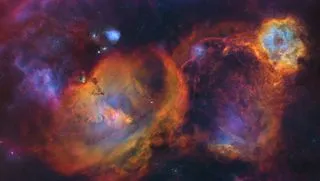 Rainbow-colored cloud of gas and dust, the Rosetta and Christmas Tree Nebulas
Rod Prazeres captured the “Running Chicken Nebula” (IC 2944), an enormous stellar nursery in the constellation Centaurus, showcasing intricate clouds of gas and dust.
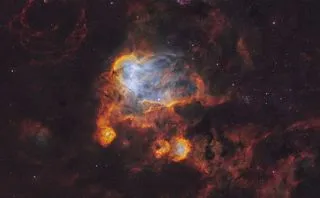 Blue and white clouds swirl among red and black nebula clouds in deep space
Shaoyu Zhang’s “electric” view of the “Spaghetti Nebula” (Simeis 147), a vast supernova remnant, used over 148 hours of exposure to reveal hidden structures in vibrant colors.
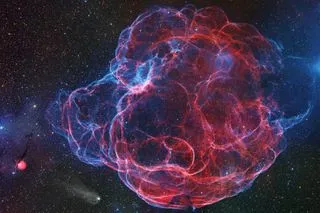 Red, blue, and purple tendrils of the Spaghetti Nebula supernova remnant on a starry background
The Sir Patrick Moore Prize for Best Newcomer & ZWO Young Astronomy Photographer of the Year
The competition also celebrates emerging talent. Deqian Li’s image of the Abel 85 supernova remnant, captured during a camping trip in China, is shortlisted for the Newcomer prize.
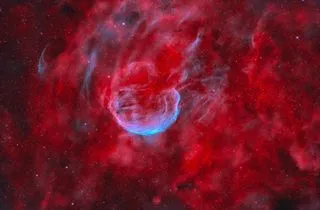 Cloud of blue gas glows amidst red dust in outer space, Abell 85 supernova remnant
Louis Egan’s 22-megapixel panorama capturing the different stages of a total solar eclipse during the April 8, 2024 event is shortlisted for the Young Photographer award.
Annie Maunder Open Category
This category encourages creative approaches. Peter Ward’s “Neon Sun” uses ultraviolet data from NASA’s Solar Dynamics Observatory, remapping colors to create a unique, artistic view of our star.
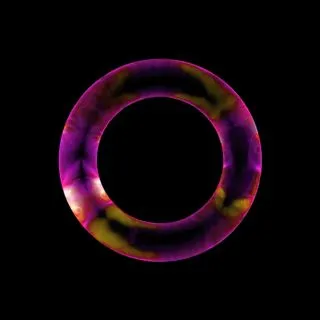 Ring of purple and yellow light against a black background, a 'Neon Sun' effect
What’s Next?
These incredible images remind us that the universe is full of breathtaking beauty, waiting to be captured and shared. The winners of the ZWO Astronomy Photographer of the Year competition will be announced in September and the winning entries, along with select runners-up, will be exhibited at the National Maritime Museum in London.
Seeing these photos is more than just viewing art; it’s connecting with the vastness of space and the fundamental processes shaping our cosmos. They inspire us to look up and wonder about the incredible universe we inhabit.
To explore more about the subjects in these photos, check out related articles on Space.com covering everything from auroras and galaxies to the Moon, Sun, planets, and nebulas.