
For centuries, we’ve learned Isaac Newton’s First Law of Motion as the rule of inertia: an object stays still or moves in a straight line unless a force acts on it. It’s a cornerstone of physics, taught in classrooms worldwide. But what if a single, overlooked word in the original Latin text subtly shifted its true meaning all along? A philosopher suggests a nearly 300-year-old translation error might have led to a fundamental misunderstanding of what Newton intended, revealing a deeper connection to the real world. This discovery offers a fascinating look into the history of science and the power of precise language.
Contents
The Law We Thought We Knew
Newton’s Principia Mathematica, published in 1687, laid out the universal laws governing motion. The first law, in its most common English translation from 1729, states that a body continues in its state of rest or uniform motion in a straight line unless it is compelled to change that state by forces impressed upon it.
This version works well conceptually – imagine a ball floating in empty space, moving forever in a straight line without anything stopping it. But in our universe, objects are always subject to forces like gravity or friction. This raises a puzzling question: Why would Newton, who was keenly aware of these ever-present forces, write a law about a hypothetical state where no forces exist?
The “Unless” vs. “Insofar” Discovery
Enter Daniel Hoek, a philosopher at Virginia Tech, who dove into the archives and Newton’s original Latin. He wasn’t the first to notice something was off; two scholars in 1999 highlighted a key word that seemed mistranslated: quatenus.
While the 1729 English translation used “unless” for quatenus, Hoek and others argue the better translation is “insofar” or “to the extent that.” This small change has a profound impact on the law’s meaning.
Instead of saying, “An object maintains motion UNLESS a force acts,” the revised reading suggests Newton meant something closer to, “A body continues in its state of rest or uniform motion INSOFAR AS no force is impressed upon it, and every change to that state is due to forces.”
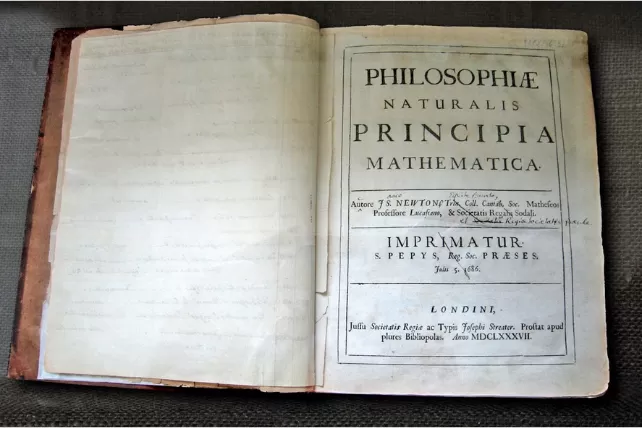 Newton's annotated copy of Principia Mathematica open to his first law of motion.
Why This Subtle Shift Matters
This reinterpretation isn’t just academic nitpicking; it changes the purpose of the first law. If the law describes how objects behave when forces act on them, it becomes a tool not for describing ideal, force-free motion, but for identifying and quantifying forces based on observed changes in motion.
Think of it like this: The common translation describes an ideal, unattainable state. The proposed translation describes how forces cause all deviations from that state. Every jolt, curve, or speed change in a real object is a direct consequence of forces acting on it, insofar as those forces are applied.
This aligns beautifully with Newton’s own examples. He used a spinning top, which slows and spirals due to air friction – a force. If the law was only about force-free motion, this example wouldn’t make sense. But if the law explains that every change (the slowing and spiraling) is because of the force (friction), the example fits perfectly.
Connecting Earthly Physics to the Cosmos
While this linguistic correction doesn’t change the mathematical formulas of physics we use today, it clarifies Newton’s original thought process and the role he envisioned for his first law. It highlights his revolutionary insight: that the same laws governing a spinning top on Earth also govern the planets orbiting the sun.
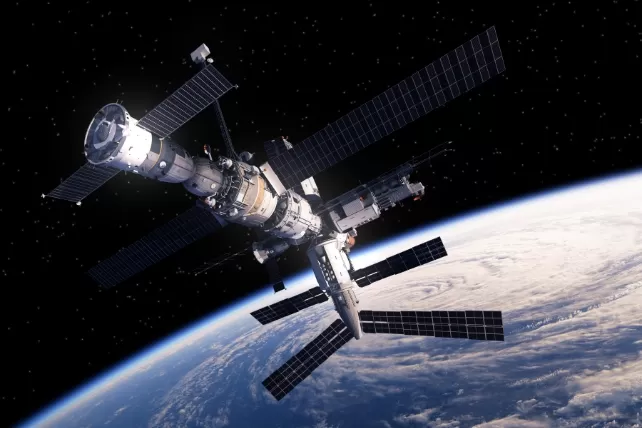 International Space Station orbiting Earth, illustrating motion influenced by gravity.
Every change in speed or direction, from a baseball curving through the air to the moon orbiting Earth or even distant galaxies swirling, is governed by forces – gravity, friction, etc. – exactly as Newton described, insofar as those forces are acting.
This forgotten word, “insofar,” restores what some see as the true elegance and intent of Newton’s First Law, rooting it firmly in the reality of a universe filled with interacting forces and reminding us how even the smallest details can hold the key to a deeper understanding of history and science.