
Imagine a time when you could walk from Africa to South America. It sounds like science fiction, but 120 million years ago, dinosaurs might have done just that. New research studying dinosaur footprints in Cameroon and Brazil has uncovered compelling evidence of a narrow land bridge that allowed these massive creatures to roam between the two landmasses long before the Atlantic Ocean formed. This discovery is like finding a hidden diary of ancient Earth, written in stone by the dinosaurs themselves.
Contents
Tracing Giant Steps Across a Vanished World
Deep within the rock layers of northern Cameroon, a three-toed footprint, the size of a large hand, was pressed into ancient river mud. Miles and millions of years away in northeastern Brazil, another similar print tells the same story. These fossilized tracks, dating back to the Early Cretaceous period, aren’t just remnants of giant lizards; they are crucial puzzle pieces that help scientists reconstruct the geography of our planet when it looked vastly different.
This connection was brought into sharp focus by a study led by paleontologist Louis L. Jacobs of Southern Methodist University (SMU). His international team meticulously catalogued over 260 dinosaur tracks in both the Koum Basin of Cameroon and the Borborema region of Brazil.
“In terms of age, these footprints were similar,” Jacobs noted. “In their geological and plate tectonic contexts, they were also similar. In terms of their shapes, they are almost identical.”
These twin sites, separated by the vast expanse of the modern Atlantic, were once side-by-side parts of the southern supercontinent called Gondwana. Researchers now refer to this ancient migratory path as the Dinosaur Dispersal Corridor.
 Long trackway of footprints left by a large plant-eating ornithopod dinosaur preserved in ancient river deposits in Brazil.
A Narrow Window in Time
Around 140 million years ago, Pangea, the supercontinent that included all of Earth’s landmasses, was already breaking apart. Gondwana, the southern portion, was beginning to rift, a process that would eventually create the South Atlantic Ocean. But this breakup didn’t happen overnight.
Even as tectonic forces pulled the land apart, a narrow, low-lying plain connected what is now northeastern Brazil to the coast of Cameroon. This connection, like a temporary bridge, allowed life to move freely between the soon-to-be continents.
Most of the footprints found belong to three-toed theropods, the agile meat-eaters of the time. A smaller number of impressions from lumbering long-necked sauropods and duck-billed ornithopods suggest herds of plant-eaters also used these paths.
The age of these tracks is further supported by fossilized pollen found in the same rock layers, confirming the connection existed around 120 million years ago. This was a critical time, right before the Atlantic rift widened too much for land animals to cross.
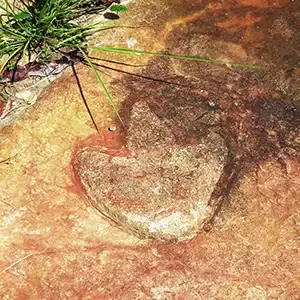 Detailed fossil footprint with three prominent claws left by a meat-eating theropod dinosaur in Cretaceous-era mudstone from Brazil.
“The two continents were continuous along that narrow stretch, so that animals on either side of that connection could potentially move across it,” Jacobs explained. The footprints capture this fleeting moment in Earth’s history, a snapshot of a world just before it was irrevocably changed.
Rivers: Ancient Highways of Life
These ancient river valleys weren’t just places where mud preserved footprints; they were lifelines. They provided water, vegetation for herbivores, and hunting grounds for carnivores.
“Rivers flowed and lakes formed in the basins,” Jacobs said. “Plants fed the herbivores and supported a food chain.”
The muddy sediments left by these waterways were perfect for capturing the impression of a dinosaur’s foot, creating a permanent record of their passage. These river systems effectively acted as natural highways, guiding animals across the landscape that would eventually sink beneath the waves.
Beyond the tracks, fossil bones from nearby areas paint a richer picture of this ancient ecosystem. Evidence of crocodilians, turtles, fish, and even early mammals hint at a diverse community thriving along these routes. Each fossil helps fill in the story of how life adapted on a dynamic planet.
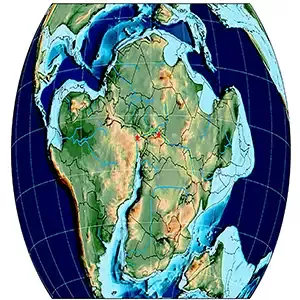 Paleogeographic map showing South America and Africa 120 million years ago, illustrating the narrow land bridge connecting them and highlighting locations of matching dinosaur footprints.
The rock basins in northern Cameroon and Brazil where these tracks are found are similar in structure, remnants of the stretching and dropping of the Earth’s crust as the continents pulled apart. This geological similarity, combined with the matching fossil record, provides powerful evidence for the past connection. Northern Cameroon, in particular, has been a key site for discoveries dating back to the 1980s, consistently yielding new insights despite its remote location.
In Brazil, the tracks are preserved in fine-grained red siltstones, capable of capturing incredible detail, including claw marks and even skin texture. Together, these sites confirm that dinosaurs continued to use these river corridors for migration even after the breakup of Pangea had begun.
Why Ancient Tracks Matter Today
Studying these dispersed footprints isn’t just about understanding dinosaurs; it has practical applications today. The data gathered improves the complex computer models scientists use to reconstruct continental drift. More accurate models can help us better predict where valuable resources like oil, minerals, or groundwater might be located today based on ancient geology.
The study also offers valuable lessons about how living things respond to drastic environmental changes. As continents shift and coastlines change, migration routes are affected. Understanding how ancient animals navigated a fragmenting world can provide insights for modern wildlife struggling with habitat loss and fragmentation caused by human activity.
In Cameroon, some of these ancient paths are now accessible to visitors, offering a chance to literally walk where dinosaurs once roamed. Locals describe the experience as feeling like “a story written in stone.”
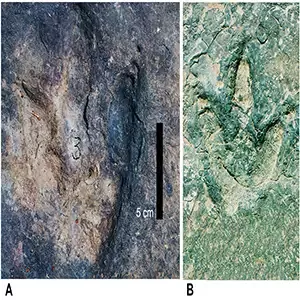 Two distinct three-toed fossil footprints from a theropod dinosaur, preserved in rock from the Koum Basin in northern Cameroon.
This story is far from over. Researchers continue to scan, map, and compare tracks, hoping to uncover more corridors and gain a deeper understanding of how widespread and complex prehistoric animal movements truly were.
The footprints in Cameroon and Brazil are a powerful reminder that our planet is constantly changing, albeit at a pace we can barely perceive. Over millions of years, slow continental drift reshapes oceans and climates, altering the very paths available to life. By reading the mudstone diaries left behind, scientists are piecing together the incredible story of how creatures adapted, walked, and thrived across a world that exists now only in the fossil record beneath our feet.
The full study was published in print by the New Mexico Museum of Natural History & Science.
Want to learn more about amazing fossil discoveries? Explore other stories about prehistoric migration or dive into the fascinating world of dinosaur research on Earth.com.