
A single, ancient bone from a giant ground sloth in Uruguay holds a remarkable secret: a deep, mysterious indentation that scientists believe might have been made by humans around 33,000 years ago. This tantalizing find pushes back the potential timeline for when humans first interacted with the massive megafauna of South America by thousands of years, challenging widely accepted theories about our ancestors’ journey across the continents.
Contents
Here’s what this discovery tells us:
- A 33,000-year-old sloth heel bone has an unusual, deep mark.
- Researchers meticulously studied the mark, ruling out natural causes like animal bites or accidents.
- The evidence strongly suggests a tool, possibly human-made, caused the injury.
- This could mean humans were present and interacting with megafauna in South America much earlier than previously thought.
The Mystery of the Marked Bone
Found at the Arroyo del Vizcaíno site in southern Uruguay, this particular bone is the right heel bone (calcaneus) of a Lestodon armatus, a type of giant ground sloth that once roamed the continent. The site itself is a treasure trove, a dense bed containing over 2,000 bones from megafauna, primarily these large sloths, dating back about 33,000 years. Among these ancient remains, bone CAV 45 stood out because of a distinctive mark.
The mark is a circular, cone-shaped depression, roughly 21 millimeters across and nearly 41 millimeters deep. What makes it particularly intriguing are its characteristics: smooth entry edges and fracture patterns, known as conchoidal fractures, which are typical indicators of something forcefully penetrating hard, thick bone.
Uncovering the Clues Inside the Mark
To understand exactly how this mark was made, the researchers used advanced techniques. They employed CT scanning to create detailed internal maps of the wound structure. They also made silicone casts of the indentation to study its shape and features closely.
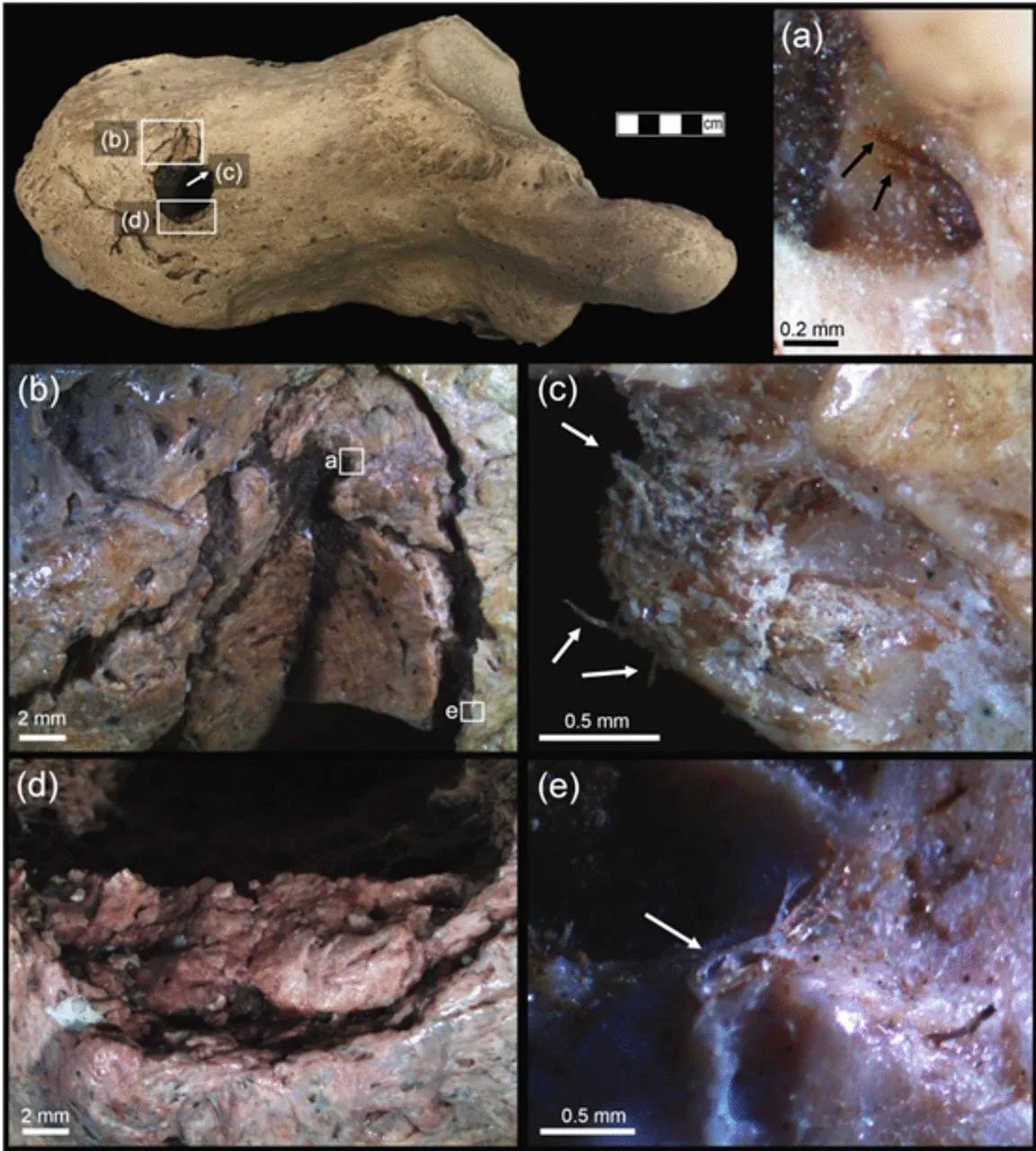 Microscopic view showing organic fibers and fractures on ancient sloth bone indentation
Microscopic examination revealed fine parallel lines or striations within the cavity. These tiny scratches suggest that whatever penetrated the bone didn’t just go straight in; it rotated and shifted slightly as it entered. Furthermore, tests for organic residues found plant materials still lodged deep within the indentation. This detail is crucial – it points not only to a traumatic injury but also possibly to the transfer of materials from the tool itself, like wood fibers from a shaft or hardened tip.
Why It Points to Human Activity
To be sure the mark wasn’t just a natural occurrence, the scientists carefully considered other possibilities. Could it have been a bite from a fearsome predator like a saber-toothed cat or a giant bear? No, carnivore teeth leave very specific puncture marks, and none match the clean, circular bore on the sloth bone. What about an accident, like being trampled or hit by a falling rock? These kinds of impacts usually cause irregular, shattered fractures, not a neat, cone-shaped hole. The precise nature and depth of the mark strongly argue against these natural explanations.
Based on the mark’s shape, the penetrating object likely had a rounded, rather than sharp, tip. The researchers propose it could have been a sturdy wooden shaft capped with a point made of bone, ivory, or dense wood. This tool would have been driven into the bone with considerable force and some rotation to create such a deep, distinct wound.
The angle of penetration, estimated at about 60 degrees relative to the ground, fits a scenario where someone might be thrusting a weapon at the animal from a relatively close distance. This type of injury might have been aimed at disabling or immobilizing the massive sloth, perhaps as part of a hunt, rather than immediate butchery. This research adds to our understanding of artifacts from this distant past.
Shifting the Timeline for Human Arrival
This potential evidence of trauma from a human tool suggests that people were interacting with, and possibly hunting, giant megafauna in southern South America long before the Last Glacial Maximum (which occurred roughly 26,500 to 19,000 years ago).
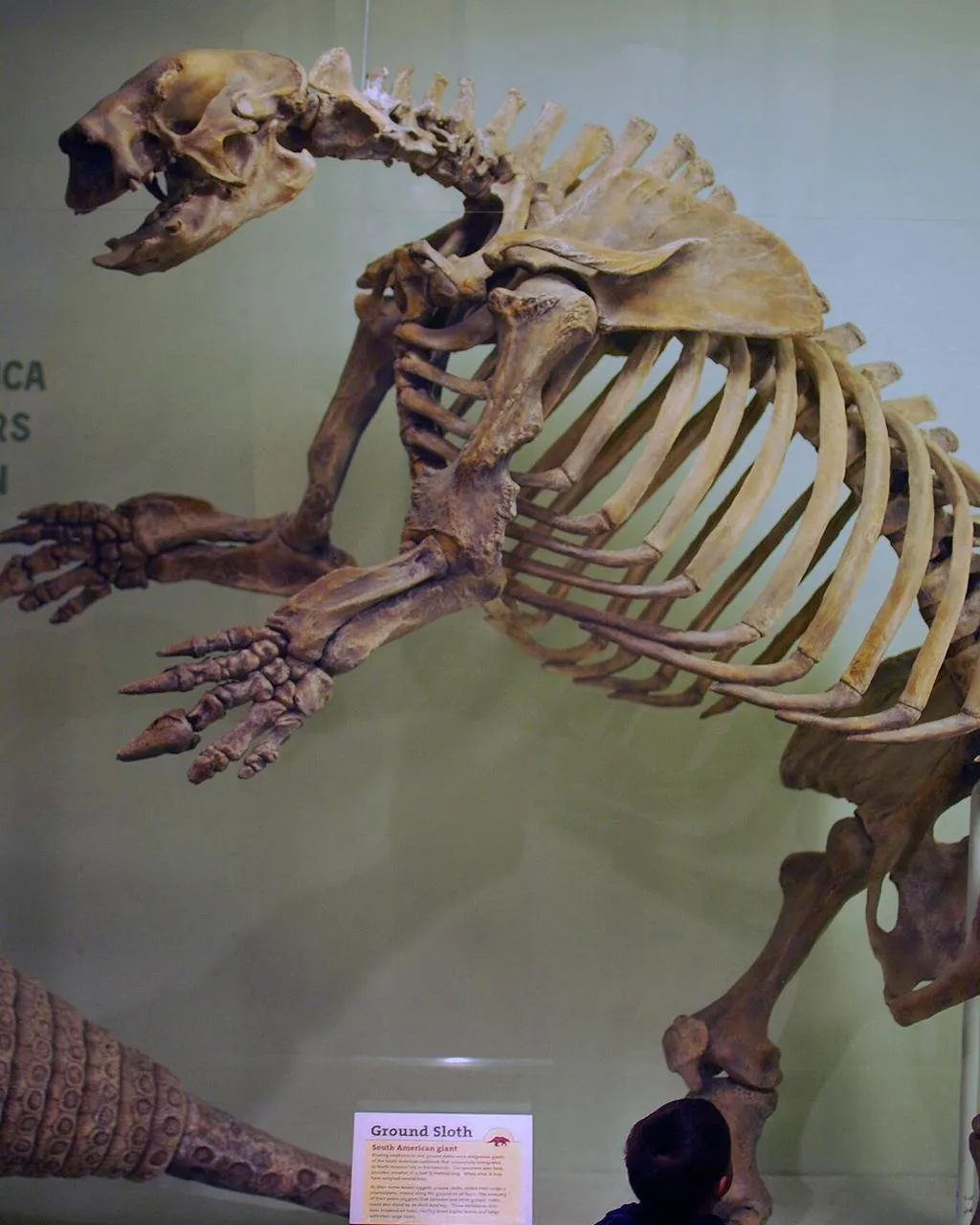 Skeleton display of the giant ground sloth Lestodon armatus, the species found in Uruguay
The widely accepted view for human arrival in the Americas places it closer to 23,000 years ago, supported by discoveries like those at White Sands, New Mexico. This finding from Uruguay, however, offers compelling support for a much earlier human presence on the continent. It aligns with other scattered pieces of evidence that hint at a deeper history for humans in the Americas.
For more on ancient tool use, see this related article: Early humans used ochre for advanced toolmaking at Blombos Cave, study finds.
What Comes Next?
While the evidence is persuasive, the researchers emphasize that this is still a hypothesis that requires more support. The Arroyo del Vizcaíno site holds incredible potential. It contains over 40 other bones with what appear to be cut marks, some resembling the injury on the heel bone. Future studies of these marked bones, along with analyses of any stone tools (lithics) found at the site, will be crucial in strengthening the case for early human interaction with these giant creatures. Discoveries like the 40,000-year-old mammoth tusk boomerang found in Poland highlight the ancient ingenuity of early humans across the globe.
Whether this indentation represents a clear instance of human hunting ingenuity or another fascinating clue in the puzzle of the Americas’ deep past, the discovery is a significant addition to our understanding of prehistoric life and human migration. Continued exploration of the artifacts, bones, and the landscape at Arroyo del Vizcaíno promises to reveal more about the earliest humans to inhabit this part of the world and their strategies for survival among giants.
The study was published in the Swiss Journal of Palaeontology. You can learn more about the specifics of the research there.





