
Forget what you thought you knew about ancient ocean life. A groundbreaking study has unearthed compelling evidence that ancient squids were not just present but were dominant inhabitants of the world’s oceans around 100 million years ago, during the Late Cretaceous period. This discovery rewrites a significant chapter in the history of marine ecosystems, suggesting squids were major players much earlier than previously believed. Key takeaways include: squids were more abundant than ammonites and fish, they acted as apex predators, and their evolutionary rise began significantly earlier than previously thought.
Contents
Unearthing the Past with Digital Fossil Mining
For decades, paleontologists faced a challenge studying ancient squids. Their soft bodies rarely fossilize, leaving behind only hints of their existence. However, a team led by scientists at Hokkaido University developed an innovative technique – a kind of digital fossil mining.
Think of it like slicing through a loaf of bread, but with extreme precision and digital recording. The researchers used a method called grinding tomography, which involves carefully grinding away thin layers of rock, taking a high-resolution digital scan after each grind. By compiling these scans, they created a detailed 3D reconstruction of the rock, revealing hidden fossils within.
This digital approach allowed them to find and analyze thousands of tiny fossilized structures within rocks that traditional methods might have missed. Specifically, they focused on squid beaks, which are tough, chitinous mouthparts that are much more likely to fossilize than the rest of the squid’s body. These beaks are like ancient dental records, providing clues about the squid’s size and species. Using this method, the team uncovered over 1,000 fossilized cephalopod beaks, including an astonishing 263 from squids. Many of these represented previously unknown species from the Late Cretaceous era.
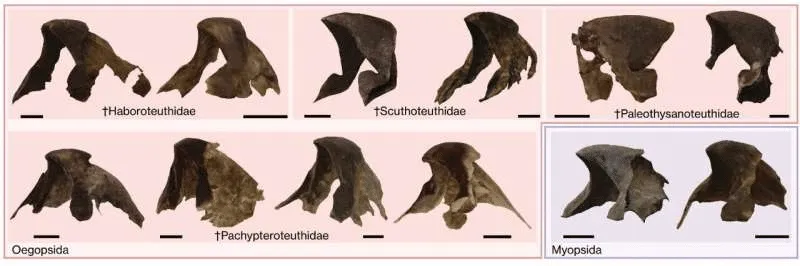 Fossilized ancient squid beaksExamples of fossilized lower beaks from ancient squids discovered in Late Cretaceous rock layers, showing their small size but robust structure suitable for fossilization.
The Reign of the Ancient Squid
The sheer number and variety of squid fossils unearthed by this digital mining technique painted a clear picture: ancient squids were incredibly abundant. Lead author Dr. Shin Ikegami stated, “In both number and size, these ancient squids clearly prevailed the seas.” This is a significant finding because it challenges the long-held belief that ammonites and bony fish were the dominant free-swimming creatures during that time.
Furthermore, the study indicates that these ancient squids were not small, insignificant creatures. According to Dr. Ikegami, their body sizes were comparable to, or even larger than, the fish and ammonites found alongside them in the fossils. This suggests squids weren’t just surviving; they were thriving as apex predators in the Mesozoic oceans, capable of hunting and competing effectively. Their likely advanced swimming capabilities and intelligence, traits seen in modern cephalopods, would have given them a competitive edge in the complex marine food web of the Cretaceous period, the age of dinosaurs.
Reshaping the Story of Cephalopod Evolution
The most significant implication of this research lies in our understanding of squid evolution. The conventional wisdom was that squids only underwent major diversification and became ecologically significant after the mass extinction event that ended the reign of the dinosaurs about 65 million years ago.
This new evidence turns that theory on its head. It shows that squids had already originated, diversified, and achieved ecological dominance millions of years before that extinction event. Co-author Dr. Yasuhiro Iba noted that these findings “change everything we thought we knew about marine ecosystems in the past.”
The study suggests that these ancient squids were likely the evolutionary pioneers of the fast, intelligent swimmers that would eventually come to dominate parts of the modern ocean ecosystem. This early rise highlights the incredible adaptability and successful strategy of the cephalopod lineage, establishing them as major players in marine history much earlier than previously credited.
The study not only provides a wealth of new data about ancient squids but also validates a powerful new technique for exploring the fossil record of life forms that don’t easily turn to stone. It opens up exciting possibilities for future research into other soft-bodied creatures and could continue to redefine our understanding of Earth’s ancient life.





