
Scientists have uncovered dramatic evidence of ancient parasitic fungi, similar to those that inspire “zombie” narratives, preserved perfectly inside amber dating back nearly 100 million years. These incredibly rare fossils offer a direct look at how these fungi infected insects during the Cretaceous period, revealing a long history of this fascinating, and sometimes unsettling, biological relationship. The discovery provides crucial insights into the evolution of host-parasite interactions over deep time.
Amber, formed from fossilized tree resin over millions of years, acts like a natural time capsule, often preserving delicate organisms with astonishing detail. These new amber specimens, now housed at the London Natural History Museum, capture two different species of ancient fungi in the genus Paleoophiocordyceps in the very act of bursting from their insect hosts.
A Glimpse into Cretaceous Parasitism
One piece of amber contains the newly identified species Paleoophiocordyceps gerontoformicae, which is seen emerging from a pupating ant. Tiny spore stalks protrude from the ant’s body, the fungal parasite’s method of spreading its reproductive units. The second specimen holds P. ironomyiae, visible as a single, distinctive fruiting body extending from the head of a fly.
These ancient fungi appear to share striking similarities with their modern-day relatives, the Ophiocordyceps fungi. These living species are infamous for their ability to infect insects, particularly ants, sometimes manipulating their behavior to reach ideal locations for spore dispersal before erupting from the host’s body – a process that has earned them the “zombie-ant” moniker.
Researchers estimate that the Paleoophiocordyceps lineage diverged from the modern Ophiocordyceps around 130 million years ago. Finding these ancient examples provides a critical anchoring point for understanding their evolutionary timeline.
Ancient Hosts, Ancient Strategies
The fact that these nearly 100-million-year-old fungi were found infecting two distinctly different insect groups – an ant and a true fly – is particularly significant.
“The fossil evidence shows that the infectious fungi were already adapted to two different insect hosts a hundred million years ago, an ant and a true fly,” explained paleoentomologist Edmund Jarzembowski from the Natural History Museum.
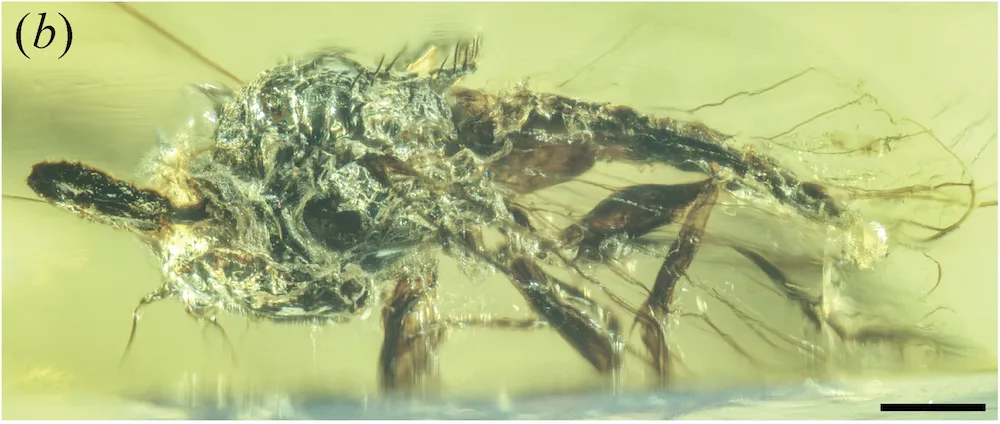 A small fly is encased in yellow amber, with a dark, elongated, club-shaped structure growing out from the top of its head.
This suggests that the fungi had already evolved the ability to target specific insect species much earlier than previously understood. Scientists believe this diversification in host preference likely occurred alongside the broader rise and diversification of insects, particularly moths and butterflies, which co-evolved with the spread of flowering plants during this period. The emergence of diverse ecological niches provided new opportunities for parasitic fungi to specialize on different hosts.
You can learn more about potential threats from modern fungi in this article: Hotter Climate Could Fuel Spread of Dangerous Fungi, Scientists Warn
What This Means
These amber fossils are among the oldest direct evidence of this type of parasitic fungal infection, surpassed only by one earlier find from 2008. They serve as a powerful reminder that complex biological interactions, including those that seem straight out of fiction, have a deep evolutionary history.
The discovery helps scientists piece together the ancient ecosystems of the Cretaceous world and understand how relationships between parasites and their hosts evolved over vast timescales. It highlights the incredible preservation power of amber and offers a tantalizing look at life caught in a moment, millions of years in the past.
The research was published in the journal Proceedings of the Royal Society B.
For more fascinating insights into ancient life preserved in amber, explore related articles on bizarre ancient wasps, unique sea creatures found alongside insects, and ancient plant life.





