
Imagine tiny organisms from Earth’s deep past, preserved exactly as they were nearly 100 million years ago. Scientists have now discovered two remarkable examples of ancient parasitic fungi caught in the act of emerging from their insect hosts, trapped in precious pieces of amber. This discovery offers a rare glimpse into the ancient history of “zombie” fungi, showing these complex parasites were already infecting different insect types millions of years ago. It helps us understand the deep roots of these fascinating, and sometimes unsettling, natural relationships.
Contents
Earth’s Ancient Time Capsules
Amber is essentially fossilized tree resin. Over millions of years, this sticky sap hardened, often trapping unfortunate plants and animals inside. These amber inclusions act like tiny time capsules, preserving details of ancient life with incredible fidelity – far better than traditional rock fossils. These two newly studied pieces of amber, now housed at the London Natural History Museum, provide an unparalleled view of parasitic fungi from the Cretaceous period.
Discovering Ancient Mind-Controllers
One piece of amber holds a pupating ant infected by a newly identified fungus species, Paleoophiocordyceps gerontoformicae. Tiny spore stalks are visible, sprouting from the ant’s body. The second specimen contains a fly with a single, distinct fruiting body of another new species, P. ironomyiae, emerging from its head. These dramatic scenes are frozen moments from an ancient battle for survival.
These ancient species show similarities to modern-day fungi like Ophiocordyceps. You might have heard of these – they’re infamous for their ability to take over an insect’s body, influencing its behavior (like forcing an ant to climb) to reach a location ideal for spreading spores. This is the “zombie” behavior that has even inspired popular fiction like ‘The Last of Us.’
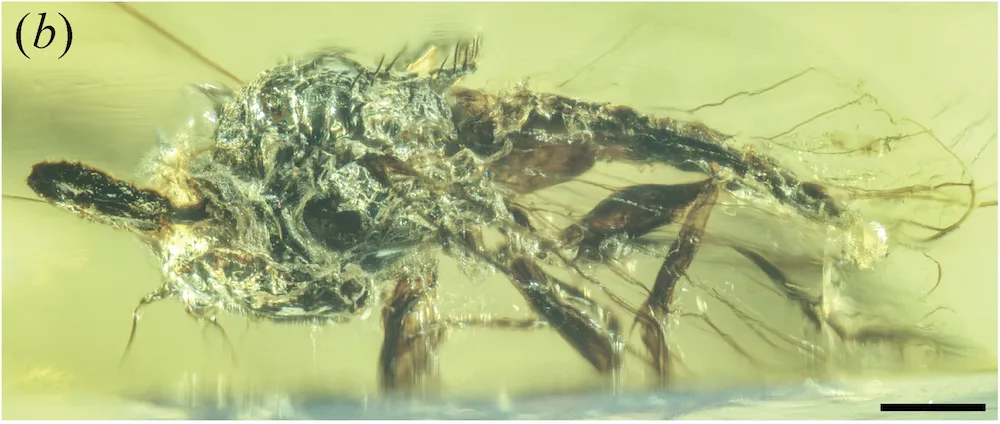 Ancient fly fossil trapped in amber with parasitic fungus fruiting body growing from its head
P. ironomyiae and its fly host, preserved in amber for roughly 100 million years.
A 100-Million-Year-Old Strategy
Dating back almost 100 million years, these amber fossils represent some of the oldest direct evidence of fungi using insects in this complex, parasitic way. Only one slightly older example of this type of fungus fossil has been found before.
Scientists estimate that the Paleoophiocordyceps lineage diverged from its modern Ophiocordyceps relatives around 130 million years ago. The fact that these ancient fungi were found infecting two very different insects – an ant and a fly – is significant.
“The fossil evidence shows that the infectious fungi were already adapted to two different insect hosts a hundred million years ago, an ant and a true fly,” explains paleoentomologist Edmund Jarzembowski from the Natural History Museum. This suggests that as flowering plants emerged and new insect groups like moths and butterflies diversified, these fungi were already adapting and jumping to different hosts.
What This Discovery Means
This finding underscores how incredibly long these sophisticated parasitic relationships between fungi and insects have existed. It offers crucial data points for understanding the evolutionary history of fungi, insects, and their intricate interactions. Amber continues to be an invaluable resource for peering into deep time and uncovering secrets of ancient ecosystems. As our climate changes, understanding how fungi adapt and spread across different hosts becomes increasingly relevant. You can read more about how a hotter climate could fuel the spread of dangerous fungi here.
The research on these ancient fungi was published in the scientific journal Proceedings of the Royal Society B.
This remarkable discovery reminds us that some of the most fascinating and bizarre aspects of nature have been playing out for millions of years. Keep exploring the world of science with us!





