
A small asteroid, officially named 2024 YR4, is currently on a path that brings it near both Earth and the Moon. While initially raising eyebrows due to its size, refined tracking shows it poses absolutely no danger to our planet. However, the latest calculations give this space rock a small, 4.3% chance of striking the Moon on December 22, 2032.
Contents
So, what does this mean? Primarily, it means Earth is safe. For the Moon, it represents a very low probability event that scientists will continue to monitor. It’s a fascinating cosmic dance to watch unfold from a safe distance.
Tracking a Tiny Traveler
Scientists constantly track near-Earth objects like 2024 YR4 using powerful telescopes. As more observations are gathered, their orbits can be calculated with increasing precision. Early tracking of 2024 YR4 showed potential paths that brought it close enough to Earth to warrant attention. However, later observations allowed researchers, like those at NASA’s Center for Near Earth Object Studies (CNEOS), to narrow down its trajectory.
As of June 3, 2025, the detailed analysis indicates a 95.7% probability that 2024 YR4 will safely pass by the Moon. The 4.3% chance of impact is low, but it’s a non-zero number that keeps it on scientists’ watch list. It means that out of roughly 23 possible orbital paths calculated for the asteroid, one or two slightly graze the Moon.
From ‘City-Killer’ Potential to Lunar Interest
Asteroid 2024 YR4 is estimated to be around 65 meters (about 213 feet) wide. While not large enough to cause a global catastrophe like the asteroid that wiped out the dinosaurs, an object of this size could cause significant regional damage if it were to hit a populated area on Earth. This potential is why asteroids in this size range are sometimes unofficially referred to as “city-killers.”
If a 65-meter asteroid entered Earth’s atmosphere, it would likely explode before hitting the ground directly. This atmospheric explosion, known as an airburst, would create a powerful shockwave capable of leveling buildings over a wide area. Fragments of the asteroid could also rain down, causing additional damage.
To understand the scale, consider the Chelyabinsk meteor event in 2013. That was caused by an object only about 20 meters wide. Its airburst shattered windows across the city, injuring over a thousand people primarily from flying glass. A 65-meter object’s airburst would be exponentially more powerful.
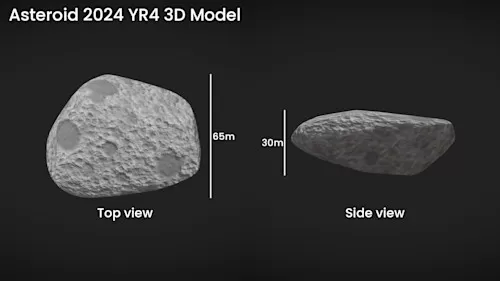 Artist's impression or model illustrating the estimated size and shape of asteroid 2024 YR4 based on telescopic observations.
Fortunately, improved orbital calculations confirm that 2024 YR4’s path does not intersect with Earth’s atmosphere in 2032 or the foreseeable future. The concern has shifted entirely to its potential close encounter with the Moon.
What if it Hits the Moon?
Unlike Earth, the Moon has virtually no atmosphere. This means that if 2024 YR4 were to hit the Moon, it wouldn’t experience an airburst. Instead, it would impact the surface directly at immense speed, calculated at nearly 13 kilometers per second (over 29,000 mph).
An impact at this speed would excavate a crater on the lunar surface. The size of the crater would depend on the asteroid’s exact size, composition, and impact angle, but it would likely be significant, perhaps hundreds of meters across. Such an event, while not a threat to Earth, would be of great scientific interest, potentially observable by telescopes and future lunar missions.
Looking Ahead
The current 4.3% chance of impact on the Moon is based on the best data available as of mid-2025. Scientists will continue to track 2024 YR4 in the coming years. As more observations are made, the asteroid’s orbit will become even more precisely known, and the probability of a lunar impact will either drop to zero or converge towards a higher likelihood.
For now, 2024 YR4 serves as a reminder of the dynamic nature of our solar system and the ongoing work of scientists to monitor near-Earth objects. It’s a story of initial concern shifting to refined understanding and the potential for observing a rare celestial event, even if it’s on our nearest cosmic neighbor.





