
Speeding around our planet at 28,000 km/h, NASA astronaut Nichole Ayers recently captured a truly incredible sight from the International Space Station: a fleeting, mysterious phenomenon known as a red sprite. These eerie, high-altitude flashes of light are far stranger than your average lightning bolt, offering a glimpse into the dynamic and still poorly understood electrical activity happening far above our heads, near the edge of space.
These stunning observations, like the one captured by Ayers, help scientists study these elusive events, often called “transient luminous events” (TLEs). Think of TLEs as spectacular atmospheric fireworks occurring above thunderstorms, balancing electrical charges between storm clouds and the upper atmosphere. While millions of lightning strikes occur daily, most are hidden within or below clouds. Only a tiny fraction, roughly one in 1,600, reach into the upper atmosphere as TLEs, making them a rare and captivating sight for those lucky enough to witness them.
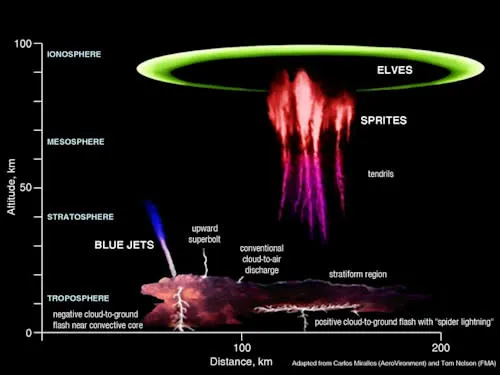 Diagram showing different types of transient luminous events like sprites, jets, and elves above a thunderstorm
What Are These Mysterious Red Sprites?
Red sprites are specific types of TLEs that appear as rapid, reddish flashes high above thunderstorms, typically occurring between 50 and 90 kilometers (30-55 miles) up in the atmosphere, in regions called the mesosphere and ionosphere. While sometimes referred to as upper-atmospheric lightning, this isn’t quite accurate. They involve the movement of electrical charge, like lightning, but the process and appearance are vastly different.
Unlike the powerful, superheated plasma of a typical lightning strike (which is hotter than the surface of the sun and occurs in the lowest layer of the atmosphere, the troposphere), sprites are a “cold plasma” phenomenon. Their glow is more akin to the light from a fluorescent tube or even the stunning Aurora Borealis, which you can learn more about. The characteristic red color comes from the excitation of nitrogen molecules, the primary component of our atmosphere, as electrical energy passes through the thin air at high altitudes.
People have likely witnessed these strange events for centuries, with pilots reporting sightings in the early 20th century. However, they remained largely unconfirmed folklore until 1989 when scientists finally captured them on camera. Seeing one from space, as Astronaut Ayers did, offers a unique perspective on these elusive flashes.
 Cropped image from the ISS showing a red sprite above distant clouds and city lights
How Do These Ethereal Lights Appear?
Understanding what triggers a red sprite takes us deep into the complex electrical dance within thunderstorms. Thunderstorms build up massive electrical charges, with positive charge typically gathering at the top and negative charge in the middle. Most lightning we see is ‘negative lightning,’ balancing the negative charge in the cloud’s core with positive charge on the ground or in other clouds.
However, sometimes the strong positive charge at the top of the cloud discharges downwards, striking the ground in a powerful event called ‘positive lightning.’ While rarer, positive lightning is often linked to sprite formation.
Here’s where the science gets particularly interesting: Normally, a layer of strong positive charge exists much higher up, near the edge of space. The positive charge at the top of the thunderstorm usually acts as a barrier, preventing the storm’s negative core from connecting with this high-altitude positive layer. But when a positive lightning strike occurs from the cloud top, it effectively removes this barrier. This allows the negative charge from the middle of the thunderstorm to suddenly interact with the positive charge far above, creating the electrical discharge we see as a red sprite.
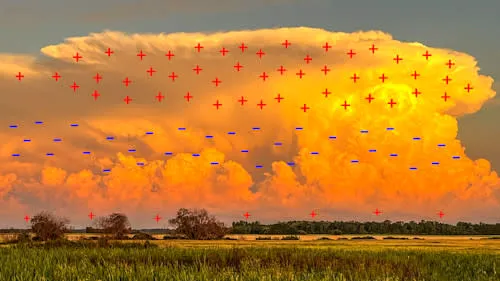 Schematic overlaid on a photo of a cumulonimbus cloud showing the typical distribution of positive and negative electrical charges
Positive lightning is considered a primary trigger for sprites, but it doesn’t guarantee one will appear. This suggests other factors are involved. One leading candidate? Gravity waves. These are like ripples in the atmosphere, often caused by powerful thunderstorms pushing air upwards. Scientists have observed sprites appearing within fields of atmospheric gravity waves. While the exact connection remains a mystery, it’s possible these waves create “plasma irregularities” in the upper atmosphere that facilitate sprite formation.
 Dramatic photo of a massive 'jellyfish' shaped red sprite captured above a storm in West Texas
Events like the impressive ‘jellyfish’ sprite seen over Texas or the captures from the ISS are crucial for researchers trying to unravel these atmospheric puzzles. Each sighting provides valuable data, helping us understand the complex interplay of electricity and waves happening far above our everyday world. To learn more about these strange occurrences, you can explore previous sightings of jellyfish sprites. The more we observe and study these transient luminous events, the closer we get to understanding their role in Earth’s atmospheric system.





