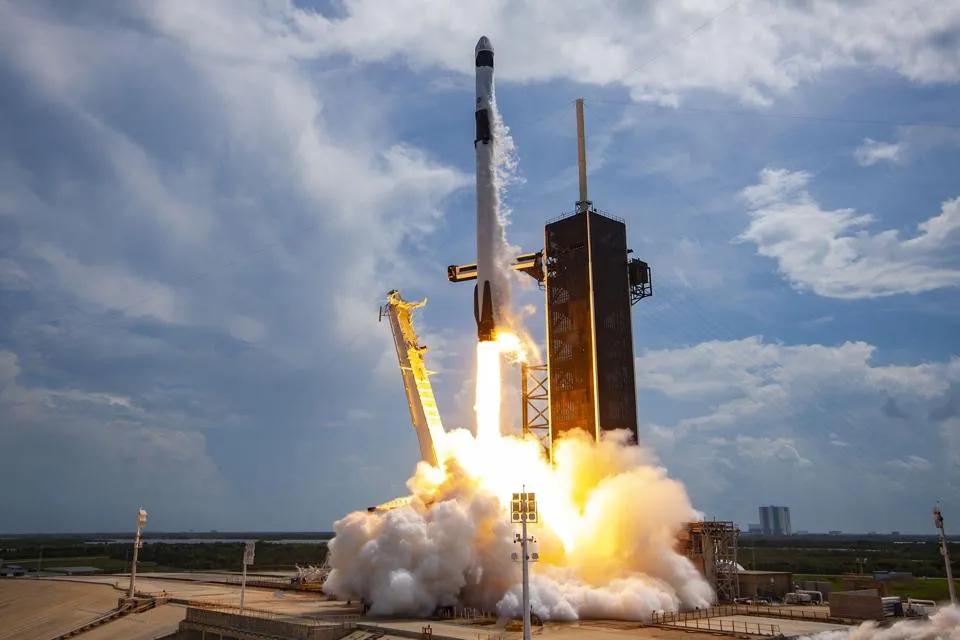
A launch planned for space has hit a temporary pause button, not because of weather or rocket issues this time, but due to a closer look at the International Space Station (ISS) itself. The Axiom Mission 4 (Ax-4) crew, carrying four private astronauts towards the orbiting laboratory, saw their lift-off delayed as NASA scrutinizes a puzzling situation with a previously leaky part of the station. The core finding? A section known for troublesome air leaks now seems to be holding pressure, but scientists want to understand exactly why before giving the all-clear for docking. This delay highlights the complex challenges of maintaining a massive, aging structure in space and what it takes to ensure safety for everyone aboard.
Contents
A Closer Look at the Delay
The four members of the Axiom-4 crew — Peggy Whitson (USA), Shubhanshu Shukla (India), Tibor Kapu (Hungary), and Sławosz Uznański-Wiśniewski (Poland) — were set to launch aboard a SpaceX Crew Dragon spacecraft atop a Falcon 9 rocket. After initial delays due to weather and a minor rocket repair, the spacecraft and booster were ready. But on June 12, NASA announced a new hold, pushing the potential launch date back to no earlier than June 19.
The reason? A closer examination of a specific area within the ISS’s Russian segment.
 Axiom-4 crew portrait
The Case of the Curious Tunnel
The source of the concern is a transfer tunnel (known as PrK) that leads to a docking port on the Russian Zvezda Service Module. This tunnel has been a headache for several years, exhibiting persistent small air leaks that defied previous repair attempts. Think of it like a tiny, stubborn slow leak in an old car tire – hard to find and fix completely.
Recently, however, engineers noted a change: the tunnel was holding pressure after new repairs. While this sounds like good news, NASA wants to be absolutely certain why. Is it because the leaks are truly sealed, or is there a subtle flow of air from another part of the station across a hatch seal that’s giving a false positive reading? Ensuring the structural integrity and air-tightness is paramount before bringing another spacecraft and crew alongside.
Living on an Aging Structure
The International Space Station isn’t new. Its first components were launched back in 1998, making parts of it over two decades old. Maintaining such a large, complex machine in the harsh environment of space is a monumental task, requiring constant monitoring, repairs, and upgrades. Issues like the persistent air leaks are a natural consequence of its age and continuous operation.
Both the United States and Russia, the primary partners, are committed to keeping the station running, ideally until 2030, provided it remains safe. However, managing the station’s health involves ongoing technical assessments, and sometimes, partners have different perspectives on the severity of issues like the leaks. This requires close cooperation and agreement on the path forward.
The Bigger Picture: Budget Battles and the Future
Beyond technical issues, the ISS faces challenges on the ground, too, particularly regarding funding. Proposed budget cuts could impact how many astronauts can live on the station and how frequently essential supplies can be sent up.
Meanwhile, discussions about the station’s eventual retirement are also taking place. The plan is to intentionally deorbit the ISS into the Pacific Ocean around 2030. SpaceX has even been contracted to build a specialized vehicle for this purpose. There are differing views, however, with some, like SpaceX founder Elon Musk, raising concerns about the station’s long-term safety and suggesting an earlier deorbit might be necessary.
Counterbalancing this, the U.S. Congress has shown strong bipartisan support for the ISS, pushing for continued funding to prevent a gap in U.S. access to space for research and to ensure the U.S. remains a leader in space, especially as China’s Tiangong space station becomes fully operational.
 NASA statement on Ax-4 postponement
The Next Era: Commercial Space Stations
Looking ahead, the future of human presence in low Earth orbit lies with commercial space stations. Companies like Axiom Space and Vast are developing their own privately-owned orbiting platforms designed to eventually replace the ISS.
Axiom’s plan is unique, starting by attaching its first module directly to the ISS in the coming years. This allows them to build out their station while still connected to the existing infrastructure. Other companies, like Vast, plan independent stations, with their first module aiming for launch as early as 2026. These commercial ventures represent the next chapter in providing destinations for research, tourism, and business in space.
 Diagram showing the International Space Station modules
For now, the Axiom-4 crew and their spacecraft remain on Earth, patiently awaiting clearance. This delay, while perhaps frustrating for those involved, underscores the careful, methodical approach required to operate safely in the challenging environment of space and the critical importance of understanding even the smallest anomalies on an aging but essential outpost. The world watches and waits to see if the ISS tunnel gets a clean bill of health for the next chapter of crewed missions.