
Earth is covered in silent reminders of its violent past, scars left by cosmic impacts that shaped our world. While some impact craters are famous landmarks, others remain hidden in plain sight. One such subtle feature is the Goyder impact structure in Australia’s Northern Territory, the eroded remnants of a giant crater left by an asteroid collision that occurred hundreds of millions, or even billions, of years ago. This discovery highlights how geological detective work, aided by satellite views, continues to reveal Earth’s dramatic history and underscores the ongoing reality of cosmic impacts.
Contents
What is the Goyder Impact Structure?
Think about dropping a small pebble into sand versus a heavy rock. The pebble leaves a simple bowl shape. The heavy rock creates a larger hole, and the sand in the middle might splash up slightly before settling. Impact craters form in a similar way. Small impacts create simple craters, typically shallow bowls. Larger, more powerful impacts create complex craters, which feature a raised area in the center, like the splash-back of sand. This central bump is called a ‘central uplift’.
The Goyder impact structure isn’t the full crater – its rim and floor have long since eroded away, much like how a ripple in sand fades over time. What remains is primarily the sturdy core, the “bones” of the central uplift, standing slightly above the surrounding landscape.
The Discovery of a Hidden Giant
The subtle nature of the Goyder structure meant it wasn’t immediately obvious. It took a geologist, Peter Haines, with a keen eye examining aerial photographs in the 1990s, to first spot the unusual circular pattern of low hills in the Northern Territory’s vast savannas.
Following up his aerial observations with fieldwork, Haines studied the rocks in the area. His detailed investigation confirmed that this subtle circular feature wasn’t just a quirk of natural erosion or folding, but the result of an immense force from space. He concluded it was indeed the remnants of the central uplift from a deeply eroded, complex impact crater.
Unmistakable Signs of a Cosmic Collision
Despite the significant erosion, the rocks within the Goyder structure hold definitive proof of a high-energy impact. Scientists look for specific geological features that only form under the extreme pressures and shock waves generated by an asteroid hitting Earth.
One of the most compelling pieces of evidence found at Goyder are ‘shatter cones’. These are distinct, cone-shaped rock fragments with fine grooves radiating outwards from the tip. They are a rare geological signature, formed only when powerful shock waves from an impact event blast through the bedrock. Finding shatter cones in the central hills of the Goyder structure is a clear sign that this location experienced an immense shock wave.
Another clue is the circular arrangement of the hills and a surrounding ring of sandstone, both believed to be part of that uplifted central area of the original complex crater.
A View from Space
Seeing the Goyder impact structure from above helps piece together the geological puzzle. The image captured by the Operational Land Imager (OLI) on the Landsat 8 satellite provides a clear perspective of the area.
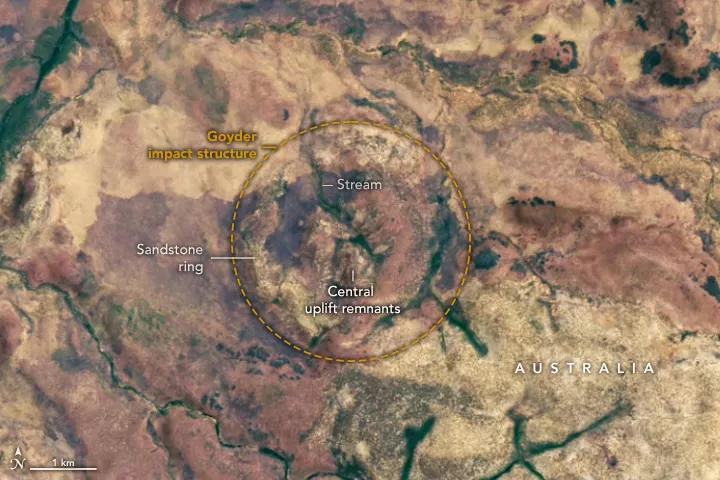 Satellite image showing the subtle circular pattern of the eroded Goyder impact structure in Australia's Northern Territory, highlighting remnants of the central uplift as hills and a sandstone ring within dry savanna landscape.
By combining the satellite data with elevation models, scientists can better visualize the subtle topography – the low hills and the faint circular patterns – that mark the location of this ancient event. While not as dramatically evident as Arizona’s square-shaped Meteor Crater or Canada’s double Clearwater West and East craters, the satellite view confirms the structure’s geological significance.
Estimating Size and Age: A Challenge
Because so much of the original Goyder crater has eroded away, estimating its initial size and the exact date of the impact is challenging. Based on the size of the remaining central uplift structure, geologists estimate the original crater could have been anywhere between 7 and 25 kilometers (4 to 16 miles) wide. An impact event creating a crater of that size would have caused catastrophic levels of damage across the surrounding region at the time.
Pinpointing the impact date is also difficult. By studying the ages of the rocks affected by the impact, scientists know it must have happened after those rocks formed. Current estimates place the impact sometime between the Late Jurassic period (around 150 million years ago) and the Mesoproterozoic era (around 1.4 billion years ago) – a vast span of time reflecting the deep erosion and limited datable material.
Why Understanding Ancient Impacts Matters
The discovery and study of structures like the Goyder impact crater are more than just historical curiosities. They help us understand the history of Earth’s surface, the incredible power of cosmic impacts, and the long-term geological processes that shape our planet.
Furthermore, they serve as a reminder that impacts from asteroids and comets are natural events that have occurred throughout Earth’s history and continue to pose a potential, albeit small, risk today. NASA’s Planetary Defense Coordination Office actively tracks near-Earth asteroids, monitoring potential threats and working on strategies to protect our planet. Studying ancient impacts provides valuable data on the frequency and consequences of such events.
The Goyder impact structure, though subtle, offers a window into Earth’s dramatic past and the powerful cosmic forces that have played a role in its evolution. Geologists and scientists continue to explore these features, unlocking more secrets from our planet’s deep history. To learn about other fascinating impact sites, explore features like Canada’s near-perfect circle, the Pingualuit Crater.





