
Far in the cold, dark edges of our solar system, a new object has been spotted that could be a potential dwarf planet. Named 2017 OF201, this chunk of rock and ice measures about 700 kilometers (435 miles) across – a size large enough to potentially join the ranks of dwarf planets like Pluto. But what makes 2017 OF201 truly fascinating isn’t just its size, it’s its wild, looping orbit, which seems to challenge the idea that a giant, unseen Planet Nine lurks in the outer solar system.
Contents
This distant discovery offers a tantalizing glimpse into the unexplored frontiers of our cosmic neighborhood and suggests that perhaps our assumptions about what lies beyond Neptune need rethinking.
Hunting for Ice Worlds at the Edge
Imagine trying to find a small, dark rock drifting in a space so vast and empty that sunlight barely reaches it. That’s the challenge astronomers face when searching for trans-Neptunian objects (TNOs) – bodies of rock and ice that orbit the Sun out beyond Neptune, roughly 30 times the Earth-Sun distance (known as an astronomical unit, AU). These objects are incredibly faint and hard to spot.
Astrophysicist Sihao Cheng of the Institute for Advanced Study and his colleagues have been on a mission to find and study these remote ice worlds. Thanks to more powerful telescopes and surveys designed to scan large swathes of the night sky, like the Dark Energy Camera Legacy Survey (DECaLS) and the Canada France Hawaii Telescope (CFHT), hunting these distant objects has become possible.
The team found 2017 OF201 hidden in years of archival data collected between 2011 and 2018. Nineteen separate observations allowed them to track its movement and calculate its path through space with remarkable accuracy.
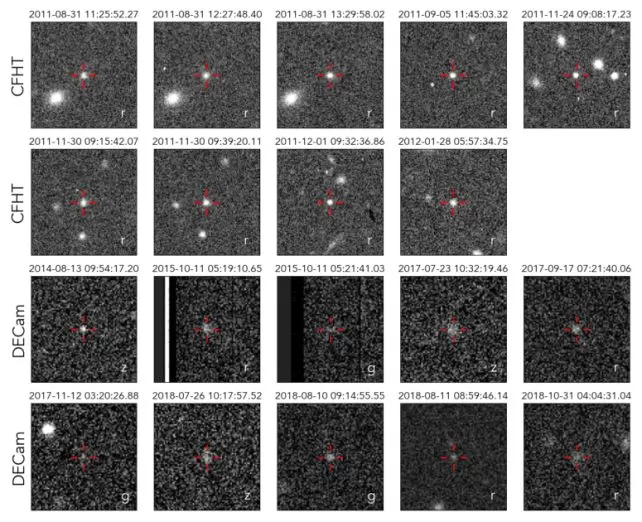 Data points showing the detected positions of trans-Neptunian object 2017 OF201 used for calculating its orbit
An Orbit Like No Other
What immediately set 2017 OF201 apart was its incredibly stretched-out orbit. Think of Earth’s orbit as a fairly round track around the Sun. Pluto’s orbit is more of an oval. 2017 OF201’s orbit is like a rubber band stretched almost to its breaking point.
“The object’s aphelion – the farthest point on the orbit from the Sun – is more than 1,600 times that of the Earth’s orbit,” explains Cheng. That’s an astonishing 1,600 AU, taking it deep into the inner Oort Cloud, a theoretical shell of icy bodies thought to surround the solar system at its very edge. Its closest point to the Sun (perihelion) is still a chilly 44.5 AU away, putting it just beyond Neptune’s average distance, similar to Pluto’s closest approach.
This extreme elliptical path means 2017 OF201 takes a staggering 25,000 years to complete just one trip around the Sun! How an object ended up in such a bizarre, distant orbit is a mystery. It could have been given a gravitational “kick” by a passing large object long ago, or its orbit might have evolved over immense timescales through multiple interactions.
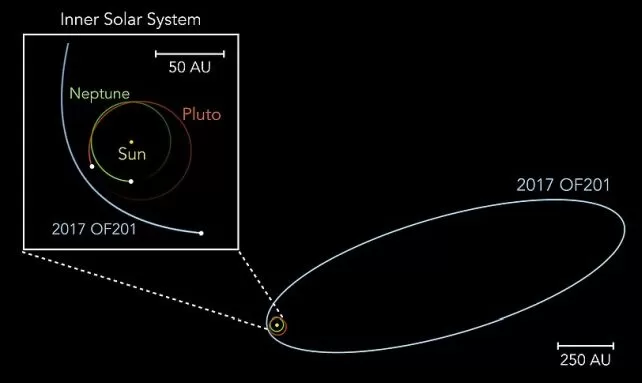 Diagram comparing the elliptical orbits of Neptune, Pluto, and the newly discovered trans-Neptunian object 2017 OF201 around the Sun
Does This Mean Planet Nine Isn’t There?
For years, some astronomers have hypothesized the existence of a massive, unseen “Planet Nine” in the outer solar system. This idea was partly based on the observation that several other distant TNOs seemed to have orbits that were clustered or aligned in a particular way, as if being shepherded by the gravity of a large hidden world.
However, 2017 OF201’s orbit is wildly different from these potentially “clustered” objects. This divergence is key. The researchers performed simulations to see how 2017 OF201’s orbit would behave over millions of years, both with and without a hypothetical Planet Nine.
Their findings were striking: Without Planet Nine, 2017 OF201’s extreme orbit remains stable over long periods. But if a Planet Nine were present with the properties that have been theorized, its gravitational pull would likely destabilize 2017 OF201’s orbit, potentially kicking it out of the solar system entirely within a relatively short cosmic timeframe (about 100 million years).
This makes 2017 OF201’s stable existence strong evidence against the specific characteristics of Planet Nine as previously envisioned based on other TNOs. While it doesn’t definitively rule out any large object out there, it puts significant constraints on the popular Planet Nine hypothesis.
A Hint of What Else Awaits
The discovery of 2017 OF201 isn’t just about potentially disproving a planet; it’s also a powerful reminder of how much we still don’t know about our own solar system’s outer reaches.
“2017 OF201 spends only one percent of its orbital time close enough to us to be detectable,” says Cheng. “The presence of this single object suggests that there could be another hundred or so other objects with similar orbit and size; they are just too far away to be detectable now.”
This potential new dwarf planet is like finding a single pebble on a vast, dark beach. It hints that countless other objects, perhaps with similarly extreme orbits, are out there, waiting to be discovered by the next generation of telescopes.
Looking Ahead
2017 OF201 has been officially recognized by the International Astronomical Union. Its unique orbit and its implications for the Planet Nine search highlight the exciting mysteries still hidden in the frigid expanse beyond Pluto. As our ability to peer into these distant regions improves, we’re sure to uncover more of these extreme cousins and piece together the story of our solar system’s formation and evolution.
To learn more about the search for Planet Nine or other distant solar system objects, explore these related articles:
- New Simulations Suggest Planet Nine Might Not Be a Planet At All
- Over 450 New Objects Have Been Found in The Cold, Dark Reaches of The Solar System





