
Imagine buildings that don’t just stand tall but also actively help clean the air. That futuristic vision is a step closer to reality thanks to scientists who have created a new “living” building material embedded with tiny, ancient life forms: blue-green algae, also known as cyanobacteria. This innovative material can pull carbon dioxide (CO2) right out of the atmosphere, offering a novel way to potentially store carbon directly within our built environment.
Contents
Here’s the core idea: researchers in Switzerland developed a material that leverages the natural power of cyanobacteria. These microscopic organisms are champions of photosynthesis, turning sunlight, water, and CO2 into energy and oxygen, just like plants. But this material goes further. In the right conditions, the cyanobacteria also trigger the formation of solid carbonate minerals, essentially turning CO2 into rock-like substances that strengthen the material and lock away carbon long-term. This dual action makes it a promising candidate for tackling climate change right where we live and work.
How This Living Material Works
At the heart of this new material is a 3D-printable hydrogel, a gel-like substance with lots of water and a porous structure. Think of it like a microscopic sponge. Scientists embedded cyanobacteria inside this hydrogel, ensuring they had access to the light, water, and CO2 needed to thrive.
Cyanobacteria are ancient and remarkably efficient. They are some of the oldest life forms on Earth and can perform photosynthesis even with weak light, converting CO2 and water into biomass, essentially growing themselves. This growth itself stores carbon, as the algae’s bodies are carbon-based.
The Power of Turning Gas into Stone
While photosynthesis is key, the truly unique aspect of this material is the cyanobacteria’s ability to facilitate mineralization. When certain nutrients are present, these tiny organisms can chemically convert CO2 into solid carbonate minerals, similar to the limestone found in rocks and seashells.
This mineral conversion is a game-changer. Without it, the material would remain soft and jelly-like. But as minerals form, they create a strong internal scaffold, gradually making the material more rigid and robust – perfect for potential building applications. Furthermore, storing carbon in this solid mineral form is much more stable and long-lasting than storing it as biomass in the algae’s cells.
In a study published in Nature Communications, the researchers demonstrated the material’s ability to continuously sequester CO2 for 400 days. It stored a significant amount of CO2 per gram by turning it into carbonate precipitates, a rate they note is very efficient compared to other biological carbon storage methods. While carbon storage in biomass eventually levels off as the bacteria growth slows (typically after about 30 days), the mineralization process continues, providing long-term CO2 capture.
Future Uses: Buildings That Clean the Air?
The potential applications for this “living” material are exciting. The researchers suggest it could one day be used as a coating on building facades, essentially turning the outside of buildings into active carbon absorbers, like a vast urban forest.
The team is already exploring different forms the material could take. At a recent architecture exhibition in Venice, they showcased tree trunk-like structures made from the material. Each of these prototypes was estimated to absorb as much CO2 per year as a 20-year-old pine tree!
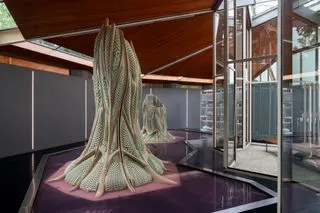 Tree trunk shaped structure made of living building material at architecture exhibition in Venice.
However, challenges remain. For instance, delivering the necessary nutrients, like calcium and magnesium (used in the study via artificial seawater), to the material if it were coating a building still needs to be figured out. Researchers are also looking into whether genetically engineering the cyanobacteria could enhance their CO2-absorbing capabilities.
A New Tool in the Climate Fight
This living building material represents a low-energy and environmentally friendly approach to capturing CO2 directly from the air. Unlike energy-intensive chemical processes, it leverages the natural power of life itself. While still in the research phase, innovations like this offer hopeful pathways for storing carbon and making our cities part of the climate solution.
Intrigued by sustainable materials? You might also be interested in a new wonder material designed by AI that’s as light as foam but as strong as steel. For more innovative ways cities are adapting to climate change, check out how some are drinking wastewater or building urban forests.





