
Imagine creating something out of absolutely nothing. That’s the mind-bending idea explored by a new scientific simulation: using incredibly powerful lasers to potentially generate light from what we perceive as empty space. This research is a crucial step towards experimentally verifying bizarre quantum effects predicted for ultra-high electromagnetic fields, suggesting we might soon see ‘light from darkness’ in a lab. The key takeaway? The vacuum isn’t truly empty, and extreme forces like lasers can reveal its hidden potential.
Contents
What is “Empty Space” Really Like?
We often think of the vacuum as being, well, empty. But at the tiniest scales governed by quantum mechanics, it’s more like a bubbling, energetic foam. This “quantum vacuum” is constantly filled with fleeting “virtual particles” – pairs of particles and antiparticles, like photons (light particles) or electrons and positrons, that pop into existence for an instant before annihilating each other and disappearing back into nothingness.
Normally, these virtual particles are impossible to detect directly because they exist for such brief moments. But theoretical physics suggests that extremely strong forces could intervene, giving some of these virtual particles enough energy or separation to become “real” and stable.
Using Lasers to Shake Things Up
For decades, scientists have theorized that incredibly intense electromagnetic fields could provide the necessary “kick” to make virtual particles manifest. And what creates some of the strongest electromagnetic fields we can generate? Lasers.
Modern laser technology has advanced to astonishing levels, capable of focusing petawatts (a petawatt is a quadrillion watts) of power onto a tiny spot for a fraction of a second. These pulses are so powerful they are theorized to be capable of literally influencing the fabric of reality itself.
A team of researchers from the University of Oxford in the UK and the University of Lisbon in Portugal set out to simulate what happens when these powerful laser fields collide in a vacuum.
Simulating Light From Nothing
Using advanced computational models that describe how electromagnetic fields behave in empty space, the team simulated the interaction of multiple strong laser beams. Their goal was to see if the combined fields could influence the virtual particles in the quantum vacuum.
The simulation specifically tested a phenomenon called “four-wave mixing.” When three strong electromagnetic waves meet in a medium (or, in this case, the vacuum influenced by lasers), they can interact and generate a fourth wave. The researchers found that blending three powerful laser beams creates a specific type of electromagnetic field arrangement.
This arrangement is predicted to be so strong that it could force virtual photons – the particles of light – to separate from their virtual antiparticle partners before they vanish, causing them to appear as real photons. These newly “born” photons would then scatter out, appearing as a mysterious fourth beam of light emerging from the laser interaction point.
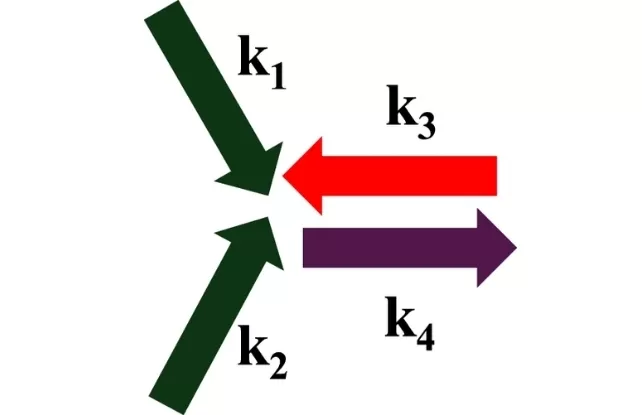 Simulation showing three beams interacting to scatter a fourth photonA 2D computer simulation illustrating how three incoming light waves could interact in a vacuum to produce a scattered fourth wave. Different colors represent hypothetical wavelengths.
“This is not just an academic curiosity – it is a major step toward experimental confirmation of quantum effects that until now have been mostly theoretical,” commented Oxford physicist Peter Norreys, a member of the research team.
Why Haven’t We Seen This Before?
Photon-photon scattering, the core idea of generating light from the vacuum using light, has been predicted for a long time. However, actually observing it is incredibly difficult. The effect is extremely weak under normal conditions, and even with powerful lasers, detecting the few photons that might be generated from the vacuum amidst the intense light of the original lasers is a huge challenge.
This new simulation provides a more detailed and realistic picture of what to expect when designing experiments to look for this effect. It gives scientists key insights into the specific conditions, timing, and how the generated light might behave, making experimental searches more feasible.
The Future is Bright (Literally?)
While this study is based on simulation, it brings us closer to a real-world experiment. Luckily, the technology needed to test these predictions is rapidly advancing.
Massive laser facilities are being built or upgraded around the world, specifically designed to reach the petawatt power levels required for such experiments. Projects like the Extreme Light Infrastructure (ELI) in Romania, the EP-OPAL project at the University of Rochester in the US, and a new facility in Shanghai, China, are pushing the boundaries of laser power and repetition rates.
These facilities will be capable of creating the intense electromagnetic fields needed to potentially trigger the creation of light particles from the vacuum. By using only photons (laser light) to create the fields, scientists hope to minimize other particle interactions that could hide the faint signal of light generated directly from the vacuum.
The hope is that these experiments can finally provide concrete proof that light can indeed be “scattered out of the darkness,” demonstrating the bizarre reality of the quantum vacuum and perhaps confirming one of the most intriguing predictions of physics: that something can, in fact, come from seemingly nothing under the right conditions.
This fascinating research was published in the journal Communications Physics. Scientists are now eagerly awaiting the results from the next generation of high-power laser experiments to see if this simulated phenomenon can be observed in the real world.





