
A newly discovered world, the gas giant exoplanet TOI-4465 b, orbits far from its star and is surprisingly cool for its type. Located around 400 light-years away, this massive planet was found thanks to data from NASA’s TESS spacecraft, but it was citizen scientists who played a crucial role in confirming its existence. This rare discovery fills a gap in our understanding of planetary systems and highlights the power of global collaboration in exploring the cosmos.
Contents
What is TOI-4465 b?
Imagine a giant planet about 1.25 times wider than Jupiter and around six times as massive. That’s TOI-4465 b. It whips around its parent star in a flattened, elliptical orbit that takes about 102 Earth days to complete one “year.” Its average distance from its star is about 0.4 times the distance between Earth and the sun. This puts it in a region where giant planets aren’t expected to be scorching hot, giving it an estimated temperature between 200 and 400 degrees Fahrenheit (93 to 204 degrees Celsius). This makes it a relatively cool giant planet compared to many others found close to their stars.
Why This Planet is So Interesting
Scientists are excited about TOI-4465 b because it’s a bit of a rarity. Most giant exoplanets discovered so far fall into two main categories: “hot Jupiters” that orbit incredibly close to their stars with years lasting just hours, or cold, distant worlds like Neptune and Uranus in our own solar system.
TOI-4465 b exists in a less explored middle ground. Giant planets that take longer than 100 days to orbit their stars, known as “long-period” exoplanets, are much harder to find.
 Illustration of the gas giant exoplanet TOI-4465 b in orbit around its star
University of New Mexico researcher Zahra Essack, who led the study, explained in a statement that long-period exoplanets are “underrepresented in our current catalog.” Studying worlds like TOI-4465 b gives astronomers crucial insights into how planetary systems form and evolve under conditions more moderate than those found near “hot Jupiters.”
How TESS and Citizen Science Found This World
NASA’s Transiting Exoplanet Survey Satellite (TESS) is a space telescope designed to hunt for planets by looking for tiny dips in starlight. These dips happen when a planet “transits,” or passes in front of, its star from our perspective, briefly blocking some of the light.
TESS initially spotted a single transit event from TOI-4465 b. However, confirming a planet requires observing at least two transits to be sure it’s a recurring phenomenon. For a planet with a 102-day orbit, waiting for a second transit takes time, and the observation window for each transit is only about 12 hours. Catching this fleeting event is incredibly difficult due to weather, telescope availability, and the need for continuous observation.
Citizen Science to the Rescue
To overcome these challenges, the research team turned to the Unistellar Citizen Science Network. They enlisted the help of 24 amateur astronomers across 10 countries, each using their personal telescopes to observe the host star.
Combining the data collected by these passionate citizen scientists with observations from professional observatories was the key. Their collective efforts successfully captured the elusive second transit, providing the confirmation needed to announce TOI-4465 b as a real exoplanet.
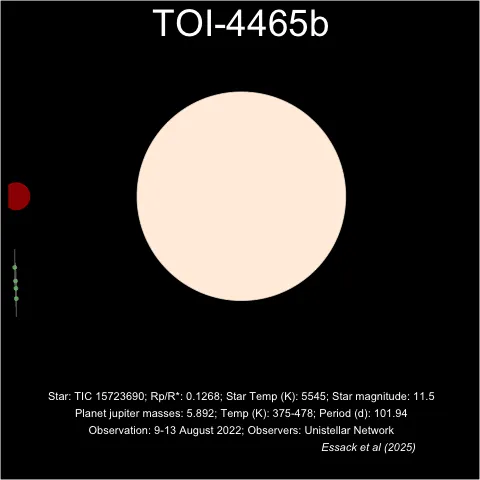 Animation showing an exoplanet transiting across its star, causing a dip in observed light
Essack noted that this discovery “shows how passionate astronomy enthusiasts can play a direct role in frontier scientific research.”
The Power of Global Collaboration
The discovery and confirmation of TOI-4465 b were a truly international and collaborative effort, involving initiatives like the TESS Follow-up Observing Program and the Unistellar Citizen Science Network. It demonstrates the significant contributions that can come from combining professional astronomical research with the dedication and resources of amateur astronomers worldwide.
Related Stories:
- The James Webb Space Telescope has discovered its 1st exoplanet and snapped its picture (image)
- Astronomers discover origins of mysterious double hot Jupiter exoplanets: ‘It is a dance of sorts’
- Strange multi-planet system proves not all hot Jupiter exoplanets are lonely giants
What’s Next for TOI-4465 b?
Given its rare characteristics and position, TOI-4465 b is now a prime candidate for future study by powerful telescopes like the James Webb Space Telescope (JWST). Further observations could reveal more about its atmosphere and composition, providing even deeper insights into the diversity of planets beyond our solar system.
This discovery not only adds another fascinating world to our growing catalog of exoplanets but also serves as a powerful reminder that some of the most exciting scientific breakthroughs happen when professionals and enthusiastic amateurs work together to explore the universe.
The team’s research was published in The Astrophysical Journal.