
Imagine a Universe shrouded in a thick, dark fog. That was the state of the cosmos for millions of years after the Big Bang, a period known as the “cosmic dark ages.” Light existed, but it couldn’t travel far, bouncing off a dense haze of neutral hydrogen. Now, thanks to the incredible power of the Hubble and James Webb Space Telescopes (JWST), scientists finally have strong evidence identifying the celestial bodies that cut through this primordial mist and brought light to the Universe: tiny, energetic dwarf galaxies. This discovery, published in Nature, reshapes our understanding of the early Universe’s critical transformation, known as cosmic reionization.
Contents
The Universe’s Dark Age
Minutes after the Big Bang, the Universe was a superheated soup of particles. As it cooled over roughly 300,000 years, electrons and protons combined to form neutral hydrogen gas. While a major step towards structure, this neutral hydrogen acted like a dense fog for most light wavelengths. Photons, the particles of light, would constantly bump into these hydrogen atoms, preventing light from traveling freely across space. The Universe was, effectively, dark.
How the Lights Came On: Cosmic Reionization
For light to shine unimpeded across the cosmos, this neutral hydrogen fog had to be cleared. This happened during a period called cosmic reionization, which unfolded over hundreds of millions of years. During reionization, intense radiation, primarily from the very first stars and galaxies, began stripping electrons away from the neutral hydrogen atoms, turning the gas back into an ionized plasma. Crucially, this ionized plasma is transparent to light. By about a billion years after the Big Bang, reionization was largely complete, and the Universe became the vast, transparent expanse we observe today.
Searching for the Source
For years, astronomers debated which sources were powerful enough and abundant enough to drive this monumental process of reionization. Leading candidates included brilliant, active supermassive black holes at the centers of galaxies, or large, rapidly star-forming galaxies churning out tons of energetic ultraviolet light. The challenge was that the early Universe, being so distant in both space and time, is incredibly hard to see through the very fog we’re trying to study.
JWST Reveals the Unexpected Answer
The James Webb Space Telescope was specifically designed to peer back into this dimly lit era. Its infrared capabilities allow it to see light stretched by the Universe’s expansion, giving us a window into the cosmic dawn. While JWST has revealed many surprises about the early Universe, one of the most significant findings concerns the true architects of reionization.
 Deep field image from JWST showing numerous faint sources, some of which are identified as early galaxies contributing to reionization.
An international team, led by astrophysicist Hakim Atek, used JWST data, supplemented by Hubble observations, to study galaxies in a particular region of space.
Using a Cosmic Magnifying Glass
To see the earliest, faintest galaxies, the researchers used a trick of nature called gravitational lensing. They focused on a massive galaxy cluster called Abell 2744. This cluster is so huge it warps the fabric of space-time around it, acting like a giant magnifying glass. This magnifying effect boosts the light from incredibly distant objects behind it, allowing JWST to see tiny dwarf galaxies that would otherwise be invisible.
Why These Tiny Galaxies Matter
By analyzing the light spectra from these magnified dwarf galaxies, the team made a surprising discovery. Not only are these dwarf galaxies the most common type of galaxy in the early Universe, but they are also far brighter in ionizing radiation than previously thought.
The research indicates that these small galaxies outnumber larger ones by a ratio of roughly 100 to 1. Even more surprisingly, their combined output of ionizing photons is four times greater than the contribution typically assumed for larger galaxies.
“These cosmic powerhouses collectively emit more than enough energy to get the job done,” said Hakim Atek. “Despite their tiny size, these low-mass galaxies are prolific producers of energetic radiation, and their abundance during this period is so substantial that their collective influence can transform the entire state of the Universe.”
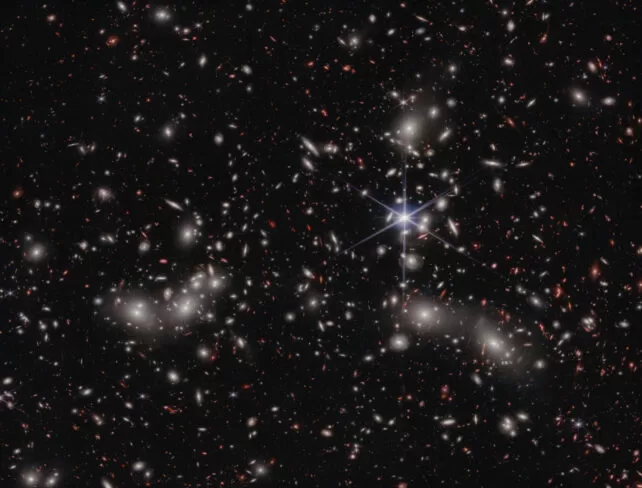 The field of view around the galaxy cluster Abell 2744. The cluster’s mass creates a cosmic lens, magnifying distant galaxies from the early Universe.
This suggests that it wasn’t the large, flashy galaxies or powerful black holes alone, but the cumulative light from countless humble dwarf galaxies that finally cleared the hydrogen fog.
What’s Next?
While this study provides compelling evidence by looking at a single, magnified patch of the sky, scientists need to confirm if this finding is representative of the entire early Universe. The team plans to study more gravitational lensing regions to get a wider sample of the galactic populations that existed during the cosmic dawn.
“We have now entered uncharted territory with the JWST,” noted astrophysicist Themiya Nanayakkara. “This work opens up more exciting questions that we need to answer in our efforts to chart the evolutionary history of our beginnings.”
This groundbreaking work brings us closer than ever to understanding how our transparent Universe came to be, revealing the crucial role of unexpected cosmic lighthouses.





