
Imagine looking billions of years into the past with a giant cosmic magnifying glass. That’s essentially what the James Webb Space Telescope (JWST) has done, capturing its deepest single view yet of the universe by using a massive galaxy cluster as a natural lens. This incredible image, JWST’s latest “Picture of the Month,” reveals faint, distant galaxies formed when the universe was still very young, thanks to the help of the powerful gravity of a foreground cluster called Abell S1063.
Contents
This new image highlights how astronomers use gravity itself to peer further into the cosmos than ever before, uncovering secrets about the universe’s origins.
What is This Amazing Image?
At the center of this spectacular view is Abell S1063, a colossal collection of galaxies located about 4.5 billion light-years away. While impressive on its own, the true wonder lies behind this cluster. Abell S1063’s immense gravity is so strong that it bends and warps the fabric of spacetime around it, much like a heavy ball placed on a stretched rubber sheet.
Light from galaxies much, much further away – billions of years more distant – travels through this warped spacetime. As the light passes near the cluster, its path is bent, creating distorted, stretched arcs and multiple images of the same background galaxy. These light distortions are clearly visible in the image, arcing around the central cluster.
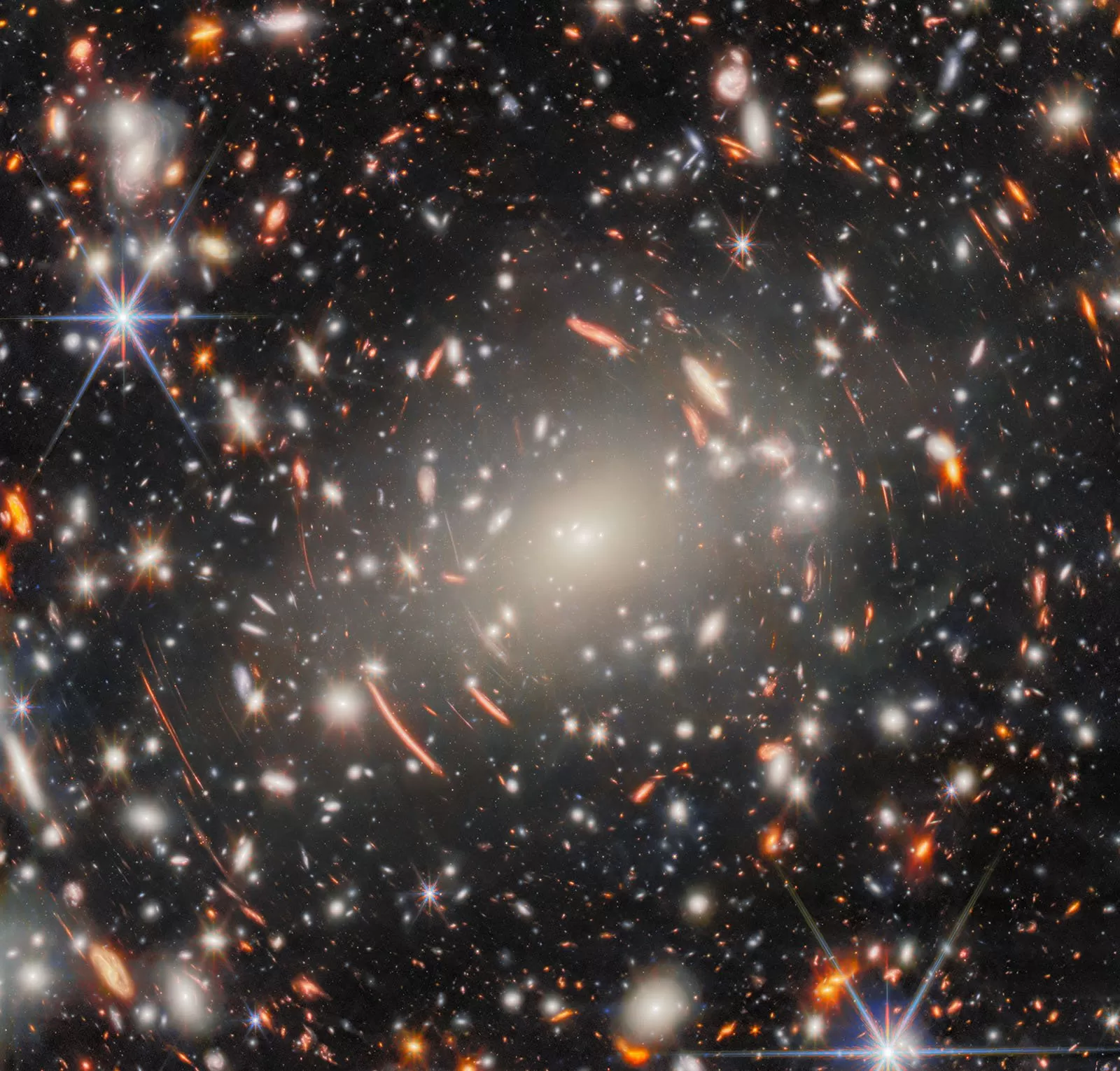 James Webb Space Telescope image shows light warped around galaxy cluster Abell S1063, revealing distant galaxies as bright arcs in deep space.
How a “Cosmic Magnifying Glass” Works
This phenomenon is known as gravitational lensing. Think of the galaxy cluster as a giant, natural lens in space. Just like a magnifying glass bends light to make objects appear larger and brighter, the gravity of Abell S1063 bends the light from galaxies behind it. This makes these incredibly distant, faint galaxies appear brighter and sometimes stretched into those striking arcs we see in the image.
Why Lensing Matters for Seeing the Past
Gravitational lensing is a crucial tool for astronomers trying to study the early universe. Galaxies from billions of years ago are typically very small and dim. Without the boost from a gravitational lens, many of them would be simply too faint for even powerful telescopes like JWST to see clearly.
By magnifying the light, lensing allows astronomers to detect these ancient galaxies and study their properties. Even though the light is distorted, scientists can use sophisticated techniques to “untangle” the effects of the lens and figure out the original shape and size of the background galaxies. This allows us to study galaxies that formed just a few hundred million years after the Big Bang, providing vital clues about how the first galaxies emerged and evolved.
Webb’s Deepest Look Yet
This particular image of Abell S1063 is not just scientifically valuable because of the lensing; it’s also a technical marvel. It’s a “deep field” image, meaning it’s created by taking a very long exposure of a single patch of sky to collect the maximum amount of light, including the incredibly faint light from the most distant objects.
The JWST used its NIRCam instrument (Near-Infrared Camera) to capture this view. It’s a composite of nine different exposures, totaling around 120 hours of observation time. This makes it Webb’s deepest observation of a single target region of the sky to date. The result is a visual feast of countless galaxies, some relatively nearby, others seen as distorted arcs that have traveled for billions of years across the cosmos.
A Window to the Universe’s Dawn
Every point of light, every stretched arc in this image tells a story from the universe’s long history. The light from some of these lensed galaxies set off on its journey before our Sun and Earth even existed. Studying these ancient systems, made visible thanks to the cosmic magnifying power of galaxy clusters like Abell S1063 and the incredible sensitivity of JWST, helps astronomers build a picture of how the universe transformed from a hot, dense soup after the Big Bang into the complex structure of galaxies, stars, and planets we see today.
It’s a powerful reminder that gravity, while seemingly simple, can act as an incredible tool, bending light and spacetime to reveal secrets hidden in the distant past.





