
Imagine a star collapsed to a city-sized ball, yet heavier than our sun, whipping up magnetic fields a trillion times stronger than Earth’s. These are magnetars, the universe’s ultimate magnets, and sometimes they throw spectacular tantrums, erupting with immense energy. Now, for the first time, NASA’s IXPE telescope has captured detailed X-ray data from a magnetar during one of these powerful outbursts, shedding light on how these extreme events unleash their energy. This groundbreaking observation gives scientists new clues about the invisible forces at play during a magnetar’s ‘activation phase,’ revealing how intense magnetic fields shape the light we see.
Contents
The Universe’s Most Extreme Stars: Magnetars
Magnetars are a type of neutron star, the super-dense core left behind after a massive star explodes in a supernova. When stars much larger than our sun run out of fuel, their cores collapse incredibly fast. This crushing weight creates a neutron star, packing more mass than the sun into a sphere only about 12 miles (20 kilometers) wide. The material is so dense that a single teaspoon of it brought to Earth would weigh 10 million tons – roughly the weight of 85,000 adult blue whales.
 Visual comparison shows that a teaspoon of neutron star material would weigh as much as 85,000 blue whales due to extreme density.
During this collapse, the star’s original magnetic field lines are squeezed together into an incredibly small space. Think of gathering all the lines of longitude on Earth into a tiny dot; the field strength would become immense. This process gives neutron stars the strongest magnetic fields known. Magnetars take this to an extreme level, boasting fields thousands of times stronger than typical neutron stars, a trillion times mightier than Earth’s magnetic field.
Catching a Cosmic Tantrum in X-rays
When a magnetar enters an “active state” or outburst, it can release energy bursts up to 1,000 times more powerful than its normal quiet state. These events are mysterious, and astronomers are keen to understand the underlying mechanisms.
The magnetar observed by NASA’s Imaging X-ray Polarimetry Explorer (IXPE) spacecraft is known as 1E 1841-045. Located about 28,000 light-years away within a supernova remnant called Kes 73, this particular magnetar unexpectedly erupted on August 20, 2024, giving scientists a rare opportunity.
IXPE is special because it can measure the polarization of X-rays. Think of light waves vibrating like ripples on a pond. Usually, these ripples go in all directions. Polarization is when the waves prefer to vibrate in a specific direction, like ripples lining up after hitting a barrier. For astronomers studying objects like magnetars, measuring X-ray polarization is like getting a blueprint of the star’s magnetic field and the environment around it, providing crucial clues about powerful cosmic processes.
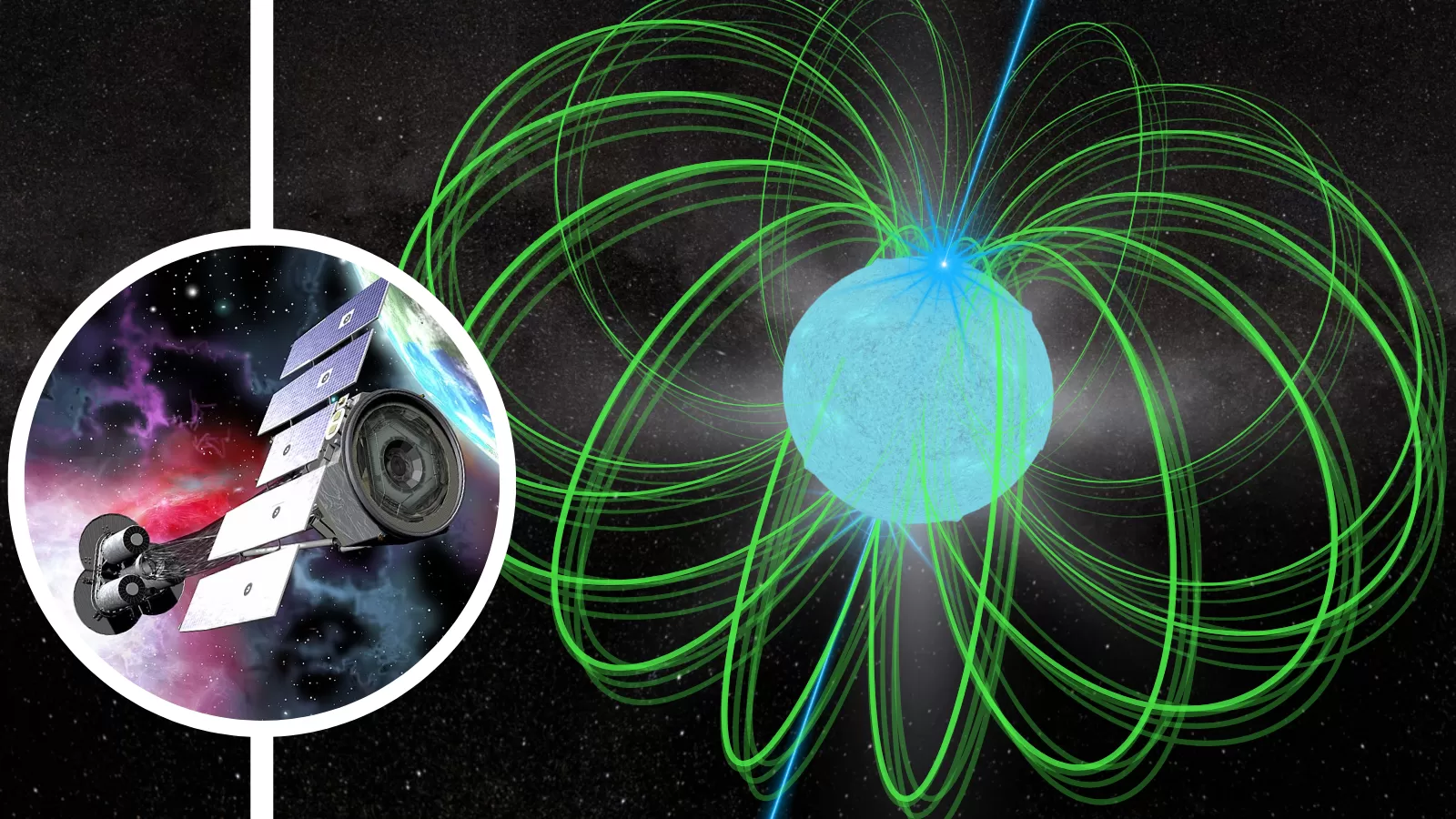 Dynamic illustration depicts a powerful X-ray flare erupting from a magnetar, a highly magnetic neutron star.
What the IXPE Data Revealed
Observing 1E 1841-045 during its outburst was the first time scientists could measure the polarization of a magnetar’s X-rays in such an active state. The team, led by Michela Rigoselli of the National Institute for Astrophysics (INAF), discovered something intriguing: the X-rays became increasingly polarized at higher energy levels. However, the angle of polarization remained the same across all energies.
This finding suggests that the different processes generating the X-rays during the outburst are somehow linked or happening within a similarly structured magnetic environment. Crucially, it indicates that the highest-energy X-rays, which are often the hardest to study, are strongly influenced by the magnetar’s incredibly powerful magnetic field.
 Artist's concept of an outburst on a magnetar, showing intense energy and magnetic activity around the dense stellar remnant.
Unlocking the Secrets of Extreme Energy
This first measurement of X-ray polarization during a magnetar outburst is a vital step in decoding the secrets of these extreme cosmic objects. As team leader Michela Rigoselli noted, these observations allow scientists to “constrain the mechanisms and geometry of emission that lie behind these active states.”
Understanding how magnetars generate and release such colossal amounts of energy during outbursts helps us learn more about the fundamental physics of matter and magnetic fields under conditions far beyond anything we can recreate on Earth. The team plans to continue observing 1E 1841-045 now that it has returned to its quieter state to see how its polarization properties change, providing even more data points on the life cycle of a magnetar’s activity.
The team’s research was published on May 28 in The Astrophysical Journal Letters. Observations like these, peering into the heart of cosmic explosions and the remnants they leave behind, help us piece together the universe’s most powerful and mysterious phenomena. You can learn more about the incredible density of neutron stars or the processes that create them by reading about what happens inside neutron stars or the violent supernova events they originate from.





