Scientists are on the verge of solving a cosmic puzzle: finding the first pieces of the mysterious planet Mercury right here on Earth. Two unusual meteorites show intriguing similarities to Mercury’s surface, potentially offering a rare look at the innermost planet’s formation and early history. This discovery, if confirmed, would be a monumental step in understanding the solar system’s smallest and most challenging world.
Contents
Why Getting to Mercury is So Hard
Imagine trying to send a spacecraft to orbit a bonfire – that’s a bit like the challenge of reaching Mercury. Located incredibly close to the Sun, any mission heading there has to fight against the Sun’s powerful gravity. This requires immense energy, often using complex planetary flybys – swinging around other planets like Venus multiple times – to slow down and eventually get into orbit around Mercury. It’s a long, hot journey, with spacecraft needing special heat shielding to survive temperatures that could melt lead. Because sending missions and landing on Mercury is so difficult and expensive, finding natural samples delivered to Earth would be a scientific goldmine.
As Johannes Benkhoff, Project Scientist for the BepiColombo mission (heading to Mercury), explains, these flybys mean “the journey takes a long time.” Given these obstacles, any material from the sun’s closest neighbor that makes its way to Earth would be a highly valuable resource for scientists.
The Hunt for Mercury Meteorites
Just like Mars and the Moon occasionally send space rocks our way after powerful impacts, scientists have long suspected that chunks of Mercury might also get blasted into space and eventually land on Earth. However, finding and confirming a Mercury meteorite has been a long-standing quest – until now.
A new study points to two specific, unusual meteorites: Ksar Ghilane 022 (KG022) and Northwest Africa 15915 (NWA 15915). These rocks were found on Earth, but their unique mineral makeup has scientists excited. Ben Rider-Stokes, a Post Doctoral Researcher specializing in achondrite meteorites at The Open University, notes that the minerals found within these meteorites, such as olivine and pyroxene, “exhibit intriguing similarities to Mercury’s crust.” This chemical fingerprint has led the research team to propose that these two meteorites might have originated from Mercury.
Clues and Puzzles: Reading the Rocks
While the mineral similarities are a strong hint, these potential Mercury meteorites also present some fascinating puzzles. One is the amount of a mineral called plagioclase. Scientists expect Mercury’s surface to have a significant amount of plagioclase (over 37%), but these meteorites only have trace amounts.
Another puzzle is their age. KG022 and NWA 15915 are dated at about 4.528 billion years old. That’s actually older than what scientists believe is the current visible surface of Mercury, which is estimated to be around 4 to 4.1 billion years old. This age difference sparks intriguing questions about Mercury’s early history.
Simone Marchi, a NASA planetary scientist, highlights this point: “If the oldest surface visible on Mercury is 4 billion or 4.1 billion years old, then that would imply that the first perhaps 500 million or 400 million years of the planet have been erased.” The researchers suggest that these meteorites could represent some of the very first materials from Mercury, which might have been removed from the planet’s surface over billions of years due to intense asteroid bombardment or volcanic activity.
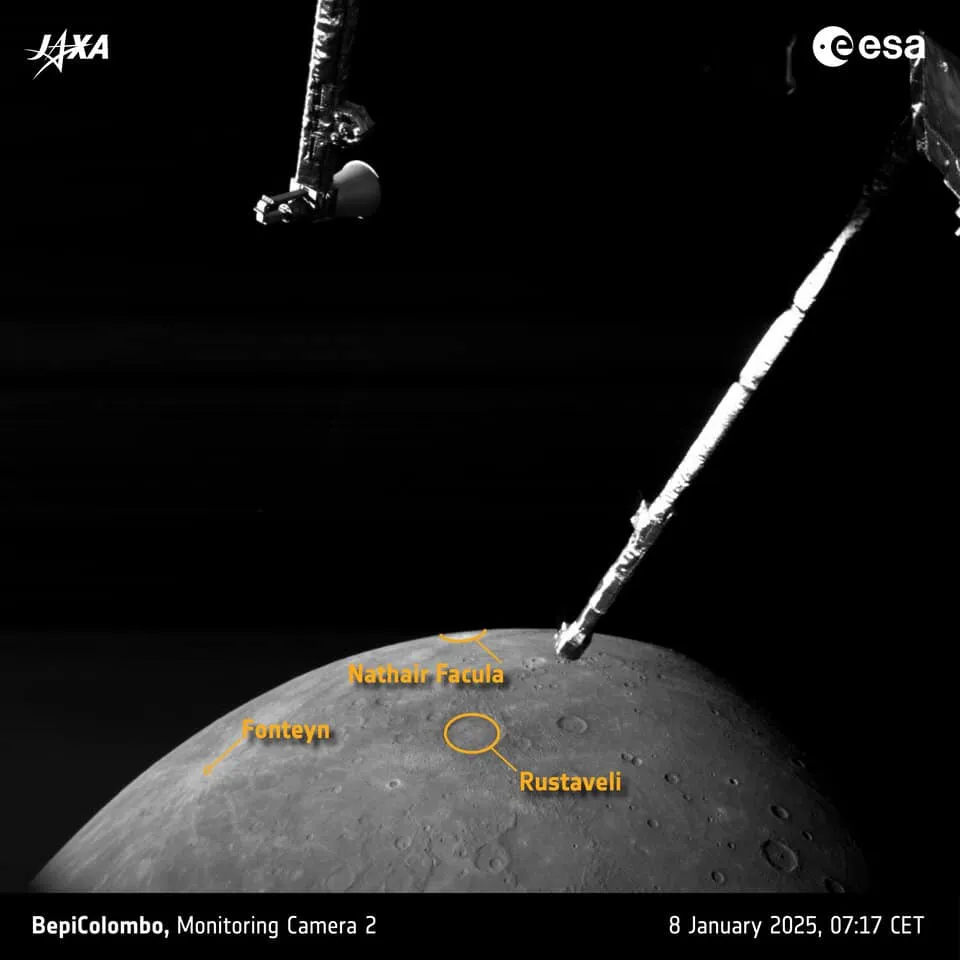 Close-up view showing bright lava flows and impact debris on Mercury's surface.
BepiColombo: The Key to Unlocking the Secret
So, are these truly rocks from Mercury? The scientific community is eager for more definitive proof. That’s where the BepiColombo space mission comes in. This joint European-Japanese mission is currently en route to Mercury and is scheduled to enter orbit in 2026.
Once in orbit, BepiColombo will use sophisticated instruments to map Mercury’s surface composition in unprecedented detail. As the study authors note, this mission will provide a “higher spatial resolution analysis” of the planet, essentially giving scientists a much clearer picture of what Mercury’s crust is truly made of. Comparing this detailed data from BepiColombo with the composition of meteorites like NWA 15915 and KG022 will be crucial. It could either confirm that these rocks are indeed Mercurian travelers or help scientists understand why they share similarities but aren’t a perfect match.
Until BepiColombo begins its detailed mapping, the potential connection between these fascinating meteorites and the innermost planet remains a compelling mystery. The upcoming mission holds the promise of potentially confirming the first-ever known samples from Mercury, offering a direct pathway to understanding the fiery secrets of our solar system’s elusive smallest planet.
Want to learn more about space rocks or other planetary mysteries? Check out these related articles:
- Scientists Discover Hidden Secrets in Mars’ Ionosphere
- The Buck Moon Is Coming: Here’s When to Catch July’s Spectacular Full Moon
- Surprising Origin of Meteorites Hitting Earth
- Mercury: Diamond Layer Beneath the Surface?
- Top three images from BepiColombo’s sixth Mercury flyby