
Somewhere out in the cosmos, powerful engines are blasting tiny atomic fragments to nearly the speed of light. Scientists have long suspected that exploding stars, known as supernovae, might be the source of these incredibly energetic cosmic bullets, but recent studies had cast some doubt. Now, new research using numerical simulations suggests that supernovae could indeed be the mysterious factories producing the universe’s most powerful particles, but only under specific, fleeting conditions. This finding potentially solves a long-standing mystery about the origin of ultra-high-energy cosmic rays.
Contents
Key Takeaways:
- Cosmic rays are high-energy particles constantly hitting Earth.
- The source of the most powerful ones (PeVatrons) is unknown.
- Supernovae were candidates but recent data from remnants like Tycho’s were inconsistent with models.
- New simulations suggest only very young supernovae (first 10-20 years) in dense gas can accelerate particles to these extreme energies.
- This timing detail could explain why older remnants haven’t shown the expected power.
The Cosmic Ray Mystery
For over a century, scientists have been tracking the relentless shower of charged particles – mostly atomic nuclei and electrons – that bombards Earth from space. These are cosmic rays. Pinpointing where they come from is tricky, like trying to find the origin of a message in a bottle tossed into a vast, stormy ocean. Because they are charged, cosmic rays are tossed around by the galaxy’s magnetic fields, erasing their original path. Scientists must look for other clues, like the powerful events that could accelerate them in the first place.
While many celestial objects are known to accelerate particles, the most energetic cosmic rays, packing energies thousands of times greater than anything we can create on Earth, remain a puzzle. These are the so-called peta-electronvolt (PeV) particles, and their sources are hypothetical cosmic engines nicknamed “PeVatrons.”
Supernovae: Prime Suspects With a Catch
Exploding stars have always been a prime suspect. When a massive star dies or a white dwarf undergoes a thermonuclear runaway (a Type Ia supernova), it creates an immense shock wave that blasts through the surrounding gas. This chaotic environment, filled with turbulent magnetic fields, is thought to be ideal for accelerating charged particles.
One famous example is the remnant of the Tycho supernova, a star observed exploding in 1572. Located relatively close to us, it’s been a key target for studying how supernova remnants might accelerate particles. However, recent analysis of the magnetic fields within the Tycho remnant found their particle-accelerating ability to be “significantly smaller” than expected by existing models for producing the highest-energy cosmic rays. This finding raised questions about whether supernovae could really be the PeVatrons astronomers were searching for.
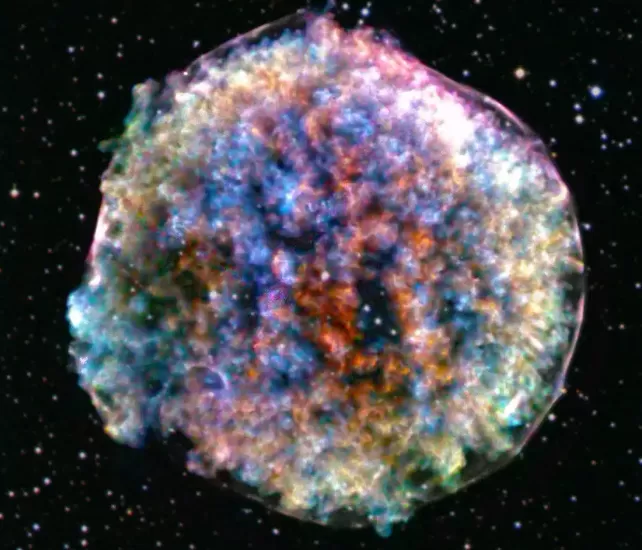 Colorful image of the Tycho supernova remnant showing gas expanding from a stellar explosion, relevant to cosmic ray research
The Crucial Role of Timing
A new study by astrophysicists Robert Brose, Iurii Sushch, and Jonathan Mackey offers a potential resolution to this puzzle. Their numerical simulations suggest that supernovae can reach the incredible power levels needed to create PeVatron-energy particles, but there’s a critical condition: timing.
For the acceleration to reach PeV levels, the supernova shock wave needs to crash into a very dense shell of gas surrounding the star. This creates the necessary intense magnetic turbulence to whip particles up to extreme speeds. The key insight from the simulation is that this extremely dense environment, capable of sustaining PeV-level acceleration, might only exist for a very brief period – perhaps just the first decade or two after the supernova explosion.
As the supernova remnant expands, the surrounding gas thins out, and the accelerating power diminishes. This means older remnants, like Tycho’s (which is over 400 years old), might no longer be capable of producing the highest-energy particles, even if they were incredibly powerful accelerators in their youth.
What’s Next?
The team states, “It is possible that only very young supernova remnants evolving in dense environments may satisfy the necessary conditions to accelerate particles to PeV energies.” This implies that our best chance of confirming supernovae as PeVatrons might come from observing a new, relatively close supernova shortly after it explodes.
This research, which has been accepted for publication in Astronomy & Astrophysics, revives the supernova as a prime candidate for creating the universe’s most powerful cosmic rays. It highlights how subtle details, like the precise timing of a cosmic event, can hold the key to unlocking long-standing astrophysical mysteries. If we’re lucky enough to witness a nearby star’s explosive demise in the coming years, we might finally see a true PeVatron in action.





