
The moon we see tonight has no global magnetic field, yet some of its ancient rocks hold a strong magnetic memory. This puzzling inconsistency has baffled scientists for decades. Now, new research suggests a dramatic event from the moon’s distant past – a colossal asteroid impact – might explain this magnetic mystery. This isn’t just about ancient history; understanding these anomalies could guide future lunar explorations.
Contents
Key Takeaways:
- Moon rocks brought back by Apollo missions show unexpected magnetism despite the moon’s lack of a global magnetic field today.
- A new study proposes that massive asteroid impacts could have temporarily amplified the moon’s weak ancient magnetic field.
- The impact mechanism involves creating a cloud of charged particles (plasma) that concentrates on the opposite side of the moon, boosting the field there.
- Future missions, like Artemis exploring the lunar south pole, could test this theory by examining rocks in highly magnetized areas.
The Moon’s Magnetic Puzzle
For years, scientists have wondered why rocks collected from the moon, especially those from the far side, show strong magnetic signatures. Earth has a powerful magnetic field generated by its churning molten core, which magnetizes its rocks over millions of years. But the moon’s core is small and relatively inactive, and it hasn’t had a significant global magnetic field for billions of years. So, how did these rocks get magnetized so strongly?
Past theories hinted the moon might have had a weak, short-lived magnetic field much earlier in its history, generated by its early molten core. However, this field was likely too weak on its own to create the intense magnetization seen in some rocks. There had to be something else.
A Violent Solution: The Impact Theory
Enter the new theory, put forth by researchers including Isaac Narrett and Professor Benjamin Weiss at MIT. Their computer simulations point to a dramatic event: a massive asteroid slamming into the moon. They suggest an impact powerful enough to create a giant basin, perhaps like the immense Imbrium basin on the moon’s near side, could be the culprit.
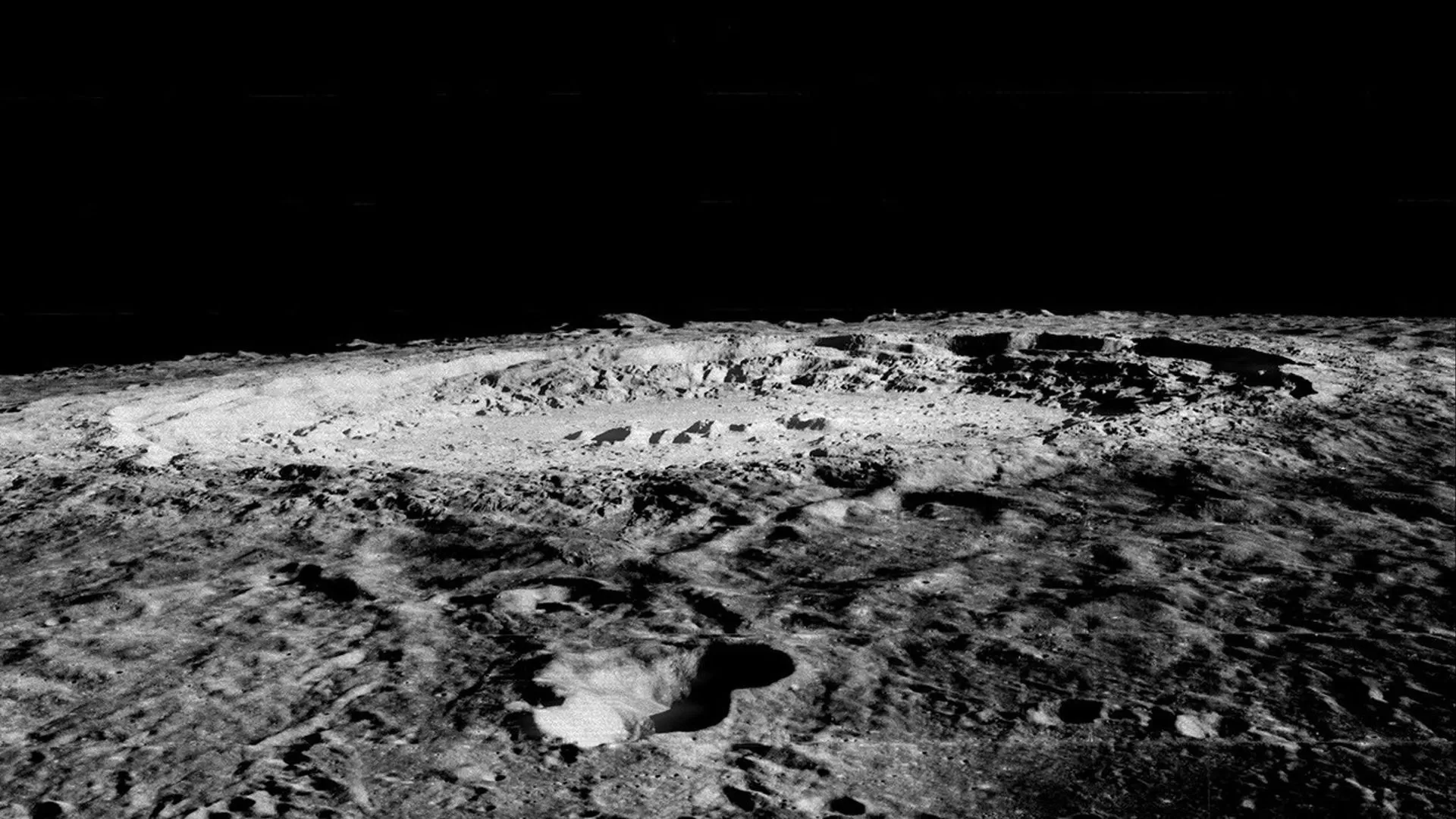 NASA image showing the vast Mare Imbrium basin on the northern nearside of the moon, possibly linked to ancient magnetism.
Here’s how it might work: such a violent impact would have vaporized vast amounts of rock, creating a gigantic cloud of superheated, electrically charged gas called plasma. As this plasma cloud expanded, the moon’s weak existing magnetic field (from its core) would have channeled it. Intriguingly, the simulations show this plasma would have naturally concentrated on the side of the moon opposite the impact site.
This concentration of charged particles could have temporarily amplified the moon’s weak global magnetic field in that specific region, boosting its strength dramatically, but only for a brief period.
Locking in the Magnetic Memory
Just having a stronger magnetic field isn’t enough; the rocks need a way to “record” it. The researchers believe the same impact that created the plasma cloud would also send powerful seismic shockwaves rippling through the moon.
These shockwaves would converge on the far side, directly beneath where the amplified magnetic field was strongest. As these waves “jittered” or vibrated the rocks and their electron alignment, the powerful, temporary magnetic field “snapped” them into a new, permanent magnetic orientation.
Imagine throwing a deck of cards with tiny compass needles attached into the air within a magnetic field. As they flutter down, the compass needles align. When the cards land and stop moving, they “freeze” this alignment, even if the external magnetic field disappears. That’s similar to how the seismic waves and temporary field might have worked together to magnetize the rocks.
This entire chaotic sequence – the impact, the plasma cloud forming and concentrating, the field amplifying, the seismic waves hitting, and the rocks getting magnetized – would have unfolded incredibly fast, perhaps in less than an hour. Yet, that brief window of intense magnetic activity could have left a lasting signature detectable billions of years later. This process could explain the strong magnetic patches observed by orbiting spacecraft, particularly on the moon’s farside.
What Comes Next? Testing the Theory
This theory offers a compelling explanation for a long-standing lunar puzzle. But how can scientists be sure this is what actually happened? The key lies in the rocks themselves.
The theory predicts that rocks with strong magnetic signatures, especially those on the farside where the impact-amplified field would have been strongest, should also show evidence of having been subjected to powerful shockwaves from an impact.
This is where future lunar missions come in. Several international efforts, including NASA’s Artemis program, plan to explore the moon’s south pole. This region is of particular interest because it’s on the farside and contains some of the most strongly magnetized areas known on the moon.
By landing near these magnetic anomalies and studying the rocks on the ground, missions like Artemis could find the evidence needed to confirm whether colossal asteroid impacts were indeed the hidden force that gave some lunar rocks their surprising magnetic memory. While this new study explains a large part of the lunar magnetism puzzle, as lead author Isaac Narrett notes, “There are large parts of lunar magnetism that are still unexplained,” leaving exciting avenues for future research. The study was published in the journal Science Advances.





