
Imagine an assembly line, but instead of cars, it’s bones, and instead of robots, it’s our ancient cousins, the Neanderthals. For tens of thousands of years, these skilled relatives navigated prehistoric landscapes. Now, a remarkable find in Germany suggests they weren’t just hunting; they were operating sophisticated processing centers to extract valuable fat from animal bones, much earlier than previously believed. This discovery reveals a level of organization and foresight that challenges outdated ideas about Neanderthal capabilities. Key takeaways include large-scale bone processing for fat happened 125,000 years ago, Neanderthals managed resources strategically, and this adds to evidence of their advanced intelligence.
Contents
Unearthing an Ancient ‘Fat Factory’
At a site called Neumark-Nord in eastern Germany, archaeologists uncovered something extraordinary: over 100,000 bone fragments. These weren’t random scatterings; they came from at least 172 large mammals like horses and deer. Crucially, many bones showed clear signs of being intentionally broken and cut. Think of it like a prehistoric butcher shop, but focused intensely on getting inside the bones.
Scientists believe this wasn’t just butchery for meat. The sheer scale and specific types of breakage point to a systematic effort to access the bone marrow and grease within. These substances are incredibly rich in calories and essential nutrients, acting as a vital energy source for survival, especially in colder climates or when other food was scarce.
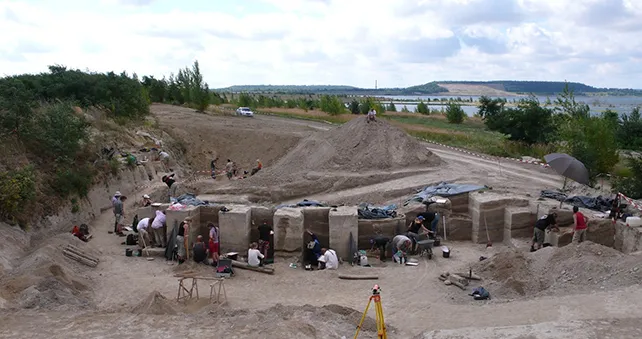 Archaeologists excavating bone fragments at the Neumark-Nord site in Germany, where evidence of Neanderthal fat processing was found
Researchers at work at the Neumark-Nord site, carefully uncovering ancient bone fragments. (Kindler et al., Science Advances, 2025)
More Than Just Hunting: Strategic Resource Management
This operation appears to be much more than just processing leftovers from a hunt. Evidence of tool use and controlled fires were found alongside the bone piles in a concentrated area. This suggests a dedicated workspace for this specific, labor-intensive task. Processing bone grease requires a significant volume of bones to be worthwhile, implying deliberate planning and transport of carcasses to this central location.
“This was intensive, organised, and strategic,” says archaeologist Lutz Kindler. “Neanderthals were clearly managing resources with precision – planning hunts, transporting carcasses, and rendering fat in a task-specific area.” They understood not only the nutritional value of fat but also how to efficiently extract it on a large scale.
Pushing Back the Timeline of Sophistication
While similar bone processing has been linked to Neanderthal sites before, the Neumark-Nord discovery shows this activity happening at an unprecedented scale and level of organization for such an early period – around 125,000 years ago. This is a significant finding because it’s about 100,000 years before our own species, Homo sapiens, is thought to have arrived in Europe and begun similar large-scale bone processing. It suggests Neanderthals independently developed this complex skill.
This discovery adds another compelling piece to the growing picture of Neanderthal intelligence and capability. Forget the old image of simple cavemen; recent research reveals they were far more sophisticated. They were adept swimmers, potentially capable of brewing, abstract thinkers who used symbols, and raised their children in ways similar to early humans. (See: Neanderthal DNA Exists in Humans, But One Piece Is Mysteriously Missing) They even used speech patterns that sound surprisingly human-like. The “fat factory” concept fits right into this revised understanding of a species that was intelligent, adaptable, and skilled.
A Window Into the Past and Future Research
The Neumark-Nord site is exceptionally large and well-preserved for its age, offering a unique opportunity for scientists to study Neanderthal behavior and their impact on the environment in detail.
“The sheer size and extraordinary preservation of the Neumark-Nord site complex gives us a unique chance to study how Neanderthals impacted their environment, both animal and plant life,” says computer scientist Fulco Scherjon. This site promises to reveal even more secrets about our closest extinct relatives in the future.
This research, published in the journal Science Advances, provides fascinating insights into the surprising complexity of Neanderthal life and reminds us how much more there is to learn about the ancient world.





