
Scientists have captured the sharpest images ever of the sun’s surface, revealing intricate stripe patterns that act like ‘fingerprints’ of the star’s magnetic fields. These unprecedented views are crucial for understanding the powerful forces driving space weather that can affect Earth. The key takeaways are the ability to see incredibly fine details on the sun, the discovery that these details trace previously hidden magnetic patterns, and the importance of this knowledge for predicting solar activity.
The National Science Foundation’s (NSF) Daniel K. Inouye Solar Telescope (DKIST), perched atop Haleakalā on Maui, Hawaii, achieved this milestone by capturing the most detailed views yet of the sun’s visible surface, known as the photosphere.
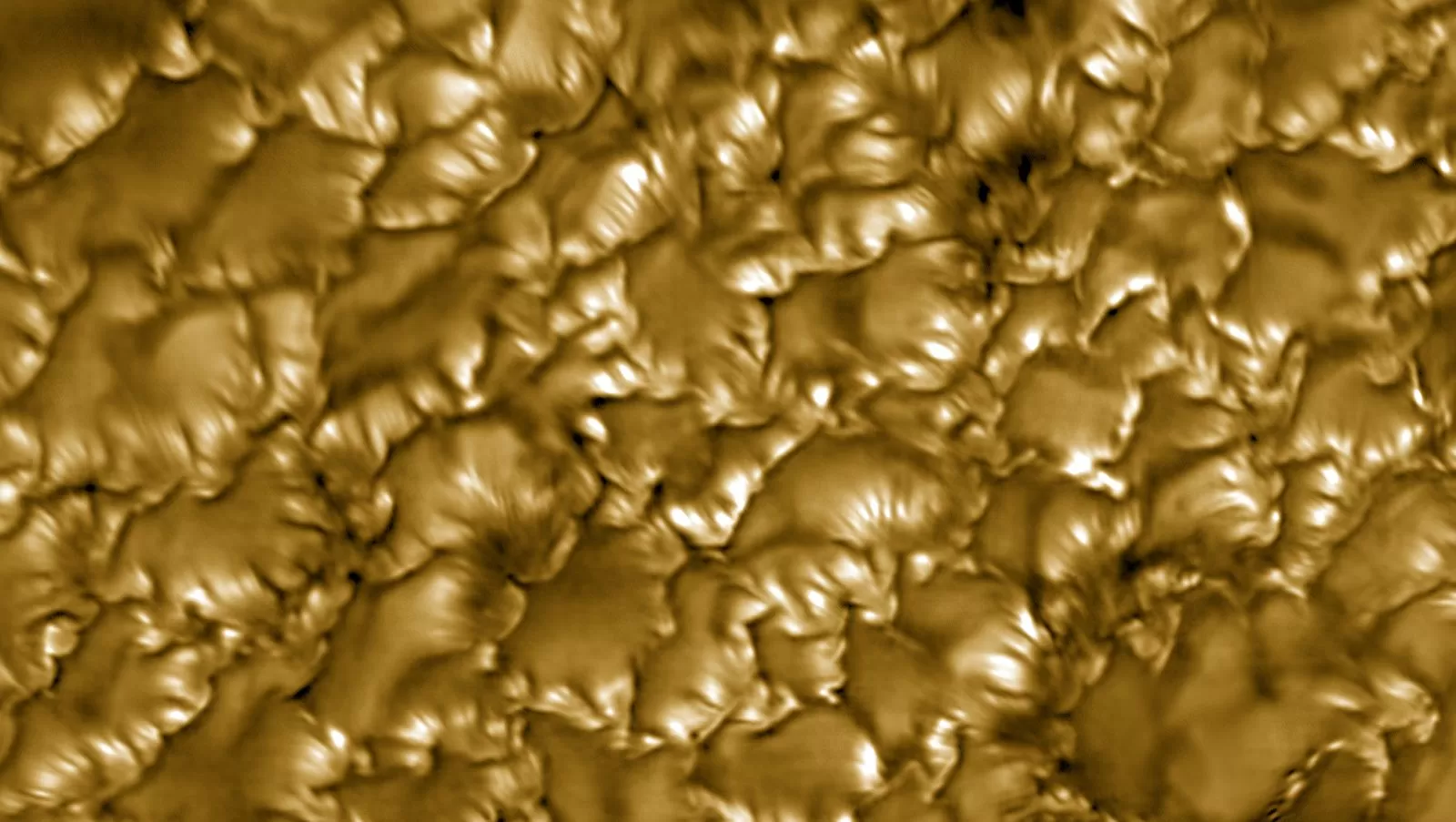 High-resolution image captures the dynamic, bubbling surface of the sun's photosphere.
These new images reveal ultra-fine bright and dark stripes, called striations, within the thin, gaseous photosphere. “In this work, we investigate the fine-scale structure of the solar surface for the first time with an unprecedented spatial resolution of just about 20 kilometers [12.4 miles], or the length of Manhattan Island,” said David Kuridze, lead author of the study and an NSO scientist. “These striations are the fingerprints of fine-scale magnetic field variations.”
The striations appear as alternating bright and dark lines snaking along the walls of solar granules. These granules are massive convection cells that churn like boiling water, bringing heat from the sun’s interior to its surface. The patterns are believed to be caused by intricate, curtain-like magnetic fields that ripple and shift, much like fabric fluttering in a breeze.
As light streams through these magnetic “curtains,” variations in the strength of the magnetic field alter the density and opacity of the plasma, causing changes in brightness. Where the magnetic field is weaker than its surroundings, it appears darker; where it’s stronger, it glows brighter. This means the striations are effectively tracing the hidden structures of the sun’s complex magnetic architecture.
These subtle shifts are only detectable thanks to the telescope’s advanced Visible Broadband Imager (VBI), which observes the sun in specific wavelengths of light, like the G-band, that are particularly sensitive to areas of strong magnetic activity.
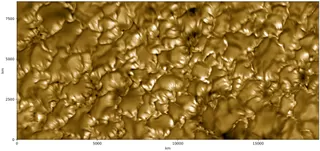 Sharpest-ever image of the sun revealing ultra-fine magnetic striations on the solar surface.
Understanding the sun’s magnetic field is not just about pretty pictures; it’s key to unlocking the mysteries behind powerful solar phenomena like solar flares, eruptions, and coronal mass ejections (CMEs). These events originate from complex magnetic processes and can launch massive bursts of energy and particles into space, driving space weather that can potentially impact technology and infrastructure here on Earth.
The findings from this research, led by Kuridze and colleagues, were published in The Astrophysical Journal Letters on May 20. Continuing to explore these fine-scale magnetic features with telescopes like DKIST will be crucial for improving our predictions of solar activity and its effects on our planet.
To learn more about the sun and its powerful magnetic forces, explore our articles on how the sun’s magnetic field works or what happens when the sun’s magnetic field flips.