
A newly found dwarf planet far beyond Neptune is posing a major challenge to the long-sought hypothesis of a large, hidden “Planet Nine” in our solar system’s outer reaches. This icy object, called 2017 OF201, has an orbit so unusual it doesn’t fit the pattern expected if Planet Nine’s gravity is shaping the paths of other distant bodies. Its existence forces scientists to rethink what might be going on in the mysterious depths of our solar system.
Contents
This discovery is significant because while many distant objects have orbits that seem to cluster together, possibly due to a large planet’s pull, 2017 OF201 goes its own way, complicating the picture and suggesting Planet Nine might not be the simple answer scientists hoped for.
Exploring the Solar System’s Edge
Our solar system isn’t just the sun and the eight main planets. Beyond Neptune lies a vast, dimly lit realm. First, there’s the Kuiper Belt, a donut-shaped region packed with icy bodies like Pluto. Think of it as a busy ring road starting about 30 times the Earth’s distance from the sun (that’s 30 astronomical units, or AU) and extending to 50 AU. NASA’s New Horizons spacecraft is currently exploring this area.
Further out is the Scattered Disk, stretching perhaps to over 1,000 AU. This region is home to objects that were likely tossed outward by gravitational encounters with Neptune long ago. Their orbits are highly stretched out and tilted, like cosmic rubber bands pinged into weird paths. Scientists also consider the influence of distant stars and even the gentle pull of the Milky Way galaxy itself, known as the “galactic tide,” on these far-flung objects. Beyond even the Scattered Disk lies the hypothetical Oort Cloud, a vast icy shell thought to be the source of long-period comets, but no object has ever been directly seen there – they are simply too far away and faint.
Each new discovery in these remote areas is like finding a new piece in a gigantic, dark puzzle, helping us understand the true shape and contents of our solar system’s outer frontier.
Meet 2017 OF201: An Icy Wanderer
Around 5,000 objects have been found beyond Neptune so far, but 2017 OF201 stands out. Discovered by a team led by Sihao Cheng at the Institute for Advanced Study in Princeton, this potential dwarf planet has a truly extreme orbit. At its closest point to the sun (perihelion), it comes within 44.5 AU – similar to Pluto’s distance. But then it swings out to an incredible 1,600 AU away from the sun at its farthest point (aphelion). To put that in perspective, 1,600 AU is about 157 billion miles (244 billion kilometers)!
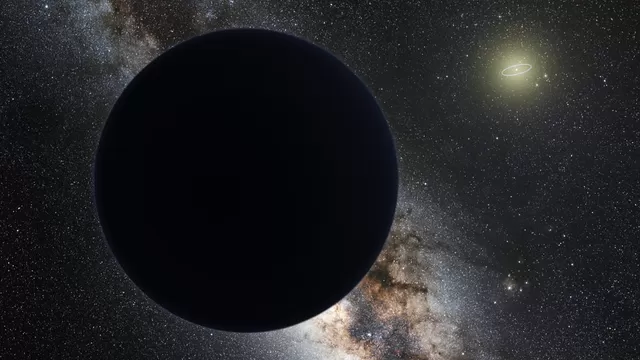 A dark circle representing a newly discovered dwarf planet is overlaid on an image of the Milky Way galaxy
Its journey around the sun takes a staggering 24,256 years. Because it spends most of this time incredibly far away, it’s usually impossible to spot with current telescopes. Scientists were able to find it because it recently passed its closest point to the sun in 1930 and is still relatively “nearby” in cosmic terms.
Finding 2017 OF201 involved sifting through vast amounts of archival data from powerful sky surveys like the Dark Energy Camera Legacy Survey (DECaLS). Based on how bright it appears, researchers estimate it’s about 435 miles (700 kilometers) across. While much smaller than Pluto, this size is large enough for it to likely be classified as a dwarf planet.
The Plot Twist for Planet Nine
So, how does this new icy world challenge the idea of Planet Nine? The Planet Nine hypothesis, first proposed in 2016, suggests that a large, unseen planet (perhaps a few times more massive than Earth) exists far beyond Neptune. The idea came about because several extreme Trans-Neptunian Objects (TNOs) seemed to have orbits that clustered together in a peculiar way. Scientists thought the gravity of this hypothesized Planet Nine was shepherding these objects into these aligned paths, like a giant cosmic sheepdog.
However, the orbit of 2017 OF201 doesn’t follow this pattern. It’s not aligned with the orbits of the objects that initially suggested Planet Nine. As Jiaxuan Li of Princeton University noted, “Many extreme TNOs have orbits that appear to cluster in specific orientations, but 2017 OF201 deviates from this.”
If Planet Nine exists and has the gravitational influence researchers predicted, its pull should eventually destabilize an orbit like 2017 OF201’s, potentially kicking it out of the solar system entirely within perhaps 100 million years. Yet, scientists believe objects like 2017 OF201 likely took billions of years to get into their current extreme orbits through interactions with Neptune and the galactic tide. The existence of an object like 2017 OF201 in a seemingly stable, unclustered orbit creates a puzzle for the Planet Nine theory.
Could 2017 OF201 have only recently arrived in this orbit, before Planet Nine has had time to disrupt it? It’s possible, but this highlights the need for more research. Scientists need to run more complex computer simulations to see just how stable 2017 OF201’s orbit really is under the potential influence of Planet Nine. If its orbit proves to be stable over long timescales, it would strongly argue against the current Planet Nine hypothesis.
For more on the search for Planet Nine, read about evidence uncovered in sky surveys taken 23 years apart.
A Universe of Discoveries Awaiting
Intriguingly, the discovery of 2017 OF201 suggests it’s likely not alone. Because this object is only detectable for about 1% of its 24,256-year orbit, finding just one implies there could be many others like it out there – perhaps a hundred or more similar dwarf planets following equally extreme, unclustered paths, simply too far away to see right now.
As Sihao Cheng puts it, “Even though advances in telescopes have enabled us to explore distant parts of the universe, there is still a great deal to discover about our own solar system.” The hunt for Planet Nine continues, but discoveries like 2017 OF201 remind us that the edge of our solar system holds surprises that might force us to rewrite the cosmic map.
The initial research describing this discovery is available as a pre-print paper on arXiv.





